

What types of powder coating finishes are available for steel protection?
Powder coating finishes for steel include epoxy, polyester and epoxy-polyester hybrid systems, selected according to the required corrosion resistance, UV exposure and service environment. They can also be specified with smooth, textured, matt, satin or gloss appearances, while primer and topcoat combinations may provide additional protection for demanding applications.
Powder coating finishes for steel protection include thermoplastic nylon coatings, zinc-rich systems, chemically resistant finishes, high-temperature coatings and electrically insulating grades. The most suitable option depends on the steel component’s exposure to moisture, salts, chemicals, abrasion, impact, heat and electrical service conditions.
Nylon and other thermoplastic finishes are used where the coating must withstand repeated contact, impact or abrasion. Nylon powder coatings can provide a tough, relatively low-friction surface for steel parts exposed to handling, sliding contact, moisture or corrosive contaminants. They are often considered for components such as guards, brackets, framework, industrial equipment parts and fabricated items where mechanical wear is a greater concern than appearance alone.
Thermoplastic finishes differ from conventional thermoset powders in the way the coating forms its film. The powder melts and flows over the prepared steel surface, creating a continuous layer. This can make thermoplastic grades useful where flexibility, impact resistance or resistance to particular chemicals is required. Compatibility with the steel substrate, service temperature and the proposed preparation method should be confirmed before specification.
Zinc-rich powder coatings are selected for steelwork where corrosion protection is a primary requirement. Zinc within the coating can provide sacrificial protection to exposed steel, helping to protect areas where the surface may be damaged. These products are normally specified as part of a complete corrosion-control system rather than assessed in isolation. The zinc content, required film build, curing conditions and compatibility with any subsequent coating all need to be controlled.
Chemical-resistant finishes are suitable for steel components exposed to oils, fuels, cleaning agents, solvents or process chemicals. Resistance varies substantially between formulations, so the specification should identify the actual substances, concentration, contact time and operating temperature. A coating that performs well against occasional splashes may not be suitable for continuous immersion or repeated chemical cleaning.
High-temperature powder finishes are available for steel components operating near heat sources or within heated equipment. Selection must consider both the normal service temperature and any peaks during operation. The curing temperature required by the powder also matters, particularly for thin steel sections or assemblies containing materials that cannot tolerate elevated temperatures. Discolouration, loss of adhesion and film breakdown can occur if a standard powder is exposed beyond its intended range.
Electrically insulating finishes can be used where the powder film must provide separation between a steel component and other conductive parts. The required dielectric performance depends on film thickness, edge coverage, surface cleanliness and the working voltage. This type of coating should be specified against the relevant electrical requirements rather than chosen solely by colour or general corrosion performance.
Specialist finishes may also be selected for particular combinations of performance requirements:
- Abrasion-resistant finishes: intended for components subject to friction, sliding contact or repeated handling.
- Impact-resistant finishes: considered for fabricated steel parts that may receive knocks during installation, use or transport.
- Low-friction finishes: useful where reducing drag between moving or contacting parts is important.
- Moisture-resistant finishes: appropriate for steel exposed to condensation, washdown or damp service environments, provided the whole system is suitable for the exposure.
Finish selection should therefore begin with the service environment rather than the desired visual result. A useful specification records the steel grade, preparation standard, expected exposure, contact with chemicals or abrasives, operating temperature, required electrical properties and any limits on film thickness. Edges, corners, welds and recessed areas also require attention because incomplete coverage in these locations can reduce the effectiveness of the finished protection.
For batch-manufactured components, consistency is equally important. The selected powder must be compatible with the curing cycle, application method and component geometry. Trial pieces or representative production parts can help confirm adhesion, coverage and the suitability of the finish before a larger batch is processed. This is particularly relevant when steel parts combine thin sections, heavy welds or areas with different thermal mass.
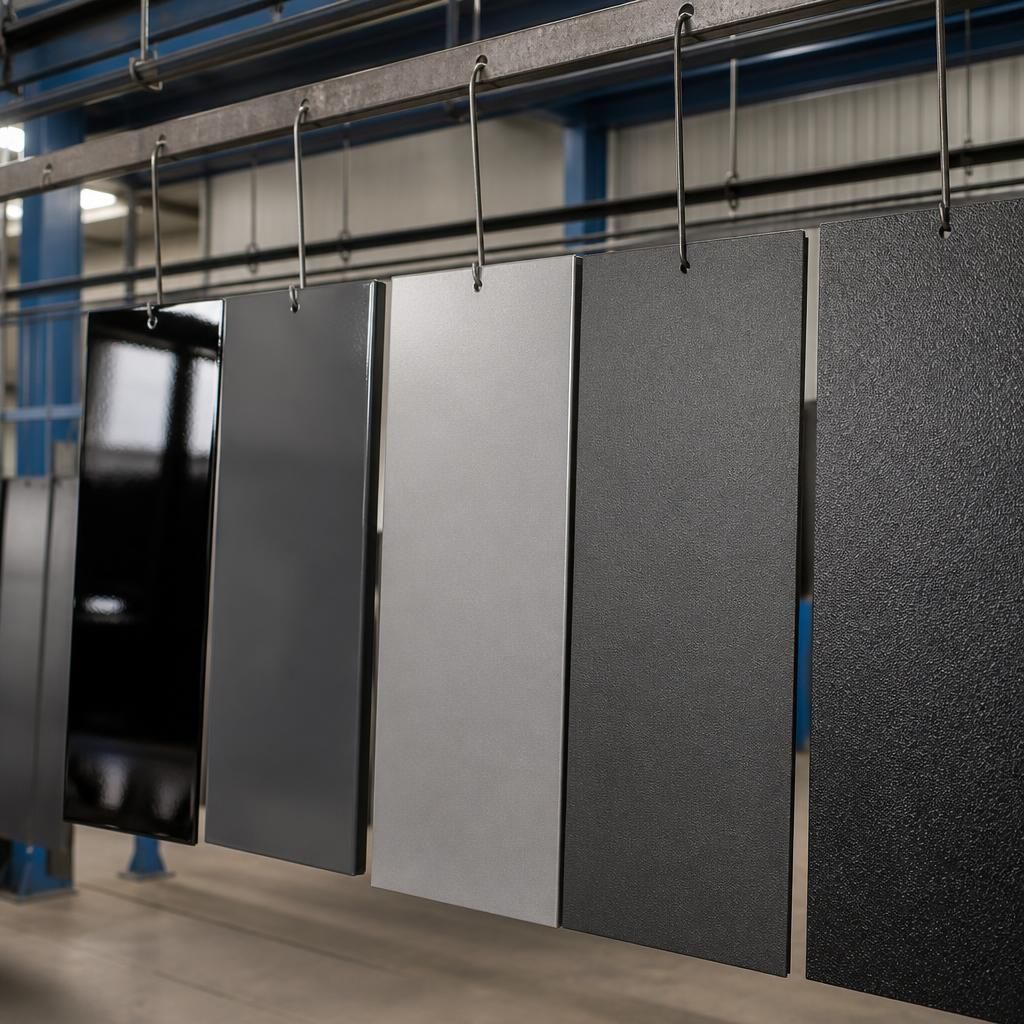
Powder coating finishes for steel are also available in different surface appearances, including smooth, textured, matt, satin and gloss. These options primarily affect the visual character and tactile feel of the component; they should be selected after the required protective performance has been established.
Smooth and gloss finishes are often chosen where a clean, easily inspected surface is important, while matt and satin grades reduce reflected light. Textured powders can provide a more pronounced surface profile and may help disguise minor visual variation in fabricated steelwork, although they cannot compensate for inadequate cleaning, blasting or repair of surface defects. The chosen appearance should therefore be confirmed alongside the coating system, application method and required film build.