

What is the impact of coating thickness on the durability and effectiveness of powder-coated steel in industrial applications?
Coating thickness directly affects how effectively powder-coated steel resists corrosion, wear and environmental exposure: an insufficient or uneven layer can leave the substrate vulnerable, while excessive thickness may cause runs, cracking or curing defects. The correct specification is therefore a controlled, uniform thickness suited to the steel component, powder system and service conditions.
Coating thickness is a key design and quality-control factor in powder-coated steel because it determines how much cured resin separates the steel from its service environment and how the finished component behaves during use. Performance depends on achieving the specified dry-film thickness consistently across the whole part, rather than simply applying the greatest possible amount of powder.
Corrosion protection: A continuous film limits the passage of moisture, oxygen, salts and industrial contaminants to the steel. The required thickness depends on the coating chemistry, the level of environmental exposure, the condition of the prepared surface and the design of the component. Thin areas, sharp edges, recesses and handling damage can become weak points even when the average reading across a large panel appears satisfactory.
Thickness also affects the coating’s ability to withstand mechanical service conditions. A suitable film provides a barrier against abrasion, impact and general handling, but the relationship is not linear. Increasing thickness does not automatically make a coating tougher. An overbuilt film can have greater internal stress and may be less tolerant of bending, impact or poor adhesion, particularly where the steel has not been prepared correctly or where the powder system has not been applied and cured within its technical specification.
Dimensional accuracy is another practical consideration. Powder coating adds material to every coated face, including holes, slots, mating surfaces, threads and close-fitting interfaces. If thickness is not allowed for in the component design, it can affect assembly, fastener fit, hinge movement or the clearance between parts. Masking, plugs and suitable allowances may therefore be needed for areas that must remain uncoated or retain a precise tolerance.
Film thickness can influence the visual result as well as protection. A consistent layer helps produce an even colour, gloss level and texture. Variations may be visible as differences in appearance, particularly on broad flat surfaces or where a textured finish highlights changes in film build. Excess powder can also affect flow and surface levelling during curing, while insufficient coverage may leave the profile of the steel, blasting marks or substrate imperfections more apparent.
Part geometry has a direct effect on thickness distribution. External corners, edges and exposed faces may attract powder differently from internal corners, deep recesses and narrow cavities. Electrostatic application can also produce a Faraday cage effect in recessed areas, reducing powder deposition in those locations. The application method, gun settings, part orientation, earthing and operator technique must be controlled so that difficult areas are considered rather than judged only by the easiest-to-reach surfaces.
The powder system and the steel’s intended service conditions determine the appropriate specification. Factors normally considered include:
- the corrosivity and moisture exposure of the operating environment;
- expected abrasion, impact, flexing and handling;
- the required appearance and surface texture;
- component tolerances, interfaces and areas requiring masking;
- the powder manufacturer’s recommended application and cure range;
- the condition and profile of the prepared steel surface; and
- whether a primer, tie coat or other multi-layer system is required.
For multi-coat systems, the total thickness is important, but so is the contribution of each layer. A primer may provide additional corrosion protection or adhesion, while the topcoat supplies colour, finish and resistance to the service environment. Applying a topcoat at the wrong thickness can upset the balance of the system, even where the combined film measurement appears acceptable. Each layer should therefore be assessed against the relevant specification.
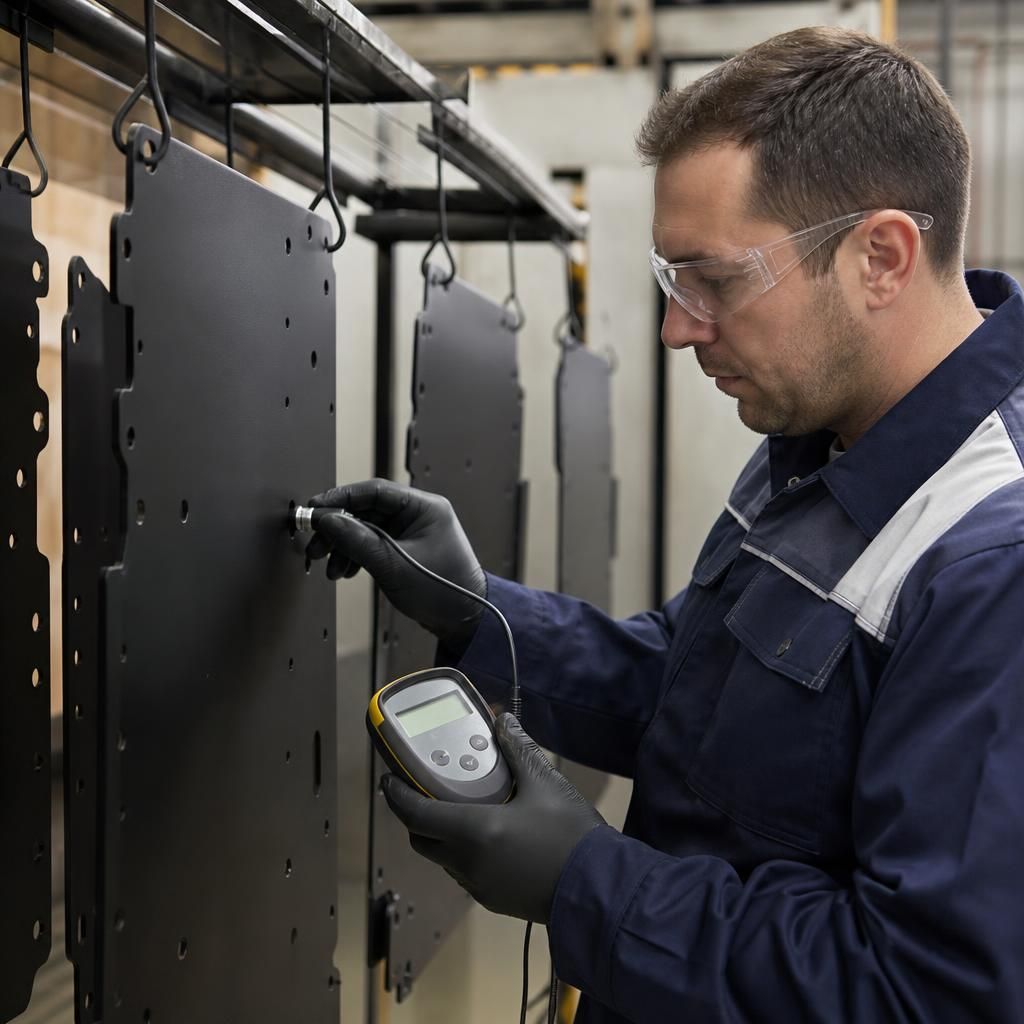
Thickness control should be based on representative measurements taken after curing, using a suitable dry-film thickness gauge. Readings should cover flat areas as well as edges, corners, recesses and other locations identified as critical. The purpose is to establish whether the coating is within the agreed specification and whether the distribution is consistent, not to rely on a single reading or an overall visual inspection.
Measurement results need to be interpreted alongside adhesion, cure and surface-preparation checks. A coating at the correct thickness can still underperform if oil, mill scale, rust, blasting residue or other contamination remains on the steel. Similarly, a suitable thickness does not compensate for incorrect curing. The cured film must develop the intended properties through the correct combination of substrate temperature and time, as defined for the powder system.
In practice, the most durable result comes from setting a thickness range for the specific steel component, identifying critical areas before coating and checking both average build and local variation. This approach supports corrosion resistance, appearance, mechanical performance and reliable assembly without treating excessive coating thickness as a substitute for correct preparation, application or curing.
Coating thickness can also influence the thermal behaviour of a steel component. Powder coating forms a polymer layer between the steel and its surroundings, so a thicker film can provide greater resistance to heat flow. This matters where the component must transfer heat, dissipate heat from equipment or maintain close control of its operating temperature.
Thickness should therefore be considered alongside the component’s thermal duty, not only its corrosion and appearance requirements. Where heat transfer is important, areas that require direct thermal contact may need to remain uncoated or be masked during application, while the selected powder system must remain suitable for the temperatures reached in service. A coating that meets its film-build requirement may still be unsuitable if it interferes with the component’s intended thermal function.
Discuss the right coating thickness for your steel components
Discuss your steel components, service conditions and dimensional requirements with the powder-coating team to establish a suitable coating-thickness specification. This can help define the right preparation, powder system and inspection criteria before production.