

What factors should be considered when selecting a powder coating system for steel protection?
Select a powder coating system for steel by assessing the steel substrate, corrosion exposure, service environment, required durability, coating thickness, component geometry and finished appearance. Surface preparation, powder chemistry, curing requirements and production constraints must also be compatible to achieve reliable protection.
Selecting a powder coating system for steel protection means matching the complete coating specification to the component’s expected exposure, required service life and inspection requirements. The correct choice is usually determined by the performance standard the finished part must meet, rather than by colour or powder type alone.
Start with the required performance specification. Establish whether the coating must resist salt contamination, industrial chemicals, moisture, abrasion, impact, ultraviolet exposure or repeated cleaning. These conditions may occur together, and a system that performs well in one environment may be unsuitable in another. The specification should state the required corrosion resistance, adhesion, hardness, flexibility and appearance, together with how those properties will be assessed.
Decide whether a single coat or a multi-coat system is appropriate. A single-layer system may be suitable where exposure is limited and the component is not subject to severe mechanical damage. More demanding applications may require a primer and topcoat arrangement. For example, a zinc-containing primer can provide an additional barrier and sacrificial element beneath a compatible topcoat, while an epoxy-based layer may offer strong barrier protection but need an additional finish where prolonged ultraviolet exposure is expected. Compatibility between layers is essential; the products must be designed to work together and cured in accordance with the specified process.
Consider the condition and design history of the steel. New, clean steel presents different coating risks from material that has been exposed to storage contamination, welding residues, previous coatings or handling oils. Welds, joints, cut edges and recessed areas should be assessed separately because they can become weak points in the protective system. Any design feature that prevents consistent coverage or allows water and contaminants to collect should be identified before the coating specification is finalised.
Set measurable acceptance criteria. A useful specification should define how the finished coating will be checked. Depending on the application, this can include:
- dry film thickness readings taken at representative locations;
- visual limits for runs, pinholes, inclusions, surface texture and colour variation;
- adhesion testing where the risk profile or contract requires it;
- inspection of edges, weld zones, difficult-to-reach faces and masked areas;
- verification that threaded holes, mating faces and other functional surfaces remain within tolerance.
Inspection points should be agreed before production begins, particularly for batch work. This avoids treating appearance preferences as defects after coating and provides a consistent basis for accepting or rejecting finished components.
Account for dimensional and functional interfaces. Powder coating adds material to the steel surface, so close-fitting parts, bearings, threaded sections, sliding faces, electrical contact points and accurately machined interfaces may need masking or a coating exclusion zone. The specification should identify these areas clearly and allow for the effect of the finished coating on assembly. Masking materials and techniques must also withstand the curing cycle without leaving residue or damaging the coating.
Check the curing and verification requirements. Powder coating is cured by applying controlled heat for a defined period, and the relevant requirement concerns the temperature reached by the component itself rather than simply the oven air temperature. Large or heavy steel parts may heat differently from small components. A suitable system therefore depends on confirming that the coating can achieve its specified cure throughout the component without adversely affecting the steel, inserts or assembled parts.
Assess repeatability for batches and future orders. Where components will be coated repeatedly, the specification should control powder identification, approved colour and gloss, application parameters, curing conditions and inspection records. This reduces avoidable variation between production runs. It is also sensible to retain a reference sample or approved finish standard where appearance is important, particularly if parts will be supplied in stages or combined with other coated items.
Review repair and maintenance provisions. Steelwork can be damaged during transport, installation or use. Before choosing a system, establish how minor damage will be identified, cleaned and repaired, and whether the proposed repair material is compatible with the original coating. For larger assets, consider whether future recoating is practical and whether the system can be inspected without removing the component from service.
Specify the coating system in writing. A robust purchase specification should record the steel grade or component type, intended exposure, coating build-up, approved powder system, finish requirements, masking points, curing instructions, inspection method, permitted repairs and packaging or handling requirements. Technical data sheets and safety information should be reviewed for each powder rather than relying on a generic description such as “corrosion-resistant powder”.
For complex steel components, the most reliable selection process is a technical review of the part, its operating conditions and the required evidence of conformity before production. This allows the coating system to be chosen on documented performance and compatibility, with the finished result judged against agreed requirements rather than appearance alone.
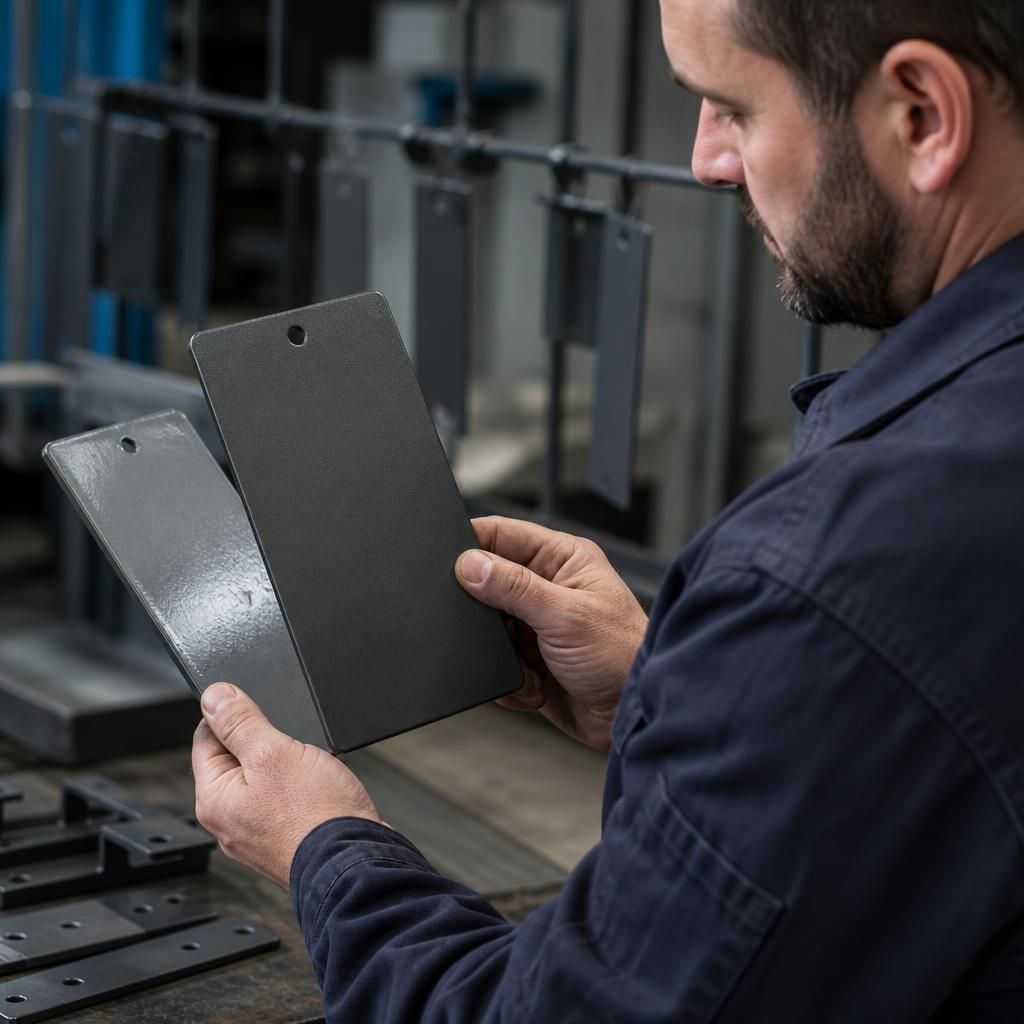
A trial piece or representative sample panel can help confirm that the proposed powder coating system is suitable before a full production batch is coated. The sample should use the same steel type, surface preparation, coating build-up and curing conditions as the finished components wherever practical. This allows the applicator and customer to assess coverage on difficult features, surface texture, colour and gloss, while also checking that the coating is compatible with the intended preparation process.
For repeat work, an approved sample can provide a physical reference for future batches. It should be supported by written requirements for the powder system, finish and inspection method rather than used as the only acceptance standard. Sampling is particularly useful where components have unusual profiles, combined visible and concealed surfaces, or a finish that must match other coated parts.