

What are the key benefits of using anti-corrosion powder coating for steel components in industrial applications?
Anti-corrosion powder coating protects steel components by forming a tough, continuous barrier against moisture, chemicals and other corrosive influences. This durable finish can extend service life, reduce maintenance requirements and provide consistent protection for industrial parts used in demanding environments.
For steel components used in industrial applications, anti-corrosion powder coating provides a specified protective system that combines corrosion resistance with a hard, adherent finish. Its main benefits are improved resistance to mechanical wear, dependable coverage of prepared steel, repeatable coating quality and flexibility in selecting a finish for the component’s operating environment.
Resistance to mechanical damage
Industrial steel parts can be exposed to handling, vibration, friction and occasional impact as well as corrosive conditions. A correctly selected powder coating can help the surface withstand abrasion and general wear, reducing the likelihood that the underlying steel becomes exposed during service. The appropriate formulation depends on the component’s use; a coating for an indoor framework may have different requirements from one used on machinery, transport equipment or external structural parts.
Reliable adhesion to prepared steel
Powder coating bonds effectively when the steel has been properly cleaned and prepared. Removing oil, rust, mill scale and other contaminants gives the coating a sound surface on which to form a continuous film. Abrasive blasting or another suitable preparation method can also create a surface profile that supports mechanical adhesion. This makes preparation a critical part of the anti-corrosion system rather than a separate cosmetic stage.
Consistent coverage across batches
Powder application uses an electrostatic charge to attract particles to the grounded steel component before curing. This process can provide even coverage across repeat batches when the application settings, powder quantity, component positioning and curing conditions are controlled. Consistency is particularly important for manufacturers and fabricators supplying components that must have a uniform specification and appearance.
Coating design still needs to account for the component’s geometry. Recesses, sharp edges, internal corners, welds and areas that are difficult to reach can affect powder deposition and film formation. These features should be considered during specification and checked during inspection so that the finished system is suitable for the part rather than selected solely by colour or appearance.
Protection suited to the operating environment
Anti-corrosion powders are available in systems formulated for different exposure conditions. Selection may need to consider outdoor exposure, humidity, industrial pollutants, contact with oils or cleaning agents, abrasion, temperature and the likelihood of standing water. A coating that performs well in a dry indoor setting may not be appropriate for prolonged external exposure or chemical contact.
Where the risk of corrosion is high, a multi-coat system may be considered. For example, a compatible primer can provide additional corrosion control beneath a topcoat, provided the products and curing requirements are suitable. The specification should also address joints, fixings, drilled holes and cut edges, because these areas can become vulnerable if they are not treated or protected as part of the overall design.
Improved finish and component identification
Powder coating can provide more than corrosion protection. A choice of colours, gloss levels and textures can help distinguish components, support an organisation’s visual standards or make equipment easier to inspect. A suitable finish may also help reveal surface damage, contamination or wear during routine checks. Appearance should not override technical requirements, but it can be an additional functional benefit in industrial settings.
Efficient repeat processing
Powder coating is applied as a dry material and then cured to form the finished film. This supports a controlled production process without the handling of a liquid coating during application. For suitable steel components, it can be integrated into batch production and repeated with defined preparation, application and curing parameters. Parts should be designed, racked and presented appropriately so that all required surfaces receive the specified treatment.
Potentially lower whole-life maintenance demands
Although no coating eliminates the need for inspection, a properly specified system can make steel components easier to maintain by providing a hard, cleanable surface and reducing the frequency of remedial attention caused by surface deterioration. The actual service performance depends on coating selection, preparation quality, film thickness, curing, installation and the severity of exposure.
For this reason, the coating should be specified as part of a complete corrosion-control strategy. Important information includes the steel grade and condition, component dimensions, welds and edges, intended location, expected contaminants, cleaning regime, appearance requirements and any known temperature or chemical exposure. Inspection should confirm surface preparation, coverage, coating thickness and cure before the parts enter service.
Anti-corrosion powder coating is therefore most effective when the powder, preparation method and application process are matched to the steel component and its environment. It offers a practical combination of mechanical resistance, controlled appearance and repeatable protection, but its performance depends on sound specification and disciplined preparation rather than the powder material alone.
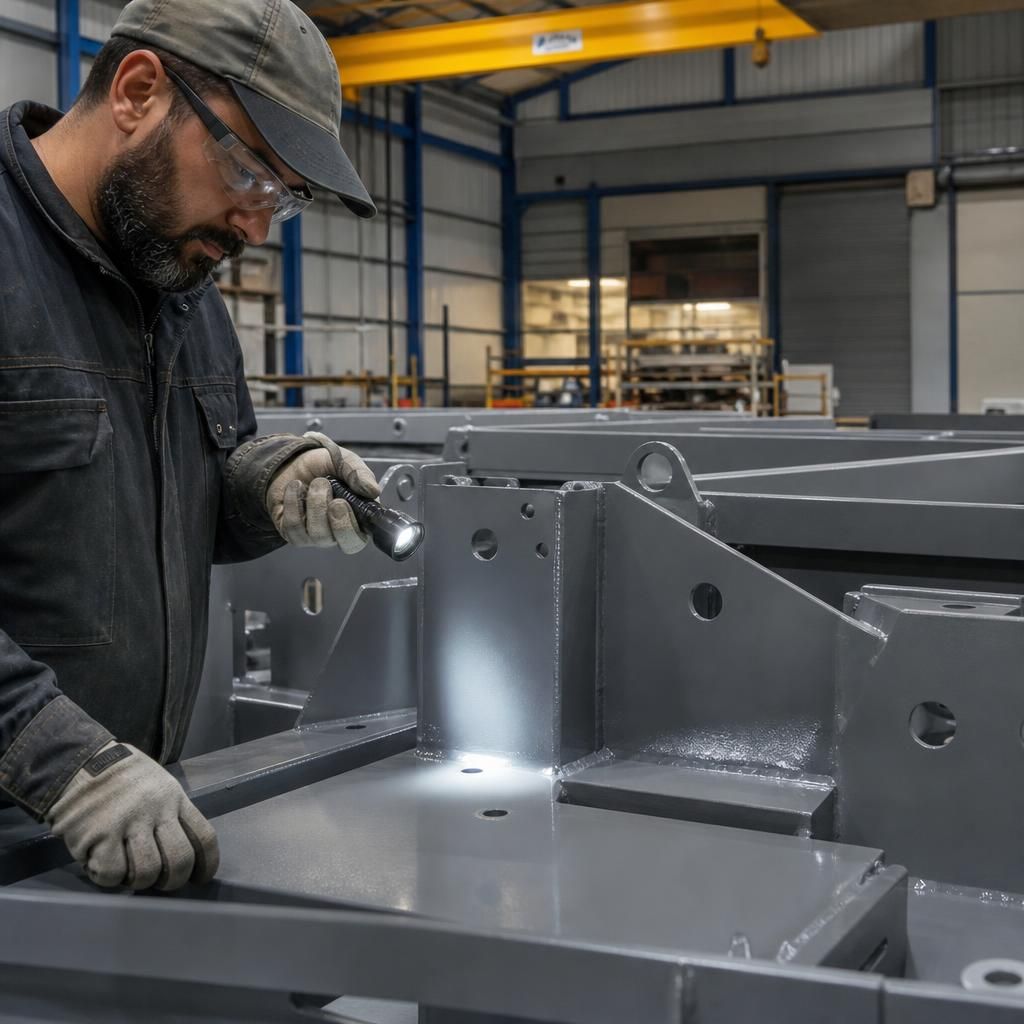
Anti-corrosion powder coating can also support more controlled inspection and quality assurance of steel components. A defined coating specification allows checks to focus on measurable characteristics such as surface preparation, film coverage, coating thickness and cure, rather than relying only on visual appearance. This is particularly useful where coated parts are produced in batches and need to meet the same documented requirements.
Inspection should include areas that are easily overlooked, including welds, edges, recesses, drilled holes and contact points created during racking. Identifying incomplete coverage or damage before installation allows the coating system to be reviewed and corrected as part of production control, helping ensure that the finished component is protected in the locations most likely to initiate corrosion.