

What types of abrasive materials are typically used in the sandblasting process for wrought iron?
Common abrasives for sandblasting wrought iron include garnet, aluminium oxide, crushed glass, glass bead, steel grit and steel shot. The most suitable choice depends on the existing coating, the level of corrosion, and whether the surface needs light cleaning or a more pronounced profile for subsequent powder coating.
Wrought iron is typically abrasive blasted with angular mineral, glass or metallic media selected according to the coating to be removed and the surface profile required. The abrasive must be hard enough to break down rust, mill scale and old paint, while remaining suitable for the thickness, detail and condition of the component.
Angular abrasives cut into contamination and leave a more pronounced key for a subsequent coating. Aluminium oxide is a hard, aggressive option for firmly bonded paint, corrosion and scale. Garnet provides effective cleaning with a comparatively controlled cutting action, while crushed glass is often used where a sharp, clean profile is required. These media are generally more appropriate for preparation before powder coating than a smooth polishing medium because the resulting texture helps the new coating adhere.
Spherical abrasives behave differently. Glass bead tends to clean and brighten the surface with a softer action, making it useful where only light contamination needs to be removed or where retaining a less pronounced texture is important. Steel shot is also rounded and primarily impacts the surface rather than cutting deeply into it. It can be useful for cleaning robust ironwork, but the operator must control the intensity to avoid unnecessary deformation or excessive peening of thinner sections.
Steel grit has an angular shape and is suited to heavier-duty removal of scale, corrosion and tenacious coatings. Its durability allows it to be recycled in suitable blasting equipment, although the resulting metallic residue and any embedded contaminants must be considered before applying a new finish. The blast equipment, recovery system and workpiece specification all influence whether metallic media are appropriate.
The grade of abrasive is as important as its material. Coarser particles remove stubborn layers and create a deeper profile, whereas finer grades provide more controlled cleaning on intricate scrollwork, edges and thinner sections. Excessively coarse media or excessive air pressure can round sharp details, damage delicate joints or produce a profile deeper than the coating system requires. A skilled operator therefore adjusts the abrasive grade, pressure, nozzle distance and travel speed together rather than treating the media in isolation.
- For heavy rust, scale or thick paint: an angular, hard abrasive is usually selected to cut through the existing layers.
- For sound iron requiring keying: a less aggressive grade may clean the surface without unnecessarily removing metal.
- For delicate or detailed work: controlled pressure and a finer medium help protect edges, decorative profiles and thin components.
- For a smoother cleaned appearance: rounded media may be considered, provided the resulting profile is adequate for the intended coating.
Silica sand should not be treated as the default simply because the process is commonly called sandblasting. Respirable crystalline silica creates a serious inhalation hazard, so blasting operations must use appropriate alternatives, enclosure, extraction, respiratory protection and other controls required by the risk assessment and applicable UK regulations.
After blasting, the wrought iron should be checked for residual dust, spent abrasive, rust staining and any remaining coating. Contamination can undermine adhesion even when the metal looks clean. The selected abrasive should also be compatible with the planned powder-coating specification: the required surface profile, cleanliness level and risk of abrasive entrapment should be agreed before preparation begins.
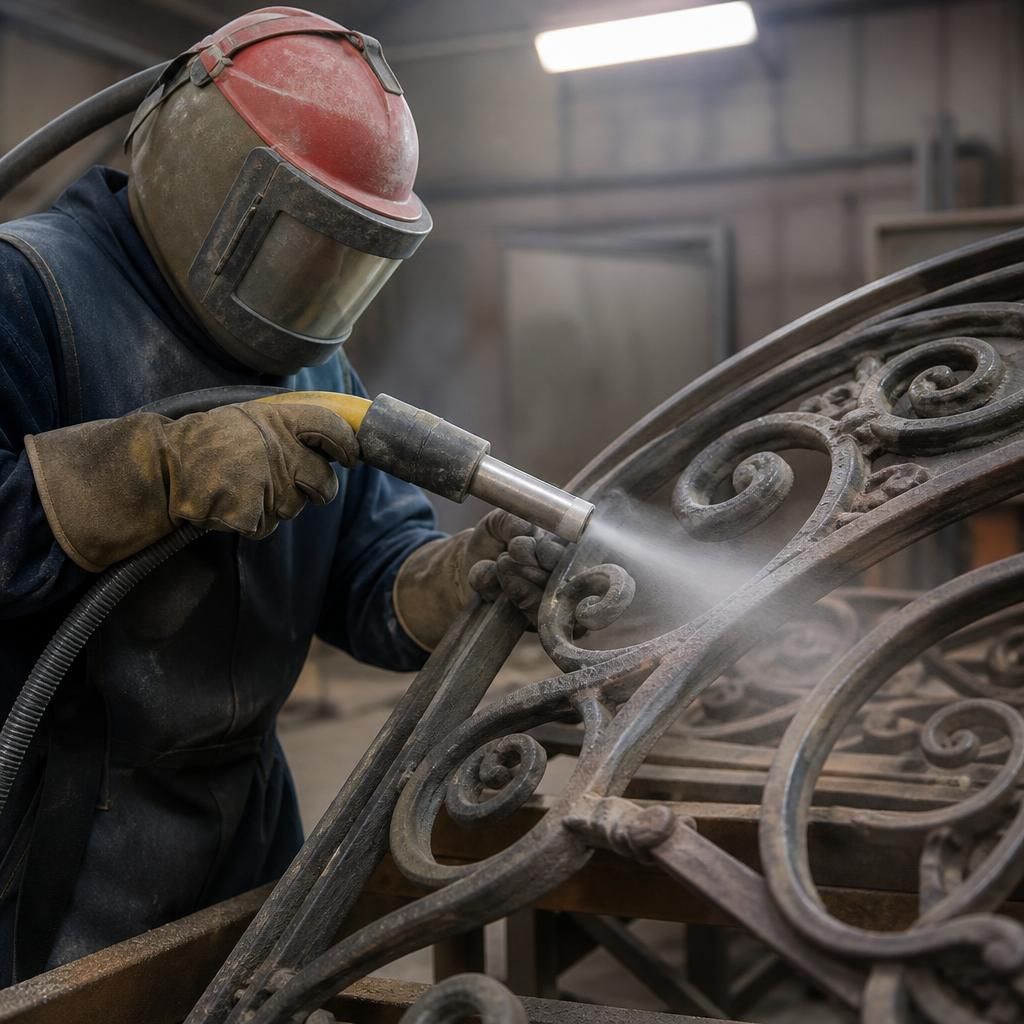
The surface profile left on wrought iron should suit the powder-coating system, not simply look visibly clean. A profile that is too shallow may provide insufficient mechanical key, while one that is unnecessarily deep can make it harder for the coating to cover peaks and recesses consistently.
For this reason, abrasive selection is normally checked on a representative area of the component before full preparation begins. This is particularly important on decorative work, where the same item may contain broad faces, narrow edges and recessed details. The chosen media and blasting settings should produce an even, controllable texture across those different areas without obscuring the original form of the wrought iron.