

What qualifications and certifications should I look for in a wrought iron sandblasting service provider?
Look for a wrought iron sandblasting provider with demonstrable abrasive-blasting competence, documented health and safety procedures, and appropriate environmental and waste-management controls. Ask for evidence of relevant operator training, risk assessments, equipment maintenance, insurance and quality procedures, rather than relying on certification claims alone.
There is no single UK qualification that certifies a provider specifically for wrought iron sandblasting. A suitable provider should instead be able to demonstrate recognised abrasive-blasting training, competence in surface preparation, appropriate inspection knowledge, and a management system that controls safety, environmental and quality risks. The evidence should relate to the type, size and condition of the wrought iron components being treated.
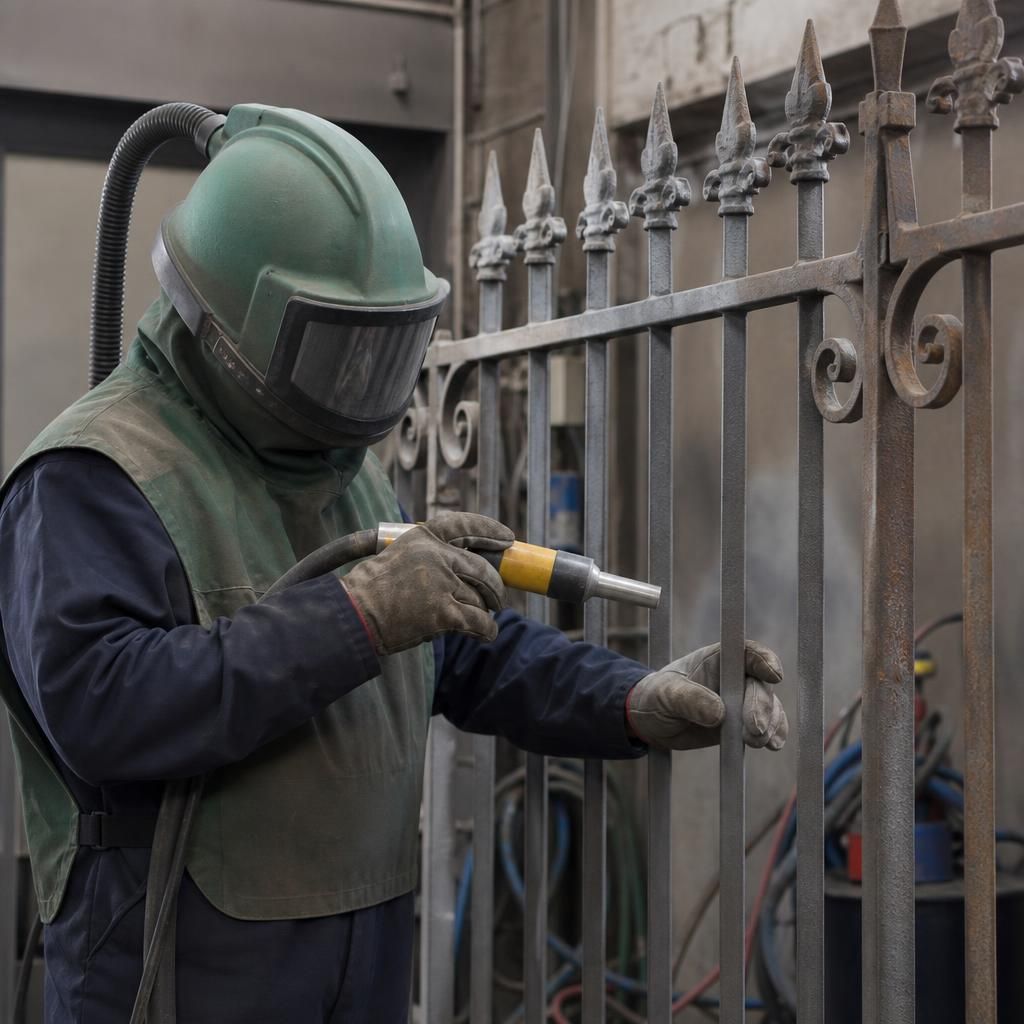
Look for relevant operator training. Ask whether the personnel carrying out the work have formal training in abrasive blast-cleaning, compressed-air equipment and surface preparation. Training should cover media selection, nozzle technique, pressure control, containment, dust control and the risk of distorting or excessively eroding older wrought iron. A certificate is useful, but it should be supported by an explanation of how the operator applies that training to fabricated, decorative or heavily corroded components.
Check knowledge of recognised preparation standards. A competent provider should understand standards used to describe blast-cleaned steel and iron surfaces, including:
- BS EN ISO 8501-1, for visual assessment of preparation grades and rust conditions;
- BS EN ISO 8503, for surface profile characteristics and comparison standards; and
- BS EN ISO 8502, for assessing contaminants such as dust and soluble salts where the subsequent coating specification requires it.
These standards do not, by themselves, prove that a company is qualified to blast wrought iron. They provide a consistent language for agreeing the required finish, checking the result and recording whether the surface is suitable for the next coating stage.
Consider inspection and coating qualifications. If the blasted surface will receive powder coating or another protective finish, knowledge of coating inspection is valuable. Relevant training may include industrial coating inspection or surface-preparation qualifications from recognised professional bodies, such as ICorr or AMPP. These qualifications are not always essential for every straightforward job, but they indicate familiarity with surface profile, cleanliness, environmental conditions and inspection records. Ask what qualification the individual holds, which parts of the process it covers and whether it is current.
Ask about third-party management-system certification. Certifications such as ISO 9001, ISO 14001 or ISO 45001 can provide evidence that a business has formal systems for quality, environmental management or occupational health and safety. They are not substitutes for practical blasting competence. Check that the certificate:
- is issued by an accredited certification body;
- is within its validity period;
- names the correct legal entity; and
- covers abrasive blasting, surface preparation or the relevant industrial coating activity within its scope.
A certificate covering an unrelated activity or a different site should not be treated as evidence for the service you are commissioning.
Establish how hazardous existing coatings are dealt with. Older wrought iron may carry lead-based paint, chromates, tar residues or other hazardous substances. A qualified provider should have a defined process for identifying uncertain coatings before blasting and for deciding whether sampling, specialist testing or additional controls are needed. Where asbestos-containing material is reasonably suspected, the work should be assessed under the applicable asbestos regulations rather than treated as ordinary paint removal. Ask who assesses the coating, what information is required from the client and what happens if an unexpected substance is found.
Review the technical records the provider produces. Good certification is supported by clear records, not just certificates on a website. Depending on the specification, useful documents may include:
- the agreed preparation grade and surface-profile requirement;
- the abrasive media specification and any restrictions on contamination or reuse;
- preparation and inspection reports;
- surface-profile, dust or soluble-salt readings where required;
- calibration records for inspection instruments;
- photographic records for complex or concealed areas; and
- non-conformance records showing how defects or missed areas were addressed.
For components destined for powder coating, it is particularly important to establish how the prepared metal is protected from recontamination and how the handover condition is recorded before the coating stage.
Check competence with wrought iron itself. Wrought iron is not always uniform. Historic sections, hand-forged details, repairs, welds, threaded parts and thin decorative elements may respond differently to blasting. Ask for examples of comparable work and find out how the provider determines suitable pressure, nozzle distance and abrasive type without damaging edges or details. Experience should include masking or protecting areas that must not be blasted, identifying fragile sections and dealing with trapped abrasive in hollow or intricate components.
Finally, distinguish between qualifications that are legally required for a particular risk and credentials that demonstrate additional competence. Request copies of relevant certificates, the issuing organisation, scope and expiry date, then compare them with the proposed method statement and coating specification. The strongest evidence is a combination of relevant training, recognised preparation standards, verifiable management systems, inspection records and demonstrable experience with the specific wrought iron components involved.
For management-system certification, check the accreditation trail as well as the certificate itself. A certificate issued by a certification body accredited by UKAS or another recognised national accreditation body provides stronger evidence that the assessment followed an established certification process. The certificate should identify the legal entity, relevant site and activities within scope; a logo displayed on a website is not sufficient evidence on its own.
Also distinguish certification of the business from qualification of the person carrying out the blasting. Company-level certification indicates that documented systems are in place, while operator training and practical experience show whether those systems can be applied safely to the particular wrought iron components. Both types of evidence should be relevant to the work being specified.
Discuss Your Wrought Iron Sandblasting Requirements
Discuss your wrought iron sandblasting requirements with Powder-coatings.co.uk, including the component’s condition, existing coating and intended finish. This helps establish the appropriate preparation specification and the records needed before coating.