

How does sandblasting prepare wrought iron for powder coating?
Sandblasting prepares wrought iron for powder coating by removing rust, mill scale, old coatings and surface contaminants. It also creates a clean, lightly textured profile that gives the powder coating a stronger mechanical key and supports a durable, even finish.
Sandblasting prepares wrought iron for powder coating by using controlled abrasive impact to produce a consistent, chemically clean and suitably textured surface. The work is more than simply directing abrasive at the metal: the component is assessed, cleaned, blasted to an appropriate condition, inspected and protected until the powder is applied.
1. Initial assessment and preparation
The wrought iron is first examined for its construction, condition and coating requirements. Welds, joints, sharp edges, deep recesses, threaded sections and enclosed areas need particular attention because they can retain contaminants or be difficult to reach. Any fittings, inserts or parts that should not be blasted are removed where possible, while sensitive faces, threads and openings are masked or otherwise protected.
Oil, grease, dirt and other loose contamination are dealt with before abrasive blasting. This preliminary cleaning matters because abrasive impact can spread oily contamination across the surface rather than remove it reliably. Components are also checked for defects such as deep pitting, damaged welds or areas of weakened metal, which may affect the final appearance and may need to be addressed separately.
2. Controlled abrasive blasting
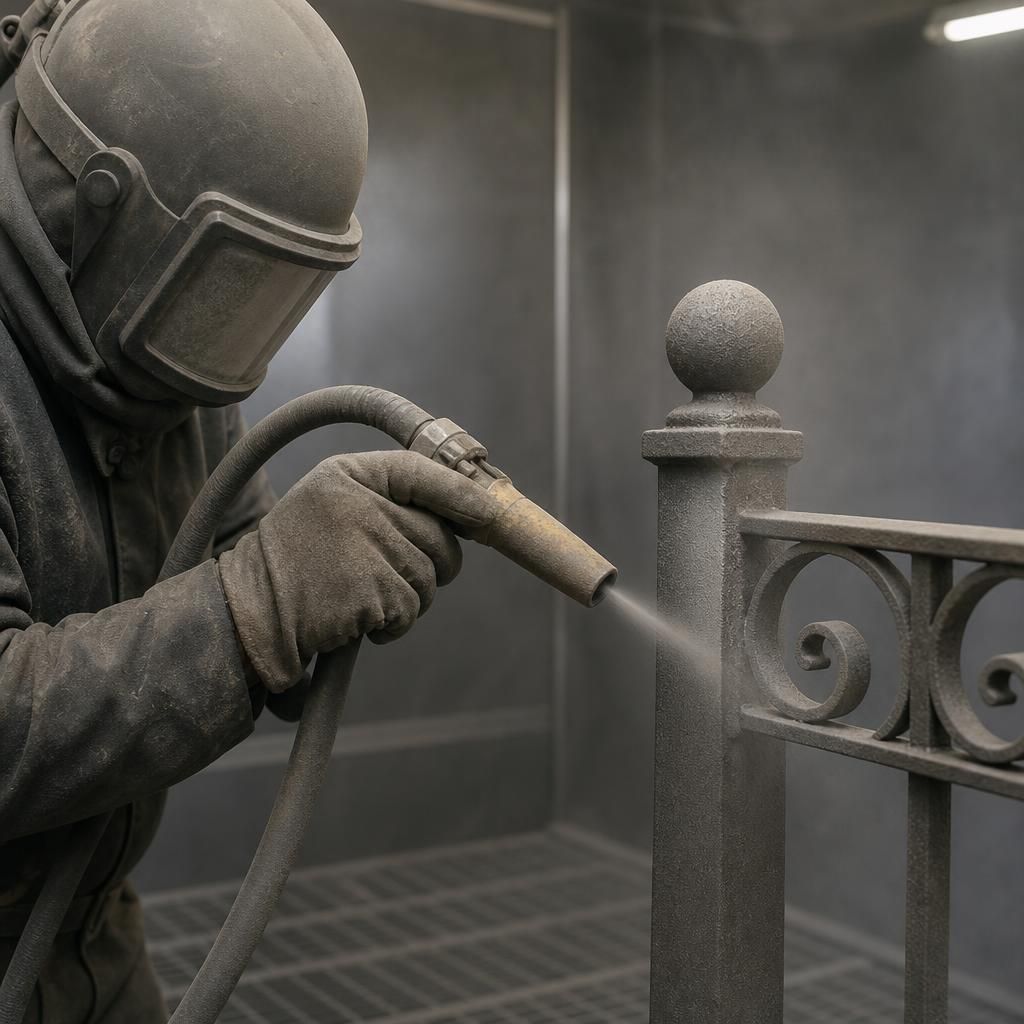
During blasting, the operator controls the abrasive flow, air pressure, nozzle distance and angle. These settings are selected according to the thickness, shape and condition of the wrought iron. Heavy sections and complex fabricated parts can require different treatment from thin sections, decorative bars or areas close to welds.
The nozzle is moved methodically so that faces, corners, welds and recessed details receive an even treatment. Poorly controlled blasting can leave sheltered areas insufficiently prepared, while excessive impact may produce an uneven surface, damage delicate detail or distort thin metal. The objective is therefore controlled consistency rather than the greatest possible blasting force.
3. Attention to wrought iron’s geometry
Wrought iron components often combine flat faces with curves, scrolls, rails, brackets and welded intersections. Abrasive can be obstructed by these changes in shape, creating shaded areas that are easily missed. Operators need to vary the angle of attack and inspect the component from more than one direction.
Edges and weld transitions also influence powder coverage. Sharp edges may receive a thinner coating than adjoining faces, whereas rough weld spatter can create visible irregularities. Preparing these areas carefully helps the subsequent coating sit more uniformly and reduces the risk of defects being carried through to the finished surface.
4. Inspection after blasting
After blasting, the component is examined under suitable lighting to check for missed areas, embedded debris, remaining contamination and inconsistent preparation. Particular attention is given to crevices, weld lines, the underside of sections and areas behind decorative features. The surface is also checked to confirm that its texture is appropriate for the specified powder coating system.
Inspection can identify conditions that are not obvious before preparation, including pitting or imperfections revealed once the previous surface condition has been removed. Where the required finish is architectural or highly visible, these findings should be resolved before coating rather than concealed beneath powder.
5. Dust removal and handling
Loose abrasive and dust are removed using a suitable clean method. Compressed air, if used, must not introduce oil or moisture back onto the prepared metal. The component should then be handled with clean gloves or suitable protective equipment so that fingerprints, moisture and workshop contamination do not compromise the surface.
Blasted wrought iron should not be left exposed unnecessarily before powder coating. Clean bare steel can react with moisture in the environment, so transport, storage and the interval before coating need to be controlled. If the surface becomes contaminated or shows signs of oxidation, it may require further preparation rather than being coated as it stands.
6. Transfer to powder coating
The prepared component is positioned for coating with attention to its hanging points and electrical contact areas. Contact points must support effective handling and, where required by the coating equipment, a reliable earth path. Masking is used where powder must not enter holes, threads, mating faces or other functional areas.
Powder is then applied and cured in accordance with the coating specification for the component. The final result depends on the complete sequence: appropriate preparation, clean handling, correct powder application and suitable curing. Sandblasting cannot compensate for poor degreasing, careless handling or incorrect curing, so each stage has a direct bearing on the finished coating.
For fabricated wrought iron supplied in batches, consistent preparation also requires the same inspection approach across every component. Parts should be presented in a way that allows all relevant surfaces to be reached, and any special requirements—such as protected threads, retained dimensions or a particularly uniform decorative appearance—should be identified before blasting begins.
Sandblasting prepares the surface of wrought iron; it does not repair damage within the metal. Removing rust and old coatings may reveal pitting, pinholes, cracked welds or areas where material has been lost. These defects should be assessed before powder coating because powder can cover a surface irregularity but cannot restore its strength, shape or original profile.
Any fabrication or welding repairs should normally be completed before the final blasting and coating stages. Repair work can introduce scale, weld spatter and other contamination, so the affected areas require suitable re-preparation to maintain a consistent surface for the powder coating.