

What types of abrasive media are best suited for different metals, and how do these choices impact the effectiveness of powder coating?
The best abrasive media depends on the metal’s hardness, thickness and condition: aluminium and other soft metals generally need a fine, non-aggressive medium, while steel and heavily corroded surfaces can tolerate harder grit or shot. Choosing the correct media removes contamination and creates a suitable surface profile without distortion, helping powder coating bond consistently and resist premature failure.
The most suitable abrasive media is determined by the substrate, the contamination being removed and the surface profile required by the powder-coating system. The choice affects more than appearance: it controls the risk of embedded particles, distortion, edge damage and uneven adhesion. Media should therefore be selected as part of the complete preparation specification rather than chosen solely for its cutting strength.
Carbon and mild steel
Carbon steel and mild steel generally provide the widest choice of blast media. Angular aluminium oxide, garnet or steel grit can remove rust, mill scale, old coatings and fabrication residue while producing a defined key for the powder coating. Steel grit cuts into the surface, whereas steel shot is spherical and tends to peen rather than cut. Shot can be useful where a more uniform, less sharply textured finish is wanted, but it may be less effective against tightly bonded scale or deep corrosion.
The condition of the steel still matters. Light surface contamination may not require an aggressive medium, while heavily corroded or coated sections may need a more cutting abrasive followed by careful dust removal. On thin sheet, excessive impact can distort the component or round important edges, so the media size, pressure and blasting distance must be controlled.
Stainless steel
Stainless steel should be prepared with clean, dedicated non-ferrous or non-contaminating media. Glass bead, aluminium oxide or garnet may be suitable depending on whether the requirement is light cleaning, coating removal or a stronger profile. Using previously contaminated ferrous media can leave iron particles on the surface. These particles may later discolour or corrode, undermining the appearance and performance of the powder-coated finish.
Dedicated equipment or carefully controlled media handling is important where stainless and ordinary carbon steel are processed in the same facility. The surface should be inspected after blasting for residue, staining and areas that remain smooth or contaminated.
Aluminium
Aluminium is readily marked and can lose its intended shape or texture under excessive impact. Glass bead, fine garnet and other controlled, non-ferrous media are commonly considered where the objective is to clean the surface and create a consistent key without deep cutting. Steel shot and steel grit are generally unsuitable where ferrous embedment, staining or distortion would compromise the coating system.
Particular care is needed around thin sections, machined faces, threads and sharp transitions. A surface that appears clean can still contain blasting residue, so thorough air cleaning and inspection are necessary before powder is applied. Any pre-treatment specified for the aluminium should be compatible with the blasted surface and the chosen powder system.
Galvanised and zinc-coated steel
Galvanised components require a controlled sweep blast rather than an approach intended to remove the zinc layer completely. Fine, clean non-ferrous media can remove surface contamination and provide a suitable key while retaining as much of the protective coating as the specification permits. Excessive blasting can thin or remove the zinc, expose the underlying steel and create an inconsistent basis for powder coating.
Edges, welds and areas where the coating is already damaged need separate inspection. The preparation method should account for the difference in hardness between the zinc coating and any exposed steel, otherwise one area may be overworked while another remains inadequately prepared.
Cast iron
Cast iron often contains pores, moulding residue and irregular areas of corrosion. An angular medium can be more effective than a gentle spherical medium where contamination is lodged in the surface texture. However, blasting may reveal oil or other substances held within the pores. Those contaminants can later cause pinholes, bubbling or local loss of adhesion in the powder film if they are not identified and dealt with before coating.
Castings should therefore be assessed for porosity, trapped moisture and embedded process residue after blasting. A visually uniform surface is not, by itself, evidence that the component is ready for powder coating.
Copper, brass and other non-ferrous alloys
Copper, brass and similar alloys are comparatively easy to mark, so glass bead or another clean, controlled medium is often more appropriate than a highly aggressive abrasive. The selected media should not introduce ferrous contamination or leave a residue that interferes with pre-treatment. Softer organic media may be useful in particular cleaning applications, but their suitability depends on whether they can be fully removed from recesses and joints.
How the media changes the powder-coating result
- Surface profile: Angular abrasives create a sharper mechanical key, while spherical media tend to produce a more peened texture. The profile should be compatible with the coating thickness; excessive peaks can remain visible through a thin film, while an insufficient profile may reduce mechanical anchoring.
- Contamination control: Media must be clean and appropriate for the substrate. Embedded steel in stainless or aluminium, residual dust and spent abrasive in holes can produce staining, inclusions or local coating defects.
- Edge condition: Aggressive blasting can round edges or expose vulnerable weld transitions. Conversely, poorly prepared edges may retain rust or old coating and become early failure points.
- Dimensional stability: Thin sheet, precision parts and fabricated assemblies can distort if impact energy is too high. Media size, nozzle pressure, angle and dwell time should be adjusted to the component rather than applied uniformly.
- Final cleanliness: Blasting does not remove every type of contamination. Oil, grease and some manufacturing residues need to be addressed through suitable degreasing or another specified preparation stage before blasting or coating.
After blasting, the component should be checked for a consistent texture, remaining corrosion, visible dust, embedded abrasive and damage to critical faces. Recesses, drilled holes and internal corners deserve particular attention because they can retain media and interfere with coating coverage. The prepared surface should then be protected from handling contamination and any moisture-related deterioration before the powder-coating process begins.
For mixed batches or unfamiliar materials, a trial preparation on a representative component is a practical way to compare media, assess the resulting profile and identify distortion or contamination risks before full production. A coating specialist can use the metal type, part geometry, existing finish and required end use to specify the media and blasting method together, which gives the powder coating a more reliable foundation.
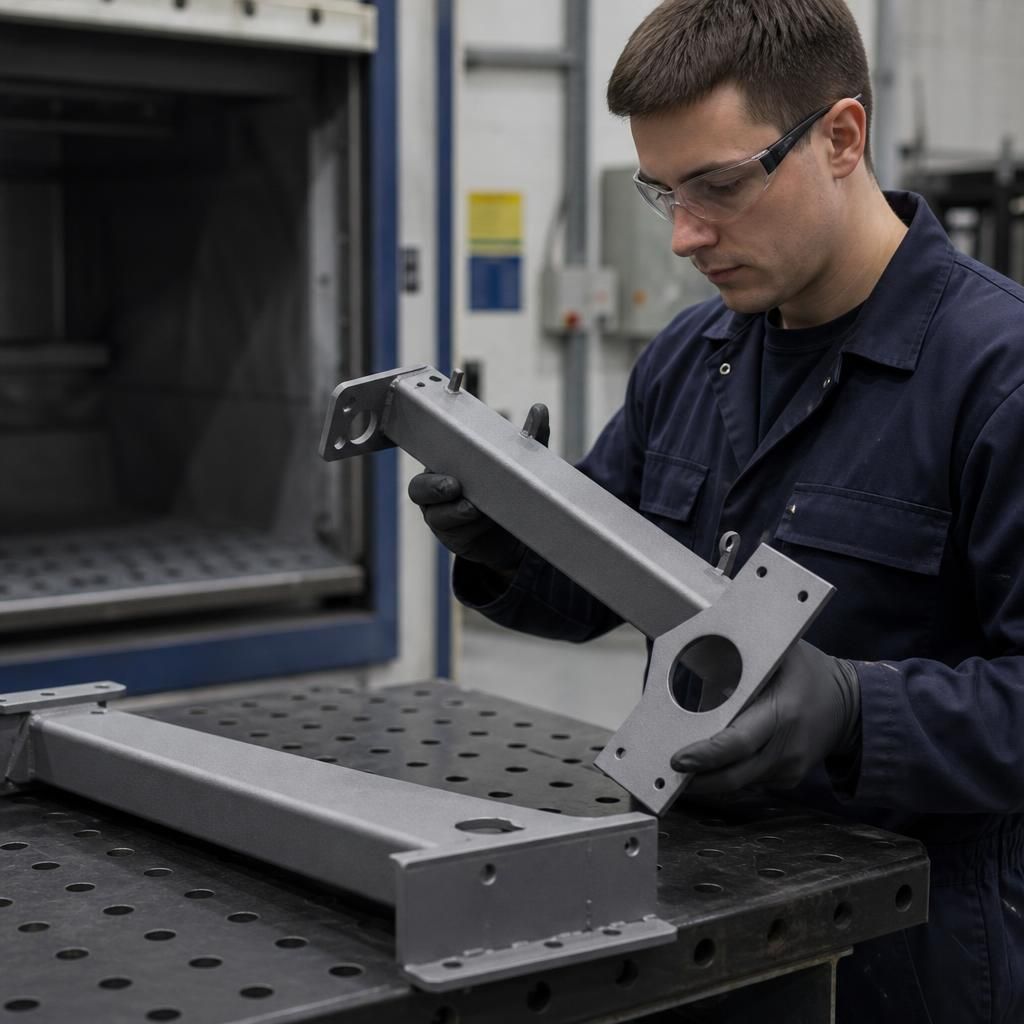
Abrasive media can only deliver a reliable powder-coating foundation if the prepared surface is kept clean afterwards. Freshly blasted carbon steel may develop flash rust if exposed to moisture, while fingerprints, dust and workshop residues can interfere with pre-treatment and coating adhesion. Components should therefore be handled carefully, inspected promptly and protected from contamination before the next preparation stage.
This is particularly important for parts with recesses, joints or hollow sections, where moisture and spent abrasive can remain hidden. Removing loose residue and confirming that the surface is dry and uniform helps ensure that the selected media has achieved its intended result rather than leaving defects for the powder coating to conceal.