

What safety protocols and compliance measures should an abrasive blasting service adhere to when preparing surfaces for powder coating?
An abrasive blasting service preparing metal for powder coating should use documented risk assessments, trained operators, suitable enclosures and ventilation, controlled access, effective dust and noise management, and correctly selected personal protective equipment. Compliance also requires safe inspection and maintenance of blasting equipment, appropriate control of abrasive materials and waste, and adherence to relevant UK health, safety and environmental duties, including COSHH and PUWER where applicable.
An abrasive blasting service preparing surfaces for powder coating should operate to a documented system that controls hazards before, during and after each blasting job. This system should cover the condition of the workpiece, the blasting method, operator competence, equipment controls, exposure monitoring, emergency arrangements, waste handling and records demonstrating that the relevant UK duties have been met.
Pre-job assessment and method statement: Before work starts, the service should identify the metal substrate, existing coating, contamination and any features that could affect safe blasting. Lead paint, chromate-containing coatings, asbestos contamination, oils and other hazardous residues require specific investigation and controls rather than being treated as ordinary blast debris. The method statement should define the approved abrasive, operating parameters, inspection stages, exclusion arrangements and actions to take if an unknown coating or unexpected defect is found.
The customer should provide accurate information about previous coatings, chemical exposure, enclosed sections, trapped liquids, hollow components and any remaining contents. Components should be made safe before arrival, with fuel, hydraulic fluid, refrigerant, pressure and other hazardous contents removed where relevant. Openings, threaded areas, bearings, machined faces and other zones that must not receive abrasive should be identified and protected using suitable plugs, covers or masking systems.
Workplace and equipment controls: Blasting plant should be suitable for the abrasive and the component being treated. Hoses, couplings, nozzles, deadman controls, pressure vessels, guards and compressed-air systems should be checked against the manufacturer’s instructions and inspected at appropriate intervals. A blast nozzle should not continue operating if the control system fails, and compressed-air lines should be depressurised before adjustments, clearing blockages or changing components.
Where work involves lifting, rotating or repositioning large fabricated parts, the handling plan should address load stability, rated lifting accessories, pinch points and communication between operators. The component should be stable before blasting begins, with no reliance on improvised supports. If access requires platforms or other elevated work equipment, the service should apply the relevant inspection and fall-prevention controls rather than treating access as part of the blasting task alone.
Exposure and health protection: Respiratory protective equipment should be selected from the actual hazard assessment, not simply from the appearance of the abrasive. Face-fit testing, clean-shaven seal requirements where applicable, inspection, cleaning, storage and replacement arrangements should be documented. Health surveillance may be appropriate where a residual risk remains from respiratory, skin, hearing or other occupational hazards. Employees should know how to report symptoms, equipment defects and suspected exposure without continuing the task.
Noise controls should follow the hierarchy of control. Enclosures, equipment selection, separation and reduced exposure time should be considered before relying on hearing protection. Air monitoring or other exposure assessment may be necessary where the abrasive, old coating or process could create a significant inhalation risk. Results should be reviewed when the material, equipment, work pattern or ventilation arrangement changes.
Control of ignition and fire risks: The service should consider whether the workpiece or residues introduce flammable vapours, combustible dust or ignition-sensitive materials. Blasting should not begin until contamination and process conditions have been assessed. Any hot work, solvent use or other activity near the blasting area should be controlled separately, and suitable fire precautions should be available. Static electricity, compressed air, electrical equipment and dust accumulation should be considered where they could contribute to an ignition event.
Isolation and emergency arrangements: Procedures should cover loss of air supply, hose failure, nozzle malfunction, entanglement, injury, fire, contamination and a worker becoming incapacitated inside or near a restricted area. Operators should be able to stop the process immediately, raise an alarm and obtain first aid without entering an unsafe area. Emergency contact details, access routes, equipment isolation points and incident-reporting arrangements should be understood by everyone involved.
Restricted or enclosed components need particular care. A space should not be treated as safe merely because it is large enough to enter. The service should determine whether confined-space controls apply, including atmospheric assessment, prevention of unauthorised entry, communications, a suitable rescue plan and trained personnel. Blasting inside a vessel or similar structure should not proceed on the assumption that an ordinary workshop procedure is sufficient.
Environmental and legal records: Compliance is supported by traceable documentation rather than a verbal assurance. Appropriate records can include:
- the job-specific risk assessment and method statement;
- information supplied about existing coatings and contamination;
- operator training, competence and face-fit records;
- equipment inspection, examination and defect reports;
- exposure monitoring and health-surveillance arrangements where required;
- abrasive and waste descriptions, transfer records and disposal documentation;
- incident, near-miss and corrective-action reports; and
- handover notes confirming any remaining masking, residue or restrictions.
Waste should be classified according to what the blasting process has removed, not simply according to the original abrasive. Coating residues can change the waste category and may require controlled storage, labelling and disposal. Any release to drains, soil or surrounding premises should be prevented, and environmental controls should be reviewed if the work involves lead, heavy metals, hazardous coatings or other regulated contaminants.
Quality and handover: Safety and coating performance are linked at the handover stage. The blasted surface should be checked for remaining contamination, embedded abrasive, flash rust, sharp edges, missed areas and damage to areas that were intended to remain protected. The service should record the agreed cleanliness and surface-profile requirements, inspection method and any deviation. The prepared component should then be protected from renewed contamination and handled in a way that does not undermine the subsequent powder coating process.
When assessing a blasting service, a purchaser should ask how it identifies hazardous existing coatings, verifies operator competence, controls enclosed or heavy components, manages exposure and records equipment checks. It is also reasonable to request evidence that waste is handled lawfully and that incidents or process changes trigger a review. These checks help distinguish a controlled, compliant preparation process from one that relies only on general workshop practice.
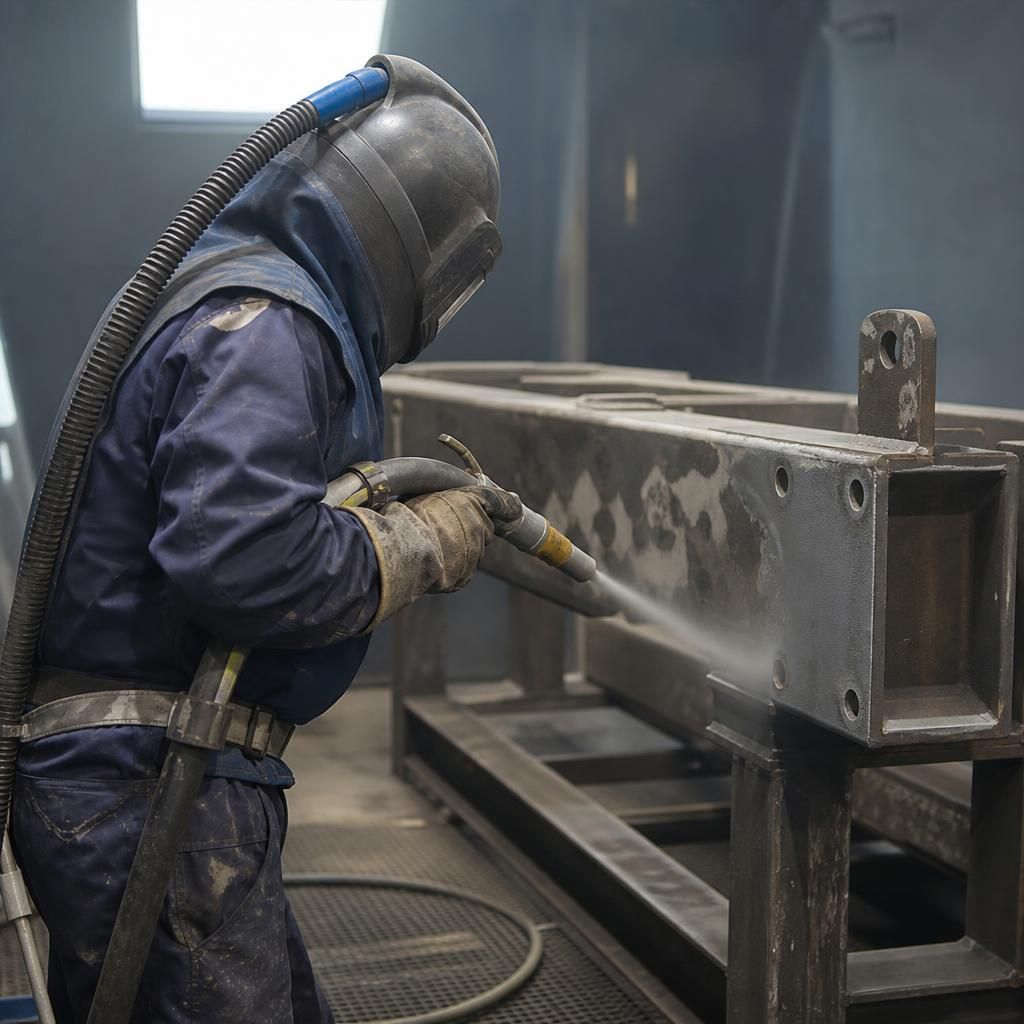
Abrasive blasting safety depends on the quality of the air supplied to the operator’s breathing zone, not just on the blast pressure. Where a blasting helmet or supplied-air respirator is used, the service should provide breathing air from a suitable, maintained system rather than assuming that ordinary workshop compressed air is safe to inhale. Intake points should be positioned away from engine exhausts, solvent vapours and other contaminants, while filters, regulators, hoses and connections should be checked and maintained in line with the equipment manufacturer’s instructions.
The service should also define what happens if airflow falls, contamination is suspected or the breathing-air system develops a fault. Operators need a clear stop-work procedure, a means of leaving the blast area safely and a documented inspection record. These controls should be considered alongside the abrasive’s dust characteristics and the existing coating being removed, so that respiratory protection is based on the actual exposure risk rather than on the appearance of the blasting operation.
Discuss compliant abrasive blasting for powder coating
If you are planning a powder coating project, discuss the component, existing finish and preparation requirements with the Powder-coatings.co.uk team. They can assess the appropriate blasting and coating approach for your metal parts, with collection and delivery options available across the Midlands and surrounding areas.