

What factors should be considered when evaluating the cost-effectiveness and investment value of abrasive blast cleaning services for industrial powder coating projects?
Evaluate abrasive blast cleaning by its total project cost rather than the cleaning charge alone, including media selection, part geometry, contamination levels, batch size, masking, handling, collection or delivery, and any additional preparation required. Its investment value is reflected in a consistent surface profile, strong powder-coating adhesion, reduced rework risk and longer coating performance, provided the method is matched to the metal and specification.
Abrasive blast cleaning is cost-effective when its full contribution to the finished powder-coated component is assessed, rather than judged by the blasting charge alone. Its investment value depends on whether the process produces the specified cleanliness and surface profile consistently, supports reliable coating adhesion, limits avoidable remedial work and provides an acceptable whole-life cost for the part.
The first step is to define what the service must achieve. A quotation should be assessed against the required cleanliness standard, surface profile range, powder-coating system and end-use conditions. A lower price may not represent better value if it is based on a less demanding preparation standard, excludes inspection or requires additional work before coating. Conversely, a more controlled process may be justified where the component will face outdoor exposure, abrasion, chemicals or demanding service conditions.
When comparing quotations, check that each one covers the same scope. Important points include:
- the preparation standard and acceptance criteria;
- how difficult areas, welds, edges and previously coated sections will be treated;
- whether inspection records or profile checks are included;
- requirements for protecting prepared surfaces before powder coating;
- any minimum charge, setup cost or separate treatment for rejected or unsuitable parts;
- the arrangements for identifying, separating and returning completed components.
This prevents an apparently inexpensive quotation from being compared with a more comprehensive specification. It also makes the commercial evaluation more transparent when different suppliers use different descriptions of abrasive blast cleaning.
Surface quality should be evaluated for consistency as well as appearance. A sound process removes rust, scale, old coating and other unwanted material while creating a suitable key for the powder coating. Excessive blasting can alter edges or remove more substrate than necessary, while insufficient preparation can leave contamination or weakly bonded areas. Both situations can increase the risk of recoating, rejection or premature maintenance. The relevant question is therefore whether the process repeatedly meets the agreed technical requirement without imposing unnecessary treatment.
Inspection and traceability have a direct investment value on industrial work. Records showing the preparation condition, profile checks and release status can help identify whether a defect originated during preparation, coating or later handling. This is particularly useful for repeat production, where process information can be used to investigate variation rather than relying on visual judgement alone. The level of documentation should be proportionate to the component’s application and the consequences of failure.
Whole-life cost is often more informative than the initial preparation price. Consider the likely cost of:
- powder coating applied over an inadequately prepared surface;
- sorting, inspection and removal of non-conforming parts;
- stripping and repeating the coating process;
- production disruption caused by a rejected batch;
- field maintenance or replacement if corrosion protection does not perform as specified;
- investigating a failure where preparation records are incomplete.
These costs will not arise in every project, and abrasive blasting cannot compensate for an unsuitable coating specification or poor application controls. However, they should be included in the assessment where the component has a high replacement cost, a difficult installation environment or limited access for future maintenance.
Production compatibility is another measure of value. The preparation method should fit the part’s manufacturing route and the powder-coating sequence without creating avoidable bottlenecks. For repeat work, consider whether the process can produce a consistent result across successive runs, whether approval samples are needed, and how changes in substrate condition will be managed. A stable process may be financially preferable even when its quoted unit price is not the lowest, because it makes downstream planning and quality control more predictable.
Environmental and regulatory obligations also affect the true cost. Ask how spent abrasive, removed coatings and collected dust are controlled and disposed of, particularly where the original coating may contain hazardous substances. Waste classification, containment, extraction and site requirements can affect the price and should be addressed before work starts. A quotation that omits these responsibilities may not provide a reliable estimate of the final project cost.
For a sound comparison, provide consistent technical information to each service provider and request an itemised quotation. Include drawings or representative parts where relevant, the substrate type, existing finish, required coating performance, acceptance standard and any inspection or documentation requirements. Clarify what happens if the supplied parts differ materially from the agreed condition. This makes allowances easier to compare and reduces the risk of unexpected remedial charges.
The most useful decision is therefore based on cost per conforming, powder-coated component over its expected service life. Price remains important, but it should be considered alongside process control, evidence of conformity, risk of rework, environmental responsibilities and the consequences of coating failure. For industrial powder coating projects, abrasive blast cleaning represents a sound investment when it is technically matched to the specification and its cost is assessed against the risks it is intended to control.
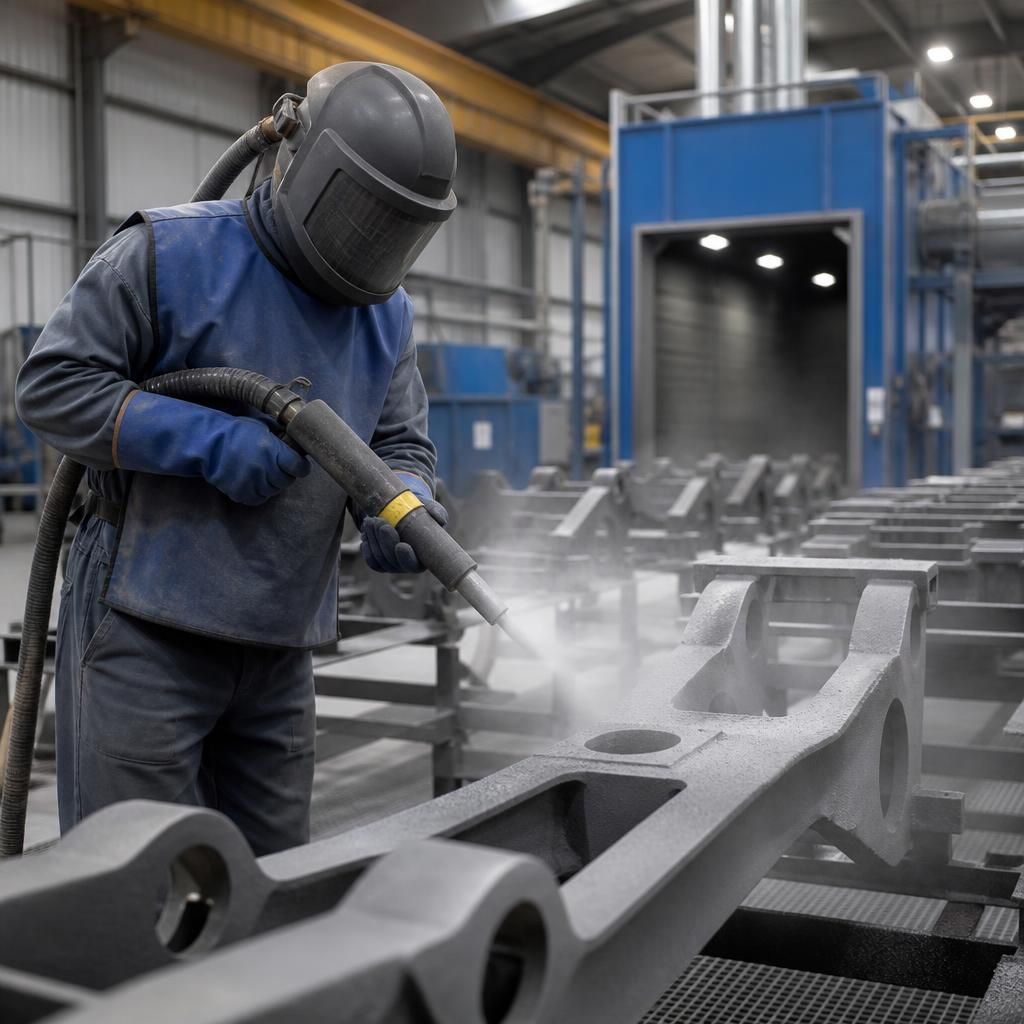
The investment value of outsourced abrasive blast cleaning should be compared with the full cost of carrying out the process internally, not only with an external service charge. An internal option may require blast equipment, extraction and containment systems, suitable workspace, operator training, maintenance, abrasive replenishment, waste handling and process controls. These costs can be significant even when the equipment is not used continuously.
For a fair comparison, calculate the cost of each viable route against the expected production volume and level of technical control required. Outsourcing may be commercially suitable where demand is variable, specialist preparation is needed or dedicating floor space and personnel would reduce manufacturing flexibility. Internal processing may be worth considering where work is frequent and consistent, provided the site can manage the required safety, environmental and quality obligations. The relevant measure is the total cost of producing compliant, powder-coatable parts through each option, including the resources needed to sustain the process.
Discuss Your Abrasive Blast Cleaning Project
Discuss your abrasive blast cleaning project with our team and provide the component details, substrate information and powder-coating requirements needed to assess the preparation scope. We can help clarify the most suitable service approach for your industrial parts.