

What specific abrasive materials does Hamilton Industrial Powder Coating select for different metal types to optimise coating adhesion?
Hamilton Industrial Powder Coating matches the abrasive to each metal’s hardness, surface condition and contamination risk: angular steel grit is suitable for robust carbon-steel components, while aluminium oxide or glass bead is preferred for aluminium, stainless steel and other non-ferrous metals where ferrous contamination must be avoided. Softer or galvanised surfaces require a gentler, non-metallic medium and controlled blasting to create a suitable key without damaging the substrate.
Abrasive selection is based on the substrate, the coating already present, the level of contamination and the surface profile required by the powder system. Hamilton Industrial Powder Coating assesses these factors before blasting rather than using one medium for every component. The objective is to remove rust, mill scale, old finishes, oil and other contaminants while leaving a clean, suitably keyed surface for powder application.
Carbon steel generally permits a more aggressive approach because the substrate is relatively hard and resistant to deformation. Steel grit is suitable where firmly bonded scale, corrosion or previous coating must be removed, particularly on robust fabricated parts. The grit grade and blasting intensity still need to reflect the component’s thickness, geometry and required profile. Excessive impact can distort thin sections, round sharp edges or create a profile deeper than the powder coating can reliably cover.
Stainless steel requires careful control because embedded ferrous particles can undermine corrosion resistance and appear later as staining or rust contamination. A non-ferrous medium, such as aluminium oxide or glass bead, can be selected to prepare the surface without introducing ordinary steel particles. The choice depends on whether the priority is stronger coating keying or a lighter cleaning action. Dedicated or suitably controlled blasting equipment may also be necessary where cross-contamination from carbon-steel work is a concern.
Aluminium is softer than steel and can be marked, peened or distorted by an overly aggressive abrasive. Aluminium oxide may be used where a defined profile is needed, while glass bead is appropriate where a gentler treatment is more suitable. Pressure, nozzle distance and dwell time are controlled so that the surface is prepared without unnecessarily removing material or altering close-tolerance features. Ferrous abrasives are avoided where they could contaminate the aluminium.
Galvanised steel needs a particularly measured treatment. The zinc layer is part of the corrosion-protection system, so blasting must remove dirt, oxidation and unstable material without stripping sound galvanising indiscriminately. A gentler, non-metallic abrasive and reduced blasting intensity can be appropriate, with the process adjusted according to the condition and thickness of the zinc coating. Areas of exposed steel, damaged galvanising and welds may require different attention from intact coated areas.
Copper, brass and other softer non-ferrous metals are also assessed for susceptibility to indentation and dimensional change. Fine non-metallic media or glass bead may be preferred when the requirement is to clean and provide a controlled key rather than cut deeply into the surface. Decorative, machined or close-fitting faces need particular care because an unsuitable abrasive can change their appearance or affect assembly tolerances.
The condition of the component can alter the initial choice. Heavy corrosion and tightly adhered scale may need a cutting abrasive capable of breaking the contamination away, whereas lightly soiled or previously prepared metal may only need a less aggressive cleaning treatment. Existing powder coating, wet paint, weld spatter and fabrication residues are considered separately because they do not all respond in the same way to the same abrasive.
- Hardness: harder substrates and firmly bonded contamination can tolerate or require more cutting action.
- Surface sensitivity: thin, soft or finely machined parts need lower-impact preparation.
- Contamination control: non-ferrous metals may require media that will not introduce iron particles.
- Required profile: the abrasive must create enough texture for mechanical adhesion without producing excessive peaks and valleys.
- Component geometry: recesses, edges, welds, holes and internal faces influence access and the risk of uneven preparation.
For assemblies containing more than one metal, the selection has to protect the most sensitive substrate while still dealing with contamination on the harder sections. Masking, selective blasting or separate treatment may be appropriate where a single setting would damage one material or leave another inadequately prepared. The condition of the surface is then checked for remaining scale, oil, dust, embedded abrasive and inconsistent texture before powder coating proceeds.
Abrasive choice is therefore only one part of adhesion control. Media condition, cleanliness, blasting pressure, nozzle angle, travel speed and the time between blasting and coating all affect the result. Hamilton Industrial Powder Coating uses the material assessment and the observed condition of each component to adjust the preparation method, helping ensure that the selected abrasive produces a clean, compatible and consistently profiled surface for the specified powder coating.
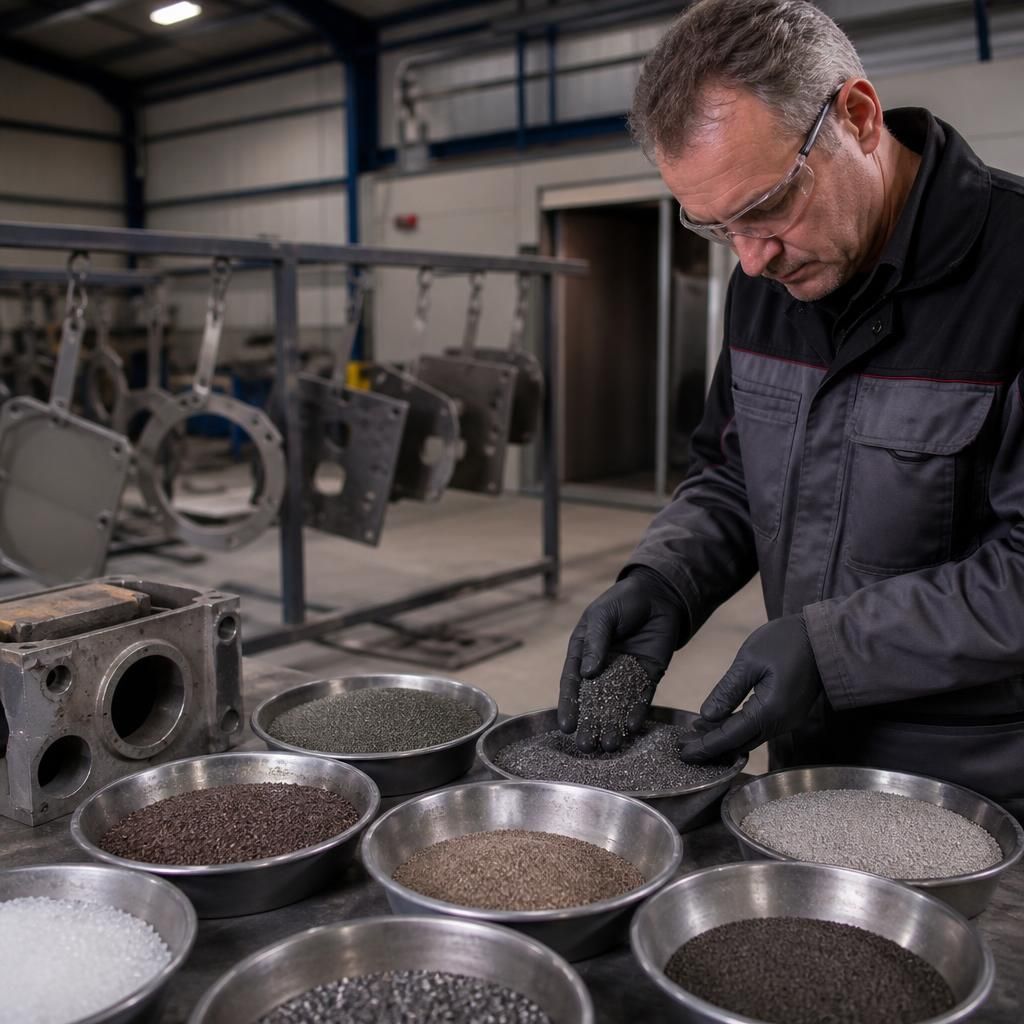
Abrasive selection can also depend on whether the medium is suitable for recovery and reuse. Reusable media may be appropriate for compatible, repeatable work, while a disposable non-metallic abrasive can be preferable where recovered particles could carry contamination from another substrate. This is particularly relevant when a batch combines ferrous and non-ferrous components, because uncontrolled reuse may transfer unwanted particles between jobs.
Hamilton Industrial Powder Coating therefore considers the abrasive’s breakdown behaviour, cleanliness and recovery route alongside its cutting action. The selected medium must remain consistent throughout preparation and must not introduce residues that compromise the specified powder coating system.