

What safety measures should be considered during blasting and surface preparation?
Safety during blasting and surface preparation depends on a documented risk assessment, trained operators, suitable personal protective equipment (PPE), controlled access to the work area and effective ventilation or extraction. Equipment should be inspected before use, abrasive dust contained, and the workpiece and surrounding area checked to control risks from noise, airborne particles, pressurised equipment and hazardous residues.
Safe blasting and surface preparation require controls that address the abrasive, the equipment, the metal being treated and the people nearby. In addition to basic site controls, effective practice includes checking the abrasive’s hazards, preventing unexpected energy release, managing contaminated residues, maintaining clear communication and preparing for foreseeable emergencies.
Assess the abrasive and surface contamination. The safety information for the selected abrasive should be reviewed before work begins. Some materials can generate hazardous dust, while old coatings, plating, oils, corrosion products or previous treatments may introduce additional risks. Where the coating history is uncertain, the material should be identified or tested before blasting. Abrasives containing respirable crystalline silica require particular caution, and a less hazardous alternative may be appropriate where the process allows it.
Control exposure through a suitable health plan. A written control system should identify who may be exposed, how exposure is limited and what monitoring is required. Operators who regularly carry out dusty or noisy work may need health surveillance appropriate to the hazards, such as checks relating to respiratory function, hearing or skin condition. Records of training, assessments, inspections and any required surveillance should be maintained and reviewed when the process or materials change.
Use respiratory and hearing protection correctly. Respiratory protective equipment must be selected for the contaminant and the blasting method, rather than treated as a standard item for every task. Tight-fitting equipment needs a suitable face-fit test, and users must be clean-shaven where the seal depends on facial contact. Hearing protection should match the noise exposure and be worn consistently in designated areas. Protective clothing also needs to be cleaned or replaced in a way that prevents abrasive dust being carried into clean areas.
Make the blasting system mechanically secure. Before pressurising the system, operators should check the blast pot, hoses, couplings, nozzle, deadman control and pressure gauges for damage, wear or incorrect assembly. Hoses should be routed to avoid sharp bends, vehicle routes and trip hazards, with connections secured against separation. The control should be designed so that abrasive flow stops when the operator releases it. The system must be depressurised before clearing blockages, changing a nozzle, disconnecting a hose or carrying out maintenance; isolation and lock-off procedures prevent another person from re-energising it unexpectedly.
Prevent unintended movement and electrical hazards. The workpiece should be supported on stable fixtures capable of handling the forces produced during blasting. Rotating, suspended or awkward components may need additional restraints, and lifting equipment should not be used beyond its rated capacity. Electrical equipment, lighting and earthing arrangements should be suitable for the environment. Static discharge, damaged cables and conductive dust can create additional hazards, so electrical checks should form part of the work instruction.
Separate people from the process. The blasting zone should have a clearly defined boundary, with entry restricted to authorised personnel. Signs, barriers and a communication method between the operator and anyone controlling access help prevent doors being opened or people entering during operation. Other workers should not rely on hearing a warning over the noise. Where the item is large or the process is carried out in stages, the team should agree signals and stopping arrangements before work starts.
Prepare for fire, spills and first-aid events. Oils, solvents and combustible residues should be removed or managed before abrasive work begins, particularly where they may create a fire or reaction risk. Suitable extinguishing equipment, first-aid supplies, emergency contact arrangements and unobstructed escape routes should be available. The procedure should cover incidents such as a burst hose, loss of control, eye contamination, breathing difficulty, entanglement or a person entering the restricted area. Operators should know how to stop the equipment safely before attempting to assist.
Handle waste and residues safely. Spent abrasive and removed coating should be collected without creating a secondary dust cloud. Waste should be placed in suitable containers, labelled where necessary and assessed for the substances removed from the component. Compressed air should not be used to blow dust from clothing, skin, machinery or floors, as this can re-suspend contaminants and spread them beyond the work area. Cleaning methods and waste arrangements should be defined before blasting begins.
Inspect the area after blasting. The work is not complete when the abrasive stream stops. The operator should confirm that the system is isolated, the component is stable and loose abrasive has been removed from ledges, cavities, walkways and equipment. The surface should be checked for sharp edges, trapped media, unstable scale or residues that could affect subsequent handling and coating. A final housekeeping check reduces slip, trip, contamination and hand-injury risks for the next person working on the component.
Maintain competence and review the controls. Operators should receive instruction in the specific blasting equipment, abrasive, substrate and coating residues involved, with practical supervision until they can follow the safe system consistently. Refresher training is appropriate after an incident, equipment change or process modification. Near misses and defects should be recorded, investigated and used to improve procedures rather than treated as isolated events.
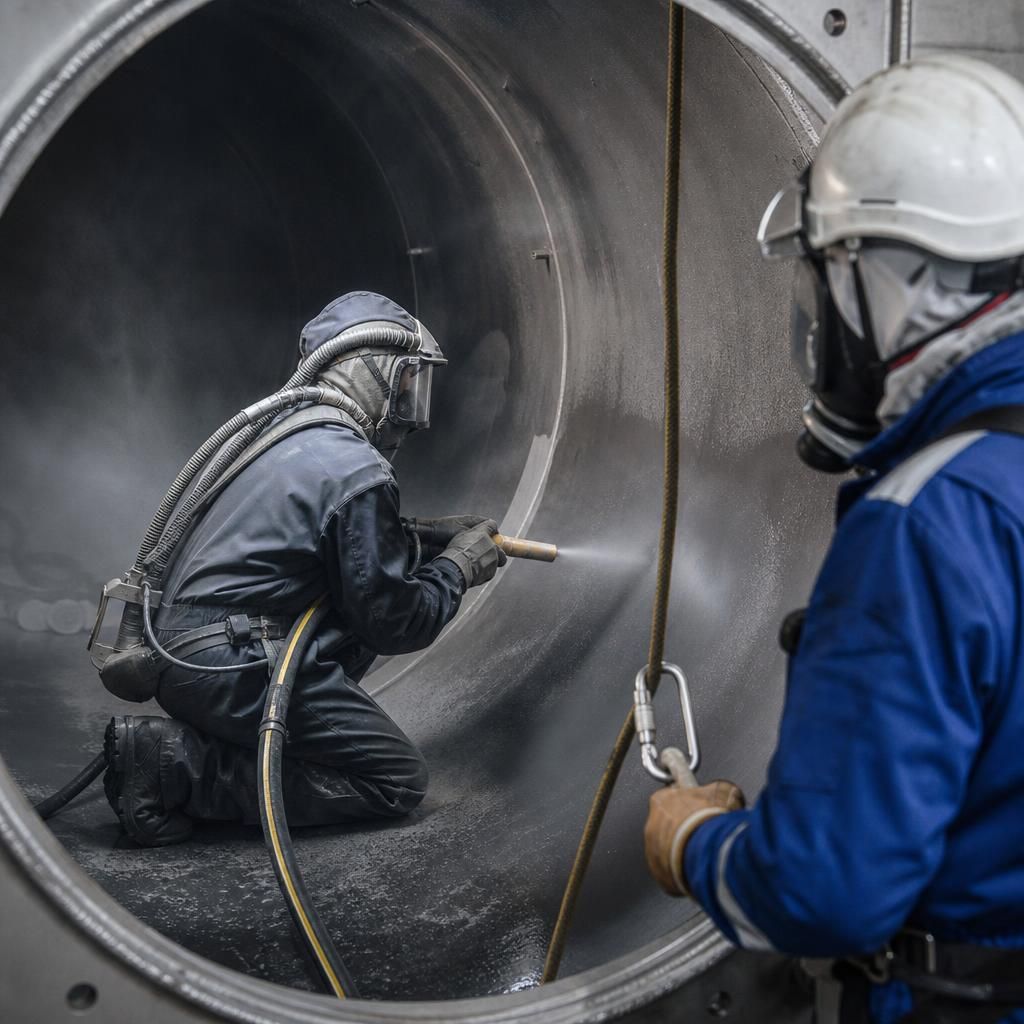
Blasting inside tanks, vessels or other enclosed areas requires additional confined-space controls rather than relying on the normal blasting procedure. Before entry, the space should be assessed for restricted access, oxygen levels, toxic residues, dust accumulation and the ability to escape without assistance. Where entry is permitted, the work should use an authorised entry system, continuous communication, suitable atmospheric monitoring and a rescue plan that does not depend on an unprotected colleague entering the space. Ventilation must be arranged so it does not introduce further contamination or compromise the operator’s breathing zone.
Discuss your blasting and surface preparation requirements
Discuss your blasting and surface preparation requirements with the powder-coating team, including the component material, existing finish and intended coating system. This helps establish an appropriate preparation approach before work begins.