

What are the critical steps involved in effective surface preparation and blasting for ensuring long-lasting powder coating adhesion?
Effective preparation involves inspecting the metal, removing oil, grease, rust and existing contamination, then abrasive blasting to create a clean, consistent surface profile. The blasted component must be thoroughly de-dusted and handled without recontamination before powder is applied, so the coating can form a strong mechanical and chemical bond.
Effective surface preparation and blasting is a controlled, documented process that links the coating specification to the condition of the metal, the required surface profile, and the conditions at the point of powder application. Long-lasting adhesion depends not only on producing a visibly clean surface, but also on choosing suitable preparation methods, controlling the blasting process, treating vulnerable areas correctly and verifying each stage before coating.
- Confirm the coating requirements first. The intended service environment, substrate, powder system and required finish should determine the preparation route. Parts exposed to moisture, chemicals, abrasion or outdoor conditions may require a different level of preparation from components used in a dry indoor setting. The specification should also identify areas that must remain uncoated, acceptable cosmetic limits and whether existing dimensions, threads or mating surfaces must be protected.
- Assess the component’s construction and condition. Welds, sharp edges, crevices, folds, drilled holes and enclosed sections can behave differently during blasting and coating. Weld spatter and abrupt edges can create weak points, while trapped moisture or residues in joints can undermine adhesion later. Fabrication defects should be addressed before blasting because coating is not a substitute for sound metal preparation or repair.
- Prepare masking and handling arrangements. Threads, bearing seats, electrical contact points, precision bores and other exclusion zones need suitable masking before abrasive work or powder application. Parts should be supported so that the blast stream reaches relevant faces without creating shadowed areas. Handling methods must also avoid damaging prepared surfaces or depositing residues on them before coating.
- Select and control the blasting method. Abrasive type, particle size, air pressure, nozzle distance, angle and travel speed all affect the result. The settings should be appropriate to the metal and component geometry: excessive force can erode edges, distort thin sections or create an unnecessarily rough surface, while insufficient action may leave poorly prepared areas. Consistent nozzle movement and access are important for producing an even profile across the complete coating area.
- Verify the surface profile rather than relying only on appearance. A suitable profile gives the powder coating a mechanical key, but an excessively deep or uneven profile can increase powder consumption, reduce visual uniformity or leave peaks insufficiently covered. Profile checks should be made using an appropriate comparison or measurement method, with results assessed against the coating system’s requirements. Areas that do not meet the specification should be corrected before progressing.
- Apply any required chemical pre-treatment correctly. Depending on the substrate and coating system, a conversion treatment or other pre-treatment may be used after blasting. Its effectiveness depends on correct concentration, contact time, rinsing and drying. Residues from chemicals or rinse water must not remain on the surface, and the prepared metal should be fully dry before powder is applied.
- Control the transition from preparation to coating. The interval between final preparation and powder application should be managed according to the metal, environment and risk of oxidation. Prepared parts must be kept away from dust, moisture, process residue and unclean contact surfaces. Clean gloves or suitable handling controls may be necessary where direct contact could transfer oils or salts back to the metal.
- Check the component immediately before coating. A final inspection should confirm that the surface is uniform, dry, correctly masked and free from visible defects, abrasive residue and handling marks. Particular attention is needed around welds, corners, recesses and difficult-to-reach sections, since these are common locations for inconsistent preparation. Any problem identified at this stage should be resolved rather than concealed beneath powder.
- Apply and cure the powder in accordance with the specification. Surface preparation cannot compensate for incorrect application or curing. Film build, part temperature, oven conditions and cure time should suit the powder manufacturer’s technical requirements and the component’s mass and geometry. Inadequate cure can reduce the coating’s performance even when the blast profile is correct, while excessive heat may affect the substrate, masking materials or dimensional tolerances.
- Record checks and inspect the finished result. Useful process records can include the preparation method, abrasive and equipment settings, profile observations, pre-coating checks and curing information. Finished parts should be examined for coverage, uniformity, defects and correct masking. Where required by the specification, additional tests such as dry-film thickness, adhesion or cure verification can provide evidence that the preparation and coating stages have achieved the intended result.
For batch work, repeatability is as important as the result on an individual component. The same preparation standard should be applied across different loads, with adjustments made for changes in alloy, thickness, geometry or the condition of incoming parts. Clear drawings, agreed acceptance criteria and feedback between the fabricator and coater help prevent incompatible preparation requirements from reaching production.
In practice, the most reliable approach is to treat blasting as one part of a complete surface-preparation system. Specification, component design, masking, equipment control, profile verification, pre-treatment, clean handling, curing and inspection all influence adhesion. If one stage is poorly controlled, a visually attractive finish may still develop premature lifting, blistering, flaking or corrosion-related failure.
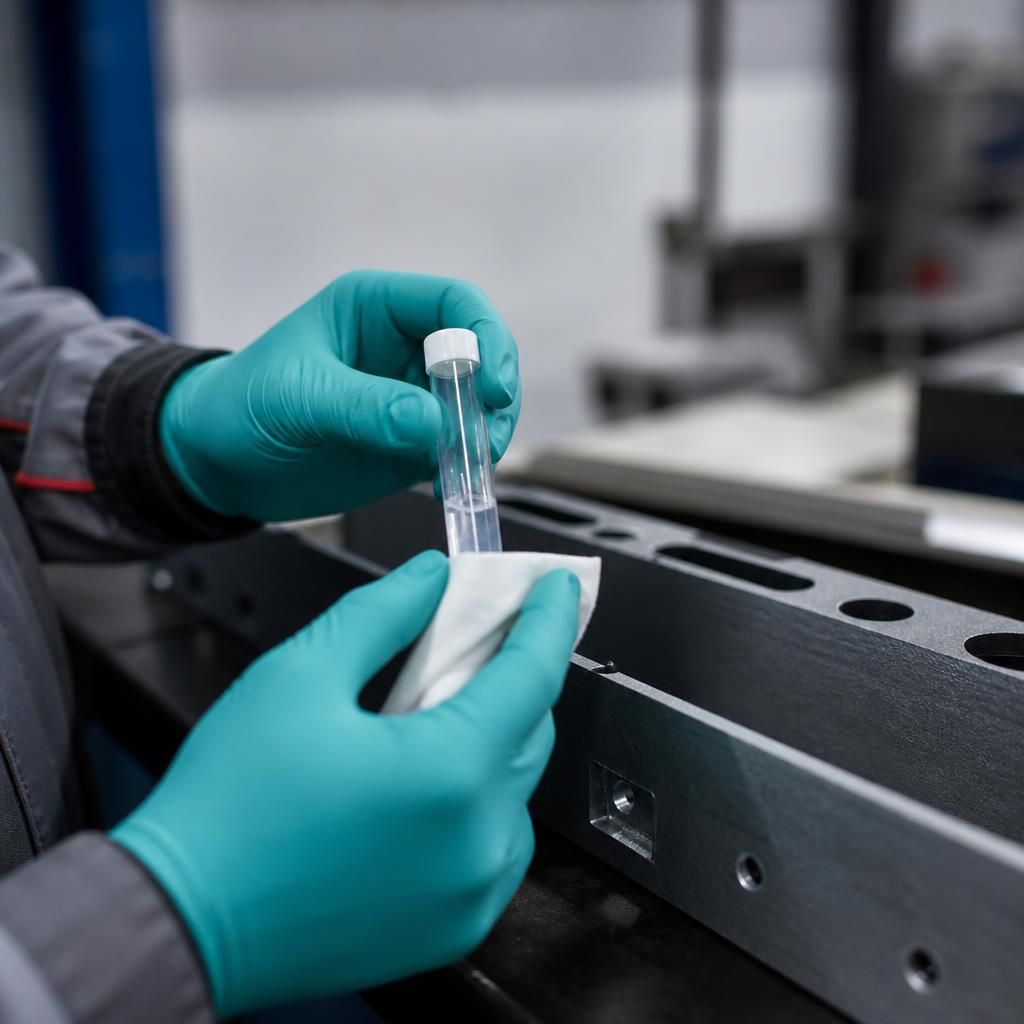
Effective surface preparation must address invisible contamination as well as visible dirt, rust and old coating. Soluble salts left on the metal can attract moisture beneath the powder film, increasing the risk of blistering, corrosion and loss of adhesion even when the blasted surface appears clean.
For components exposed to moisture or corrosive conditions, the prepared surface should be assessed using a suitable soluble-salt test where required by the coating specification. If residues exceed the agreed acceptance level, the part should be cleaned and dried again before coating. This additional check is particularly valuable for items that have been stored outdoors, handled extensively or exposed to process fluids before reaching the coating stage.