

What specific surface conditions should be evaluated before choosing a sandblasting solution?
Before choosing a sandblasting solution, assess the metal substrate, existing coatings, rust or scale, oil and other contaminants, surface profile, component thickness and geometry. These conditions determine the suitable abrasive, blasting pressure and technique while helping prevent distortion, incomplete preparation or damage to the underlying metal.
Choosing a sandblasting solution requires evaluating the surface’s moisture condition, soluble salts, welds, edges, repairs, defects and areas that are difficult to access. These factors affect whether blasting can proceed safely, which abrasive and technique are suitable, and whether additional preparation is needed before coating.
Moisture and condensation
Check whether the component is damp or likely to develop condensation during preparation. Water on the surface can interfere with abrasive action, encourage rapid flash rusting on susceptible steel and reduce the consistency of the prepared finish. A surface may appear dry while still being affected by storage in a humid environment, contact with wet floors or temperature changes. The inspection should therefore consider both visible moisture and the conditions in which the component has been stored.
Soluble salts and previous exposure
Components exposed to road spray, marine conditions, de-icing materials, process chemicals or outdoor storage may carry soluble salts that are not always visible. Blasting can remove some surface deposits, but embedded or retained salts may remain and later draw moisture through a coating. Where this type of exposure is possible, the preparation specification should include an appropriate method of checking and treating salt contamination rather than relying on visual inspection alone.
Welds, joints and fabricated details
Inspect weld beads, heat-affected areas, lap joints, corners and crevices separately from the main face of the component. Weld spatter, slag residues, sharp projections and uneven weld profiles can affect abrasive access and create weak points in a subsequent coating system. Crevices may also retain moisture or processing residue. These areas may require mechanical dressing, deburring or a modified blasting approach before the main preparation takes place.
Edges, burrs and sharp transitions
Sharp edges and punched or cut sections deserve particular attention. Abrasive impact can leave thin edges less uniformly prepared than broad flat faces, while burrs may remain attached or become more pronounced after cleaning. If the finished part requires consistent coverage around an edge, edge condition should be addressed before blasting. Removing loose burrs and defining acceptable edge treatment helps avoid relying on blasting to correct a fabrication defect.
Surface defects and repairs
Look for pits, laminations, scratches, dents, gouges, grinder marks, weld repairs and areas filled or dressed during fabrication. Sandblasting cleans and textures a surface; it does not restore missing metal or remove every physical defect. Deeper imperfections may remain visible after preparation and can influence both the appearance and service performance of the finished coating. The decision should be made in advance about whether such defects are acceptable, need repair or require a different preparation sequence.
Residues from manufacture and handling
Although the surface may look generally clean, manufacturing processes can leave residues in seams, recesses and around fixings. Cutting operations, marking products, protective films, handling equipment and temporary storage materials may all affect the preparation requirement. Identify where residues are concentrated and whether they are loose, bonded or liable to spread during blasting. Heavy or sticky deposits may need removal before abrasive preparation so that the abrasive can act directly on the surface.
Accessibility and masking requirements
Assess whether the abrasive can reach internal faces, narrow channels, drilled holes, recesses and areas close to attached fittings. Restricted access can produce an inconsistent result even when the exposed faces are prepared correctly. Components should also be checked for threads, precision interfaces, machined seats, nameplates and other areas that must not receive abrasive or coating. These features may require masking, plugs or a defined exclusion zone, which should be included when selecting the process.
Variation across a batch
Do not assume that every item in a batch has the same preparation requirement. Parts made from different stock, stored under different conditions or subjected to different fabrication steps may present noticeably different conditions. Inspect representative items and identify the most demanding areas before setting the blasting specification. This helps prevent a process chosen for an easy sample from being unsuitable for more difficult pieces.
What the inspection should establish
- Whether the surface is dry and suitable for preparation.
- Whether salts or other residues require testing or preliminary treatment.
- Whether welds, burrs and sharp edges need dressing before blasting.
- Whether physical defects should be repaired or accepted as part of the finished appearance.
- Whether every required face can be reached without damaging protected features.
- Whether different areas or items need separate preparation settings.
The inspection findings should be recorded with photographs, marked-up drawings or a written preparation specification where the component is complex. Sharing details such as the material condition, affected areas, access restrictions and required finish allows the blasting method to be selected for the actual part rather than an assumed surface. Where the condition is uncertain, a test area or trial component can help confirm that the chosen process produces the required preparation without adversely affecting the component.
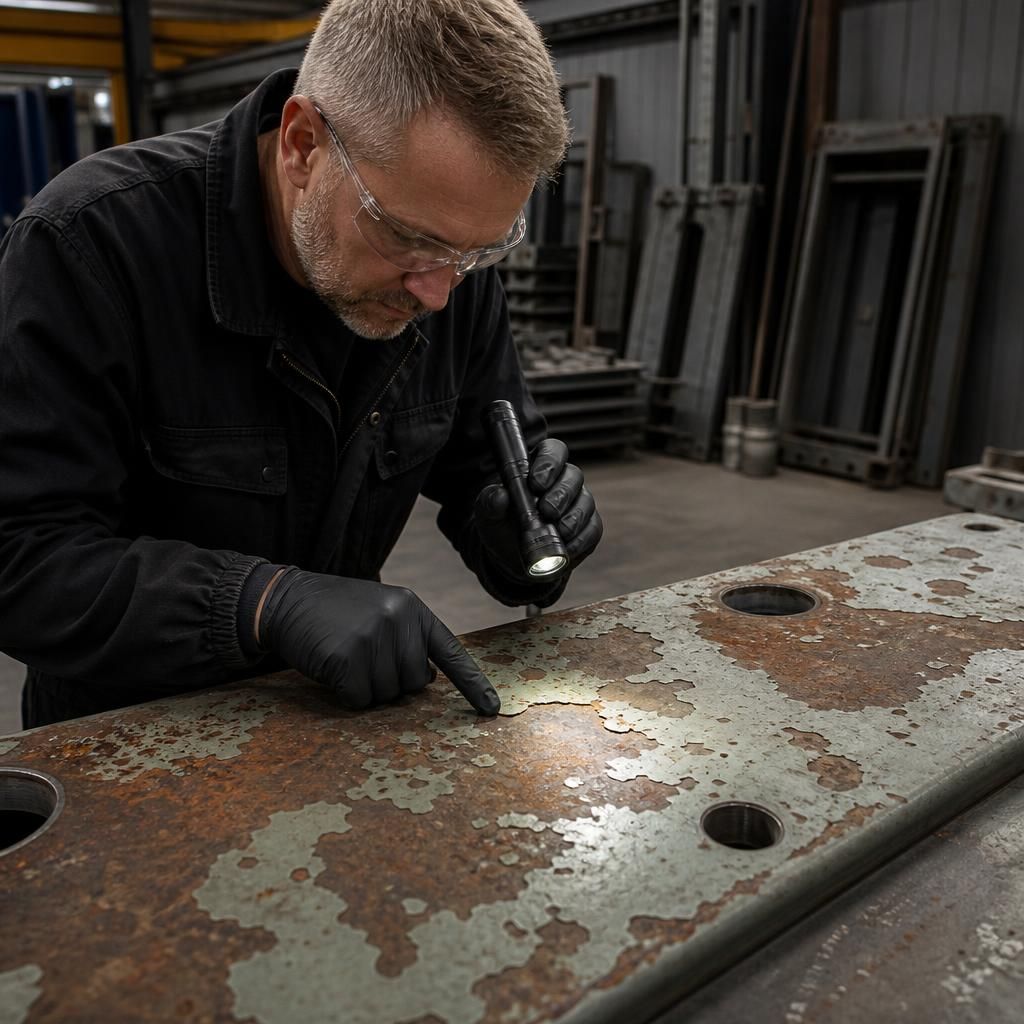
The condition and composition of any existing coating should be assessed before selecting a sandblasting solution. A firmly bonded, thin coating may require a different approach from a thick, brittle or poorly adhered layer, particularly where the objective is to remove the coating completely rather than prepare it for overcoating.
Check for peeling areas, multiple coating layers, concealed corrosion and differences between exposed metal and coated sections. A small test area can help establish whether the selected abrasive and blasting intensity remove the unwanted coating without unnecessarily working the substrate. If the coating’s composition is unknown, it should also be identified before preparation so that appropriate controls can be included in the blasting specification.