

What is the optimal blasting media for different metal surfaces?
The optimal blasting media depends on the metal’s hardness, condition and sensitivity to deformation: steel commonly suits steel grit or aluminium oxide, while aluminium and other softer metals are better matched with glass bead, fine aluminium oxide or another non-ferrous abrasive. The chosen media should remove rust, scale or old coating without embedding abrasive or changing the component’s profile needed for powder coating.
The optimal blasting media is the one that removes contamination and creates a suitable key without distorting, embedding or chemically contaminating the metal. Carbon steel generally tolerates more aggressive abrasive action than aluminium, zinc-coated steel, stainless steel or copper alloys, so the correct choice must reflect both the substrate and the finish required for subsequent powder coating.
Carbon and mild steel
Carbon steel can be treated with angular steel grit, aluminium oxide or other hard mineral abrasives when rust, mill scale or firmly bonded old coating needs to be removed. Angular media cuts into the surface and produces a more pronounced profile for coating adhesion. Steel grit is useful where substantial scale or corrosion is present, while aluminium oxide provides a non-ferrous alternative and can be selected where avoiding ferrous residue is important.
Steel shot is different from steel grit: its rounded shape peens and cleans the surface rather than cutting a sharp profile. It may suit cleaning and smoothing operations, but it is not automatically the best choice where the powder coating system requires a clearly defined anchor pattern. The condition of the steel should therefore be assessed before selecting shot instead of grit.
Stainless steel
Stainless steel is usually prepared with clean, non-ferrous media such as aluminium oxide, glass bead or a suitable mineral abrasive. The main concern is cross-contamination. Ferrous particles left on stainless steel can later oxidise on the surface and undermine the appearance of the coating, even though the base metal itself is corrosion-resistant.
Glass bead gives a comparatively gentle cleaning action and can be appropriate where the stainless surface must retain a controlled, relatively fine finish. Aluminium oxide is more suitable when heavier contamination or a stronger profile is required. Equipment, recovery systems and storage areas should also be kept free from carbon-steel abrasive when stainless components are being processed.
Aluminium
Aluminium is relatively soft and can be marked, distorted or excessively roughened by coarse, high-impact abrasive. Glass bead, fine aluminium oxide, plastic media or another carefully controlled non-ferrous abrasive is normally more appropriate than a highly aggressive steel grit.
The objective is to remove oxide, dirt and previous coating while preserving dimensional accuracy and avoiding deep cutting. Particular care is needed around thin sections, edges, fins, threads and machined faces. A media that is suitable for a robust aluminium casting may be unsuitable for a thin fabricated panel, so the component’s thickness and geometry should be considered alongside the alloy.
Galvanised and zinc-coated steel
Galvanised surfaces require controlled preparation because the zinc layer is part of the corrosion protection. Aggressive blasting can strip too much coating or expose the steel beneath it. Fine glass bead, plastic media or a light application of another non-metallic abrasive may be selected to remove surface contamination and provide a suitable preparation without unnecessarily removing the zinc.
Existing corrosion, white oxidation products and the condition of the zinc layer should be checked first. Areas where the coating has already failed may need a different treatment from intact areas. The selected preparation should also be compatible with the powder coating system, since excessive damage to the zinc can affect both appearance and long-term protection.
Cast iron
Cast iron can contain moulding residue, scale, graphite-rich areas and corrosion within pores. Aluminium oxide or angular steel grit may be appropriate where a firm, cutting action is needed, although the abrasive must be chosen according to the casting’s surface condition and the required finish.
Blasting does not remove oil that has penetrated into porous cast iron. If oil or grease is present, degreasing and suitable drying are required before abrasive preparation. Otherwise, contamination can reappear during or after coating and cause defects such as poor adhesion or surface cratering.
Copper, brass and other soft non-ferrous alloys
Copper and brass can be damaged by aggressive media, and their surface appearance can change quickly under abrasive impact. Glass bead or plastic media is often considered where gentle cleaning is needed, while a finer mineral abrasive may be used when more coating or oxidation must be removed.
Ferrous media should generally be avoided unless there is a specific, controlled reason to use it. Embedded iron particles can create staining and introduce corrosion-related defects beneath a later coating. A trial on a representative area is particularly useful for decorative or finely machined components.
How the required finish changes the choice
The substrate alone does not determine the answer. The abrasive must also be matched to:
- the type and thickness of rust, scale, oxide or existing coating;
- the surface profile specified by the powder coating system;
- the component’s thickness, edges, holes, threads and tolerance requirements;
- whether ferrous contamination is acceptable;
- the required visual appearance beneath the powder coating; and
- whether the abrasive can be fully removed from recesses and cavities.
Angular abrasives generally provide more cutting action and profile, whereas rounded or softer media provide gentler cleaning with less risk of altering the surface. Coarse media is not automatically more effective: it may remove contamination quickly but can damage thin sections, exaggerate surface defects or leave a profile that is unsuitable for the coating specification.
Verification before full production
For unfamiliar components or mixed batches, the safest approach is to test the proposed media on a representative sample. The prepared surface should be inspected for remaining corrosion, embedded abrasive, excessive roughness, distortion and contamination. Recesses, welds and edges deserve particular attention because they can retain residues or receive a different blasting action from broad flat areas.
After blasting, the component should be protected from handling contamination and prepared for powder coating in line with the agreed process. The best media is therefore not simply the hardest or fastest option; it is the one that delivers the required cleanliness and profile while preserving the metal’s dimensions, chemistry and intended appearance.
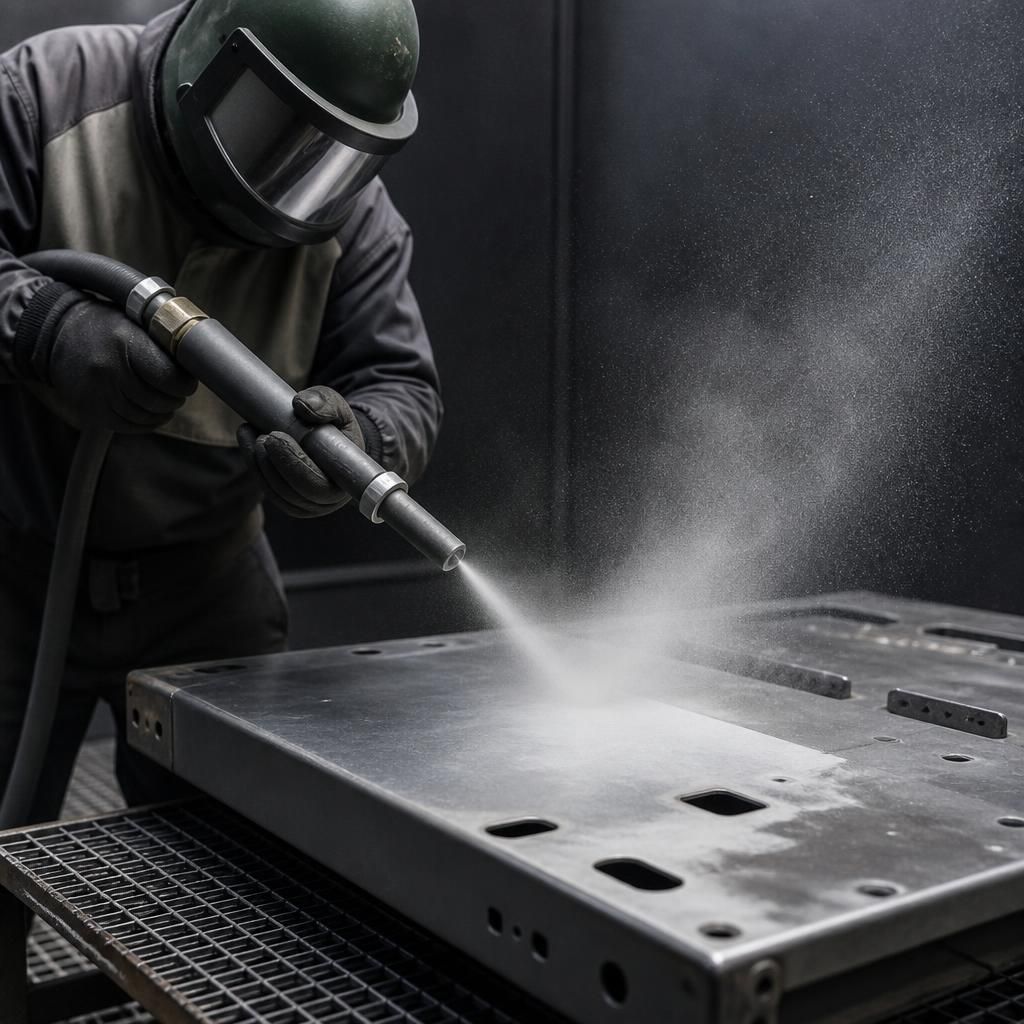
The same blasting media can produce different results when application conditions change. Abrasive size, nozzle pressure, blasting angle, stand-off distance and dwell time all affect the resulting surface profile, so media selection should be considered alongside the equipment settings.
- Higher impact can deepen the profile or damage thin sections.
- A shallow blasting angle may clean more gradually, while a direct impact gives greater cutting action.
- Excessive dwell time can create uneven preparation, particularly around edges and welds.
For powder coating work, the prepared surface should be checked against the coating specification rather than judged by appearance alone. A controlled trial allows the operator to adjust the media and blasting parameters together, producing consistent preparation across the component without unnecessarily changing its dimensions or texture.
Discuss the Right Blasting Media for Your Metal Surfaces
Discuss your component’s material, condition and required coating finish with the powder-coating.co.uk team to identify a suitable blasting approach. Collection and delivery options are available for businesses across the Midlands and surrounding areas.