

What factors should be considered when selecting a sandblasting service provider?
When selecting a sandblasting service provider, assess its experience with comparable metal components, choice of blasting media and techniques, surface-preparation standards, inspection procedures and ability to handle your batch size safely. Also confirm how parts will be protected and transported, whether collection and delivery are available, and that the quotation clearly sets out preparation requirements, finish expectations and agreed timescales.
Select a sandblasting service provider by assessing its technical capability, control of the preparation process, compliance practices, documentation and ability to work to your component requirements. The lowest quotation is not necessarily the most suitable option if the provider cannot control the blast profile, protect critical features or demonstrate how work is checked and recorded.
Check whether the provider can assess the complete coating system. Sandblasting should be considered alongside the coating that will follow it, the metal substrate and the conditions in which the finished component will be used. Ask how the provider deals with factors such as:
- Different substrates, including steel, stainless steel, aluminium and cast components.
- Existing paint, rust, mill scale, weld discolouration, grease or other contaminants.
- Thin sections, sharp edges, threaded areas, machined faces and close-tolerance components.
- Holes, recesses, corners and complex geometries that may be difficult to clean consistently.
- Areas that must remain unblasted or meet a particular dimensional requirement.
A competent provider should identify potential problems before processing begins rather than treating every component in the same way. This assessment is particularly important where blasting could alter an edge, affect a mating surface or expose defects that were hidden by the previous finish.
Evaluate equipment and process control. The provider should have equipment appropriate to the size, weight, shape and production requirements of the parts. Relevant considerations include enclosure capacity, access for awkward components, abrasive recovery, dust extraction, pressure control and the means of supporting or rotating parts during processing. Equipment should allow the operator to work consistently across the whole component, not just on easily accessible faces.
Ask how process settings are controlled and how changes are authorised. Uncontrolled adjustments can produce inconsistent surface profiles or uneven cleaning between batches. Where components are being prepared for powder coating, the provider should understand that excessive blasting can be as unsuitable as insufficient preparation: one can affect dimensions or edges, while the other can leave contamination or a poorly keyed surface.
Ask what evidence supports the stated quality level. Useful records may include job instructions, component identification, process details, preparation results and any agreed acceptance criteria. Traceability helps link a finished batch to the relevant drawings, specifications and processing records. It also makes it easier to investigate a concern if a part is later found to have an unclean area, inconsistent texture or damage.
Find out how non-conforming work is handled. A reliable provider should have a defined approach for identifying, quarantining and discussing parts that do not meet the agreed requirements. This is more useful than relying solely on a general statement that work is checked, because it shows what happens when the result is outside specification.
Review safety and environmental controls. Abrasive blasting creates dust, noise and spent abrasive, so the provider should be able to explain how these risks are controlled. Consider whether it has suitable:
- Enclosures and extraction systems to control airborne dust.
- Operator training, protective equipment and procedures for safe handling.
- Controls for noise, pressure equipment and the movement of heavy components.
- Waste segregation, storage and disposal arrangements for spent abrasive and removed coatings.
- Procedures for coatings or residues that may require particular handling.
These points are relevant to both legal compliance and the protection of the components. Poor containment can contaminate surrounding areas, while inadequate waste controls may create additional environmental and disposal issues.
Confirm how technical information is exchanged. Provide accurate drawings, photographs, material details, dimensions, masking instructions and information about any critical faces or tolerances. The provider should be able to identify missing information and record agreed revisions. Clear document control reduces the risk of parts being processed against an outdated drawing or an assumption that was never approved.
It is also worth establishing who is responsible for decisions if the condition of the components differs from the information supplied. For example, heavily corroded areas, previously repaired sections or unexpected contaminants may require a revised approach. Agreeing an escalation process in advance prevents unsuitable work from continuing without consultation.
Compare commercial terms on a like-for-like basis. Quotations should make clear what is included in the preparation service and what may be charged separately. Check whether pricing is based on component size, weight, surface area, handling requirements, the condition of the parts or the number of processing stages. Clarify provisions for rework, rejected components, special masking, additional cleaning and changes to the supplied information.
A transparent quotation allows you to compare providers without mistaking a limited scope for a lower overall cost. It should also identify any requirements placed on your business, such as removing loose fittings, draining components or providing suitable lifting points.
Consider capacity and operational fit. A provider may be technically capable but unsuitable if its handling arrangements do not match your component dimensions, batch structure or production planning. Discuss how it organises different jobs, separates customer parts and maintains identification throughout the process. For recurring work, consider whether the provider can apply the same documented process to repeat batches and accommodate controlled revisions when the design changes.
For a Midlands manufacturer, fabricator, construction business or automotive supplier, a provider that combines suitable equipment, documented controls, safe waste handling and clear technical communication is generally a more dependable choice than one selected on price alone. Before appointing a supplier, compare its answers against your drawings, coating specification, component risks and quality requirements, and record any assumptions in the order documentation.
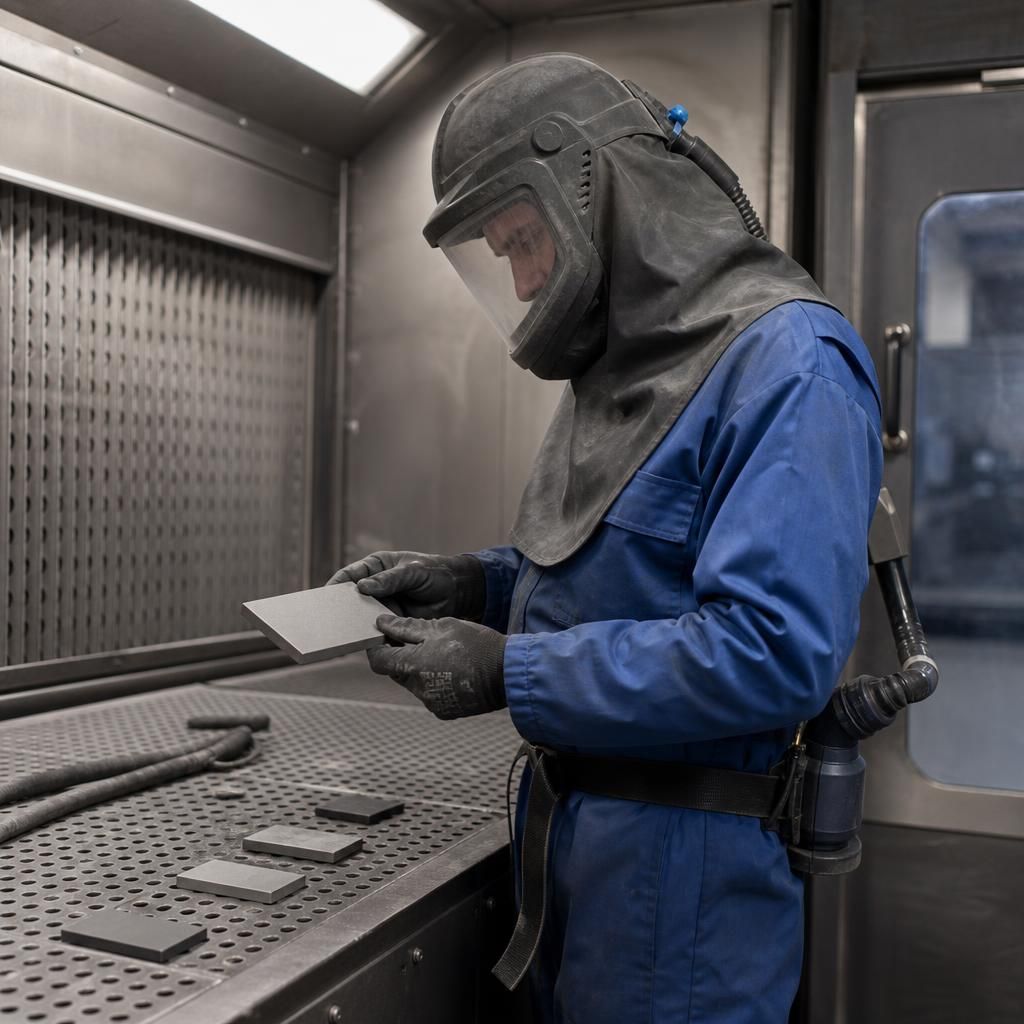
For critical or unfamiliar components, ask whether the sandblasting provider can process a representative trial piece or test coupon before the full batch. This allows you to examine the prepared surface and, where appropriate, assess the finished powder-coated result against the component’s appearance and performance requirements.
A trial is particularly useful when the substrate, existing coating or required texture is unusual. It can reveal whether the proposed abrasive and technique are suitable without committing the entire batch to an untested process. Agree what will be assessed, who will approve the result and how any required adjustment will be recorded before production work begins.