

What are the key considerations for choosing the right blasting media for your project?
Choosing the right blasting media depends on the metal substrate, existing coating or contamination, required surface profile, component geometry and the finish to be applied. Balance cleaning performance against the risk of distortion, embedment, excessive roughness, dust, waste and overall processing cost.
The right blasting media is selected by matching its physical properties and working behaviour to the component, the required surface condition and the coating system that follows. The decision should also account for operator safety, dust generation, waste handling, equipment compatibility and whether the result can be repeated consistently across the full batch.
Media hardness and cutting action determine how quickly a material removes unwanted layers and how aggressively it affects the surface beneath. Angular media cuts into residues and creates a more active surface, while rounded media tends to peen, polish or clean with a less pronounced cutting action. Harder media can be suitable for robust steelwork, but may be unnecessarily aggressive for softer alloys or thin sections. The aim is sufficient cleaning and keying without damaging the component.
Particle size and shape should be considered together. Coarse particles can process a large area efficiently but may leave a more pronounced texture. Fine particles are useful for smaller features and detailed areas, although they may require different nozzle settings and can produce more dust. Angular particles reach into pits and corners more readily; rounded particles are less likely to create sharp surface features. A mixed or poorly controlled size distribution can make the finish less uniform.
Media density and impact energy affect both productivity and the risk of deformation. Dense materials deliver greater impact at a given operating condition, whereas lighter materials can provide a gentler treatment. The choice should be assessed against sheet thickness, unsupported sections, folded parts, machined faces and tight tolerances. On delicate components, reducing pressure or using a less aggressive medium may be more appropriate than relying on operator technique alone.
Compatibility with the coating specification is essential. The blasted surface must be suitable for the powder coating system, service environment and appearance requirements. Media should not introduce residues, embedded particles or contaminants that could interfere with adhesion, colour, gloss or corrosion protection. Where a component has critical faces, threaded areas, bearing seats or electrical contact points, masking and media selection need to be considered as part of the same process rather than treated as separate decisions.
Cleanliness of the media can be as important as its cutting ability. Reused media may accumulate removed coating, oil, salts, moisture or metal particles. If that contamination is carried onto the workpiece, it can undermine the subsequent preparation stage. A suitable process therefore includes controlled storage, screening or separation where appropriate, and checks on media condition. New media should also be kept dry and protected from contamination before use.
Dust, occupational exposure and housekeeping must influence the choice. Some media create substantially more airborne dust than others, and the dust may include material removed from the component. The blasting method should be supported by suitable extraction, enclosure, personal protective equipment and workplace controls. In the UK, the process should be assessed under relevant health and safety procedures, including control of substances hazardous to health where applicable. A medium that performs well but creates unmanageable dust is not a practical choice.
Waste and environmental handling are also part of the specification. Spent media can contain paint, corrosion products, oils or other residues, so it should not be treated as clean waste without assessment. The expected consumption rate, opportunities for recovery and the disposal route can affect the overall environmental impact and processing cost. A less wasteful option is not automatically suitable if it compromises the required surface condition, but waste should be evaluated before the project begins.
Equipment and process control place practical limits on media selection. Check that the abrasive is suitable for the blast pot, feed system, hoses, nozzle and recovery equipment. Media flow, air pressure, nozzle distance, angle and traverse speed all influence the finished result. Changing the medium without reviewing these settings can lead to uneven cleaning, excessive roughness or inconsistent results between operators.
Before committing to a full production run, a controlled trial on representative material is advisable. The trial should assess:
- the visual cleanliness and consistency of the prepared surface;
- the resulting surface texture against the coating specification;
- any distortion, edge rounding, embedded particles or masked-area damage;
- dust levels, media consumption and ease of recovery;
- the appearance and performance of the applied coating after preparation; and
- whether the same settings can be reproduced across the component batch.
Acceptance criteria should be agreed before blasting starts. Depending on the project, this may involve visual standards, surface profile measurements, checks for visible residues and verification that critical dimensions remain within tolerance. Recording the selected medium, grade, equipment settings and inspection results helps maintain consistency when components are processed in stages or returned for future coating work.
For a B2B coating project, the most suitable media is therefore the one that provides the required preparation without creating avoidable damage, contamination, safety issues or waste. Sharing drawings, material details, coating requirements, tolerance information and any restrictions with the blasting provider allows the media and process to be assessed together rather than chosen on abrasive performance alone.
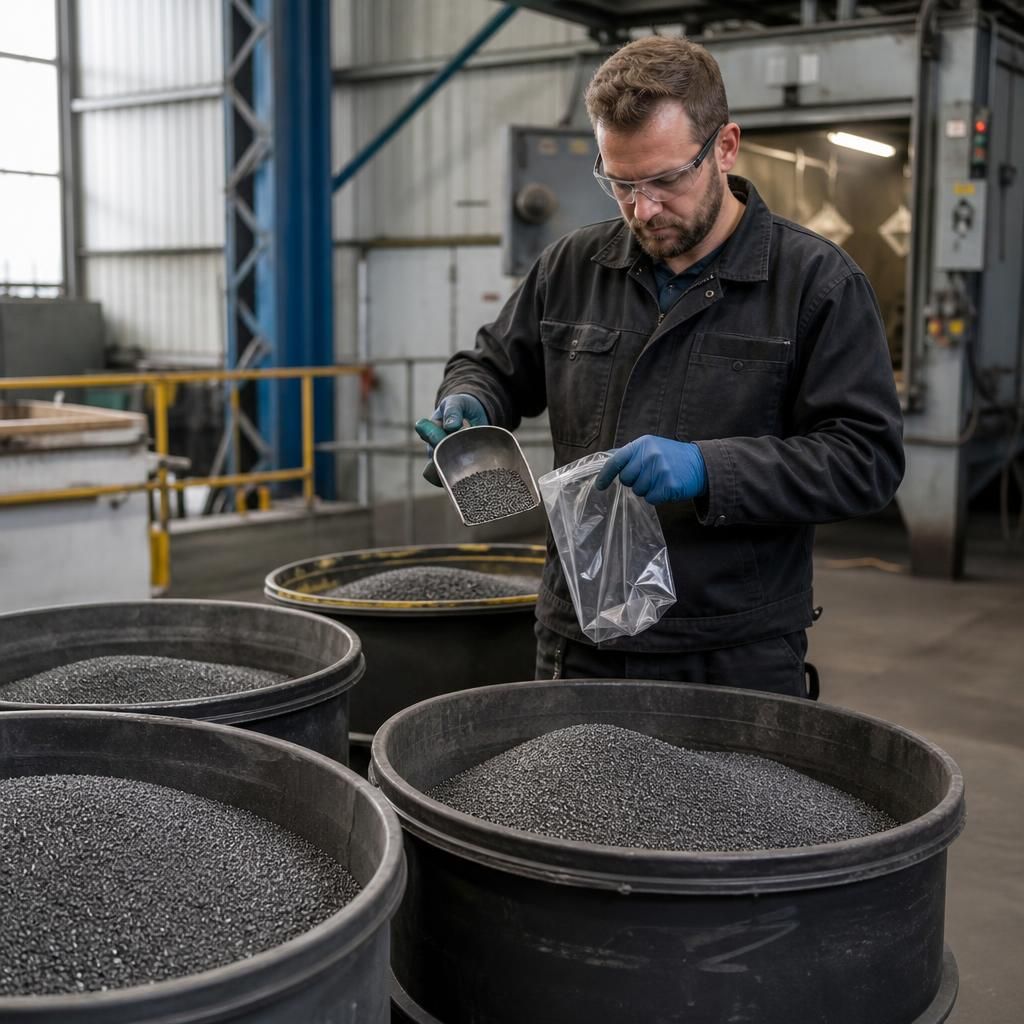
Consistency of the blasting media supply is an important project consideration, particularly when components are processed in separate batches. The same stated grade can produce different results if particle grading, shape or moisture content varies between deliveries. Confirm the media specification, permitted size range and condition requirements before production begins, and check that replacement material will match the original selection.
Keep the chosen media identifiable throughout the job rather than allowing different grades to be mixed inadvertently. Recording the media specification alongside the process settings makes it easier to investigate changes in surface appearance or coating performance. This is especially relevant where a uniform finish is required across components manufactured or blasted at different times.