

What are the benefits of using different blasting media in sandblasting?
Different blasting media provide varying levels of cleaning power, surface roughness and profile control, allowing the preparation process to be matched to the metal, coating and required finish. Selecting the appropriate medium can remove contaminants effectively while reducing the risk of distortion, excessive abrasion or an unsuitable surface for subsequent coating.
Using different blasting media allows the preparation process to be controlled according to the substrate, contamination, coating system and required working conditions. Each medium has distinct properties, including hardness, particle shape, density, reusability and dust generation, so the benefit is not simply stronger cleaning; it is greater control over how the surface is treated and what happens during the process.
Abrasive media for heavy-duty preparation
Hard, angular media such as aluminium oxide, garnet and certain mineral or slag abrasives are suited to removing firmly bonded rust, mill scale, old coatings and other difficult contamination. Their sharp edges cut into deposits and expose sound metal efficiently. This is useful where a component needs substantial preparation before a protective coating is applied, particularly when residues are too adherent for a gentler medium.
These abrasives can also produce a consistent anchor pattern when the process is correctly controlled. The resulting surface gives a coating something more substantial to key into than a smooth, contaminated or poorly prepared substrate. The appropriate grade still depends on the metal and the coating specification: a medium that is suitable for structural steel may be inappropriate for a thin fabricated part or a softer alloy.
Media for controlled cleaning and surface refinement
Glass bead is a rounded medium that cleans and refines the appearance of many metal surfaces without cutting as aggressively as angular grit. It can produce a more uniform satin or matt effect and is commonly considered where the visual condition of the substrate matters alongside cleanliness. Because it peens rather than cuts in the same way as angular particles, it may be useful for removing light oxidation, marking or residue from suitable components.
Steel shot is also rounded, while steel grit is angular. Shot is often selected for cleaning and work-hardening compatible steel parts, whereas grit provides a more cutting action. The possibility of recovering and reusing steel media can be an operational advantage in suitable enclosed blasting systems. It must, however, be matched to the equipment, component geometry and required surface condition, since its density and impact energy can be unsuitable for delicate work.
Media for softer or more sensitive substrates
Plastic media, walnut shell and other relatively soft abrasives provide a less aggressive alternative for applications where the underlying material or a retained feature must be protected. They can remove selected coatings, deposits or contaminants while reducing the likelihood of cutting deeply into the substrate. This makes them relevant to components with fine detail, thin sections or surfaces that must not be altered unnecessarily.
Soda-based media can be used for certain cleaning tasks where a relatively gentle action is required and minimal impact on the substrate is important. It is water-soluble, which can assist with removal after blasting, but its residues and the condition of the surface afterwards must be considered before coating. Not every soft medium is suitable for powder-coating preparation: the surface must still be clean, free from residues and capable of supporting the specified coating system.
Benefits of choosing the right particle characteristics
- Hardness: determines how readily the medium breaks through deposits and how likely it is to affect the underlying material.
- Particle shape: angular particles cut and create a more pronounced texture, while rounded particles provide a peening or refining action.
- Particle size: influences access to small recesses, the uniformity of treatment and the amount of texture produced.
- Density: affects impact energy, equipment settings and the suitability of the medium for lighter components.
- Reusability: some media can be recovered and cycled through blasting equipment, while others break down more quickly or are intended for single-pass use.
- Dust behaviour: the selected medium affects visibility, housekeeping, extraction requirements and the working environment.
Using an appropriate medium can therefore improve process consistency as well as the condition of individual parts. It may reduce the need for repeated treatment, prevent unnecessary alteration of profiles or edges and make it easier to achieve a finish that is compatible with the next stage. Those benefits depend on more than the abrasive itself: nozzle pressure, stand-off distance, angle, dwell time, media condition and the operator’s control of the equipment all influence the result.
Media selection should begin with an assessment of the component rather than a preference for one abrasive. Relevant questions include what the existing contamination consists of, whether the metal is mild steel, stainless steel, aluminium or another alloy, how thick and detailed the part is, whether any areas must remain masked, and what coating will follow. A small test area or sample component can help confirm that the chosen medium removes the required contamination without leaving an unsuitable residue or altering critical features.
For industrial powder-coating preparation, the preferred blasting medium is the one that delivers the required cleanliness and surface condition while remaining compatible with the material, equipment and downstream coating specification. Different media are valuable because they provide different levels of control across these variables, not because one type is universally better than another.
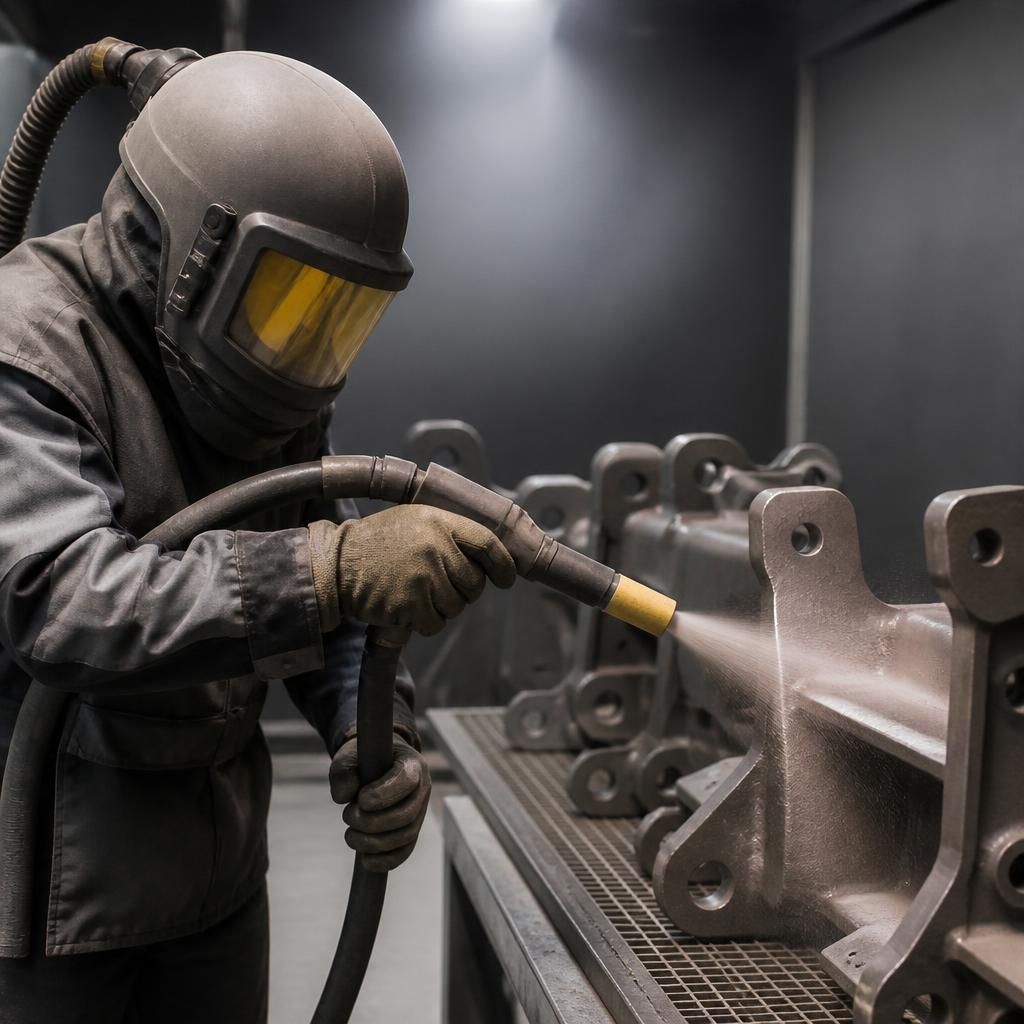
Different blasting media can help prevent cross-contamination between the abrasive and the metal being prepared. This is particularly important for stainless steel, aluminium and other non-ferrous components, where unsuitable or previously used ferrous media may leave embedded iron particles that later discolour or corrode.
Using a compatible, clean medium for the material helps preserve the substrate’s intended surface condition before coating. It also reduces the risk that abrasive residues will interfere with cleaning, chemical pre-treatment or powder-coating adhesion. For mixed production work, separating media by material and application can therefore improve process control and protect the specification of the finished component.