

How does the choice of blasting media impact the effectiveness of sandblasting solutions for powder coatings?
The choice of blasting media determines how effectively contaminants, corrosion and existing coatings are removed while creating a suitable surface profile for powder coating. Matching the media’s hardness, shape and size to the metal and coating condition helps prevent substrate damage, achieve consistent preparation and support strong, durable adhesion.
Blasting media affects the effectiveness of powder-coating preparation by determining how material is removed, how the surface is conditioned and how consistently the finished component can be processed. The most suitable media produces the required cleanliness and surface texture without introducing residues, distortion or unnecessary work before powder is applied.
Different media act on the substrate in different ways:
- Angular mineral or abrasive media cuts into corrosion, mill scale and firmly bonded coatings. This makes it useful where substantial removal is required, although its dust generation and abrasive action need to be controlled.
- Steel grit provides a sharp cutting action for demanding preparation and can create a pronounced profile. It is generally considered where the substrate can tolerate more aggressive treatment and where ferrous media are appropriate.
- Steel shot has a rounded form and tends to clean and peen rather than cut deeply. It can be effective for removing lighter contamination or conditioning robust steel, but may not provide the same cutting action as grit on heavy corrosion or thick coatings.
- Glass bead gives a comparatively gentle cleaning action and can produce a more uniform, satin-like appearance. It is useful for light cleaning and cosmetic conditioning, but may be unsuitable where a substantial anchor profile is needed.
- Plastic or nylon media can remove existing finishes while limiting attack on the underlying metal. These specialist options are relevant for softer substrates, thin sections or components where preserving edges and dimensions is important.
The shape of the abrasive influences the resulting surface in addition to its material. Sharp particles tend to cut and form deeper irregularities, while rounded particles distribute their impact and may compact or smooth the surface. This difference affects how the powder coating wets and keys to the substrate. An excessively mild medium may leave corrosion or old coating behind; an excessively aggressive one may make the surface unnecessarily rough, alter fine features or damage edges.
Media selection also affects dimensional accuracy. Thin sheet, machined faces, threads, holes and close-fitting components can be affected by prolonged blasting, particularly if high impact energy is used. A process that is suitable for a heavy structural part may therefore be inappropriate for a precision component. Edges and welds also need attention because they can receive a different level of impact from broad, flat areas.
Cleanliness is a separate consideration from surface texture. Blasting can remove rust, scale and coatings, but it does not reliably remove grease, oil or soluble salts. If these contaminants are present, blasting may spread them across the surface or drive them into surface irregularities. Degreasing and other pre-cleaning steps may therefore be needed before abrasive treatment. The media itself must also be clean and suitable for the application, since dust, spent abrasive or embedded particles can contribute to coating defects.
Contamination risk varies with the media and the substrate. Ferrous particles can be unsuitable for non-ferrous metals or applications where iron contamination is unacceptable. Conversely, a non-ferrous abrasive may be preferable when preserving the chemistry or appearance of the base metal matters. Recycled media can change as particles fracture and become finer, so its performance may differ from that of fresh media. Effective control includes removing degraded abrasive, managing dust and preventing different media types from becoming mixed.
Operating parameters determine whether the selected media performs as intended. Pressure, nozzle distance, impact angle, abrasive flow, traverse speed and the number of passes all influence the result. High pressure does not automatically produce better preparation: it can increase substrate damage, distortion, dust and media consumption. A controlled combination of media and settings is more important than relying on abrasive strength alone.
Component geometry may require more than one approach. Broad, accessible faces can often be treated efficiently with a standard abrasive process, while recesses, internal corners and narrow openings may need different nozzle positioning or a less aggressive medium. Masking may be required for threads, machined surfaces, bearing seats or other areas that should not be blasted. Where a part contains several metal types, the process must account for their different responses rather than treating the whole component identically.
After blasting, the result should be checked before powder coating. A suitable inspection considers whether the intended coating and corrosion have been removed, whether the surface is visibly clean, whether the profile is consistent and whether abrasive residue remains. Parts should also be protected from handling contamination between preparation and coating. If the profile is uneven or the surface has been overworked, changing the blasting settings or media may be more effective than trying to compensate during powder application.
For manufacturers and fabricators, the practical impact is a balance between removal performance, surface control, process cleanliness and repeatability. A blasting solution is effective when its media, equipment settings and inspection method are matched to the metal, existing finish and requirements of the powder coating system. Specialist powder-coating preparation can involve reviewing the component condition and selecting a treatment that supports consistent downstream coating rather than using one abrasive for every job.
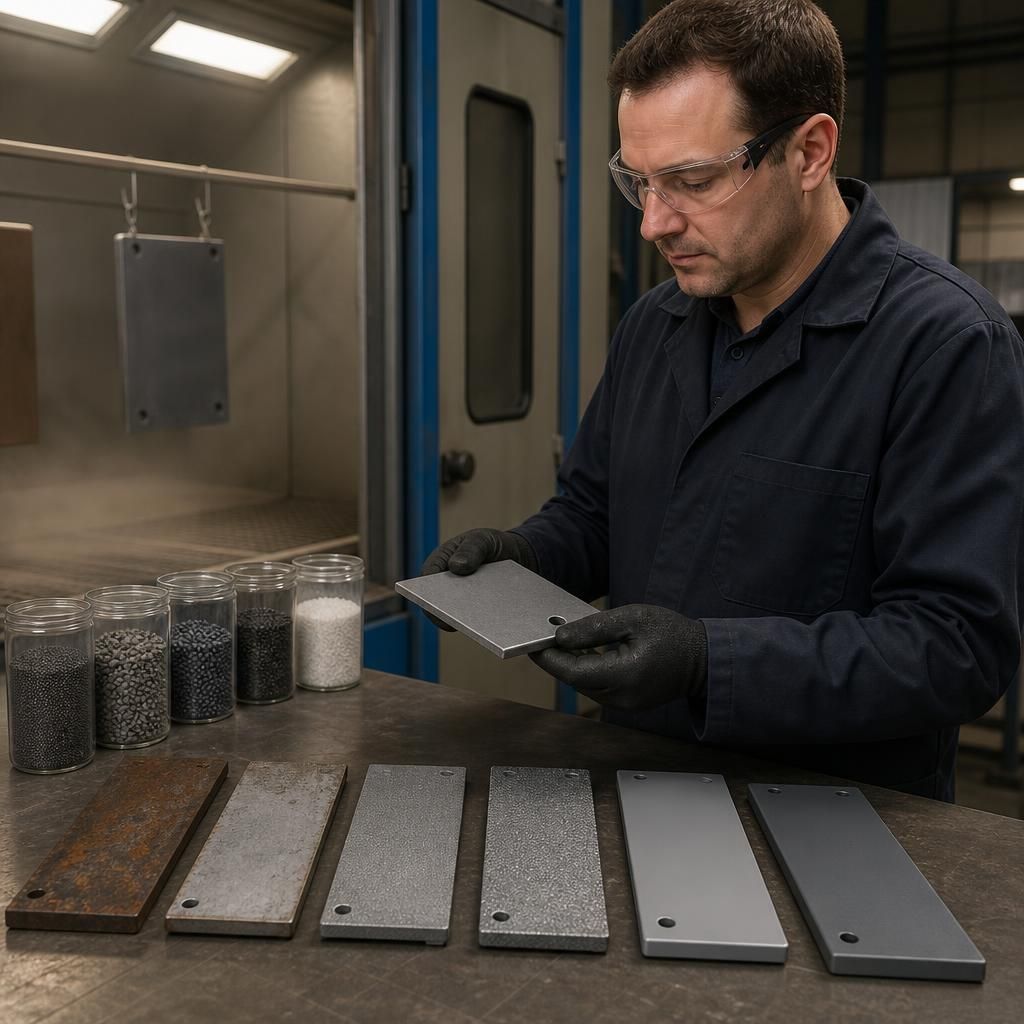
A controlled trial is often the most reliable way to confirm that a chosen blasting medium is effective for a particular powder-coating job. A representative component, or a suitable test piece, can be blasted using a defined combination of media and equipment settings before full production begins.
The trial should assess more than visual cleanliness. It can show whether the process produces the required surface profile, preserves critical dimensions and removes the existing finish without creating defects. The prepared sample can then be coated and inspected for adhesion and finish quality. Once the results are acceptable, the media type, operating settings and inspection criteria can be recorded as a process standard for the batch.
This approach is especially useful where components vary in thickness, geometry or previous coating condition. It reduces the risk of selecting an abrasive solely because it removes material quickly, when a less aggressive or differently shaped medium may provide more consistent preparation for the powder-coating system.
Discuss the Right Blasting Media for Your Powder Coating
Discuss your components, existing finish and powder-coating requirements with the Powder-coatings.co.uk team to assess a suitable blasting media and preparation approach. Collection and delivery options are available for businesses across the Midlands and surrounding areas.