

What role does metal surface profile play in powder coating adhesion?
Metal surface profile affects how securely powder coating bonds to the substrate by providing texture for mechanical interlocking and increasing the effective bonding area. A suitable, consistent profile supports adhesion and coating durability, while an excessively smooth, uneven or contaminated surface can contribute to poor coverage, weak bonding and premature failure.
Metal surface profile is the controlled pattern of peaks and valleys created on a substrate during preparation. It affects the geometry of the coating-to-metal interface, the amount of powder required to cover the surface consistently and the conditions under which adhesion can develop. The correct profile is therefore a specification to control, not simply a by-product of abrasive blasting or other preparation work.
Profile is commonly assessed by its depth and consistency. A surface may have a relatively fine, even pattern or a more pronounced profile with deeper valleys and sharper peaks. The suitable result depends on the metal, the preparation method, the powder coating system and the service conditions of the finished component. A profile selected for a heavy-duty steel structure may not be appropriate for thin sheet, aluminium or a precision-fabricated part.
Why profile consistency matters
Powder coating is applied as a dry film and then melted and cured. During this process, the coating must flow across the prepared surface and form a continuous film. If the profile varies substantially across a component, the cured film can have different thicknesses and coverage characteristics from one area to another. High points may receive less effective film build, while deep depressions may require more powder and careful control of application and curing.
Variations can arise between the face of a component, its edges, welds, corners and areas that were difficult to reach during preparation. Large fabricated parts are particularly likely to show differences if blasting distance, abrasive impact or cleaning has not been controlled. Consistent preparation helps the applicator set more predictable coating parameters and identify areas that need additional attention before powder is applied.
How the profile is produced
Abrasive blasting is one of the main ways to create a controlled profile on steel and other suitable substrates. Abrasive type, particle size, equipment settings, nozzle distance, angle of impact and exposure time all influence the resulting surface. Changing any of these variables can alter the depth and shape of the profile, even when the same component is being prepared.
Other preparation methods may produce a different surface condition. Mechanical abrasion can create directional marks, while chemical treatments alter the surface chemically rather than creating the same kind of blasted texture. Pickling, phosphating and other conversion processes may support powder coating adhesion, but they should not automatically be treated as substitutes for a specified abrasive profile. The complete preparation route needs to be selected for the substrate and coating system.
Profile and coating thickness
The profile should be considered alongside the intended dry-film thickness. If the profile is relatively pronounced compared with the specified coating thickness, the film may not provide the same protection over peaks and within valleys as it would on a finer surface. This is important where corrosion resistance, edge protection or a uniform decorative finish is required.
Applying additional powder is not a reliable way to correct an unsuitable profile. Excessive film build can affect appearance, curing behaviour and dimensional tolerances, while still failing to address an inconsistent or poorly controlled substrate. It is better to establish an appropriate profile before coating and then verify that the application process produces the required film thickness.
Inspection and control
Surface profile should be checked after preparation and before powder application. Common inspection approaches include replica tape, depth micrometers and comparator methods, with the selected method depending on the substrate, component geometry and required level of control. Measurements should be taken at representative locations rather than relying on a single reading from an accessible area.
- Confirm the preparation specification for the particular metal and powder system.
- Check representative faces, edges, welds and recessed areas.
- Record whether the profile is within the specified range and sufficiently consistent.
- Remove abrasive residue and other loose material after profiling.
- Prevent prepared components from being recontaminated before coating.
Inspection should also consider the condition of the abrasive and the preparation equipment. Worn abrasive, blocked blast nozzles, unstable air pressure or poor extraction can change the surface result and introduce contaminants. A visual check alone may show whether a surface has been treated, but it cannot reliably establish profile depth or consistency.
Relationship with other adhesion factors
Profile is only one part of the adhesion system. The substrate must also be clean, suitably prepared and free from residues such as oil, grease, dust, moisture, salts and corrosion products. The powder must be compatible with the substrate and cured within the manufacturer’s specified conditions. Poor application, incorrect film thickness or incomplete curing can undermine adhesion even when the profile is suitable.
Weld spatter, sharp edges, laminations and existing corrosion may also affect the result. These defects can interrupt the coating film or create localised weaknesses that a correctly prepared profile cannot resolve. Surface preparation should therefore include defect removal and edge treatment where required, followed by a final inspection before powder coating begins.
For manufacturers and fabricators, the practical objective is a documented, repeatable profile that matches the coating specification and component design. Discussing the substrate, preparation route, required finish and service environment before processing helps establish suitable controls. Professional powder coating preparation can include checking these factors as part of the process, particularly for batches containing different metals, geometries or levels of fabrication complexity.
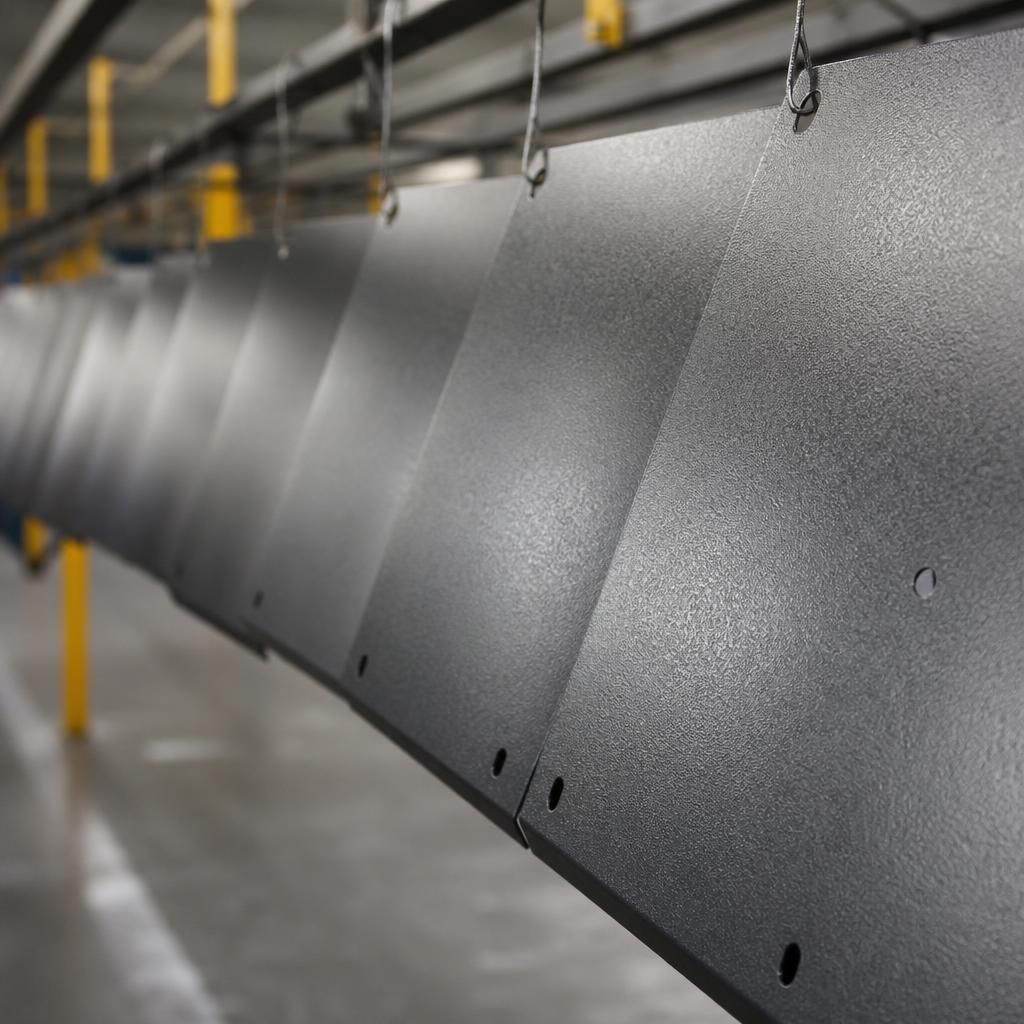
A suitable metal surface profile influences more than adhesion; it also affects the appearance of the cured powder coating. Peaks and valleys alter how light is reflected, so an uneven or overly pronounced texture can produce differences in apparent gloss, colour uniformity and surface smoothness across the component.
This is particularly relevant where a consistent decorative finish is required on visible fabricated parts. The preparation specification should therefore consider the intended appearance as well as the coating system and service conditions. A profile that supports bonding but is unnecessarily coarse may remain visible through the finished film, while a controlled, uniform texture gives the powder coating a more consistent surface to cover.
Discuss your metal surface profile requirements
Discuss your substrate, coating system and required finish with the powder-coating.co.uk team to help define suitable metal surface profile requirements for your components. Collection and delivery options are available for businesses across the Midlands and surrounding areas.