

How does phosphate treatment contribute to the powder coating surface preparation process?
Phosphate treatment prepares metal for powder coating by creating a thin conversion layer that helps the powder adhere more consistently to the surface. It also improves corrosion resistance and supports a more uniform, durable finish when applied after suitable cleaning and before powder coating.
Phosphate treatment is a chemical conditioning stage used after cleaning and before powder application. It reacts with the prepared metal surface to alter its chemistry and create a more suitable foundation for the coating system. Its main contribution is to reduce the risk that contamination, surface reactivity or poor wetting will undermine the performance of the powder coating.
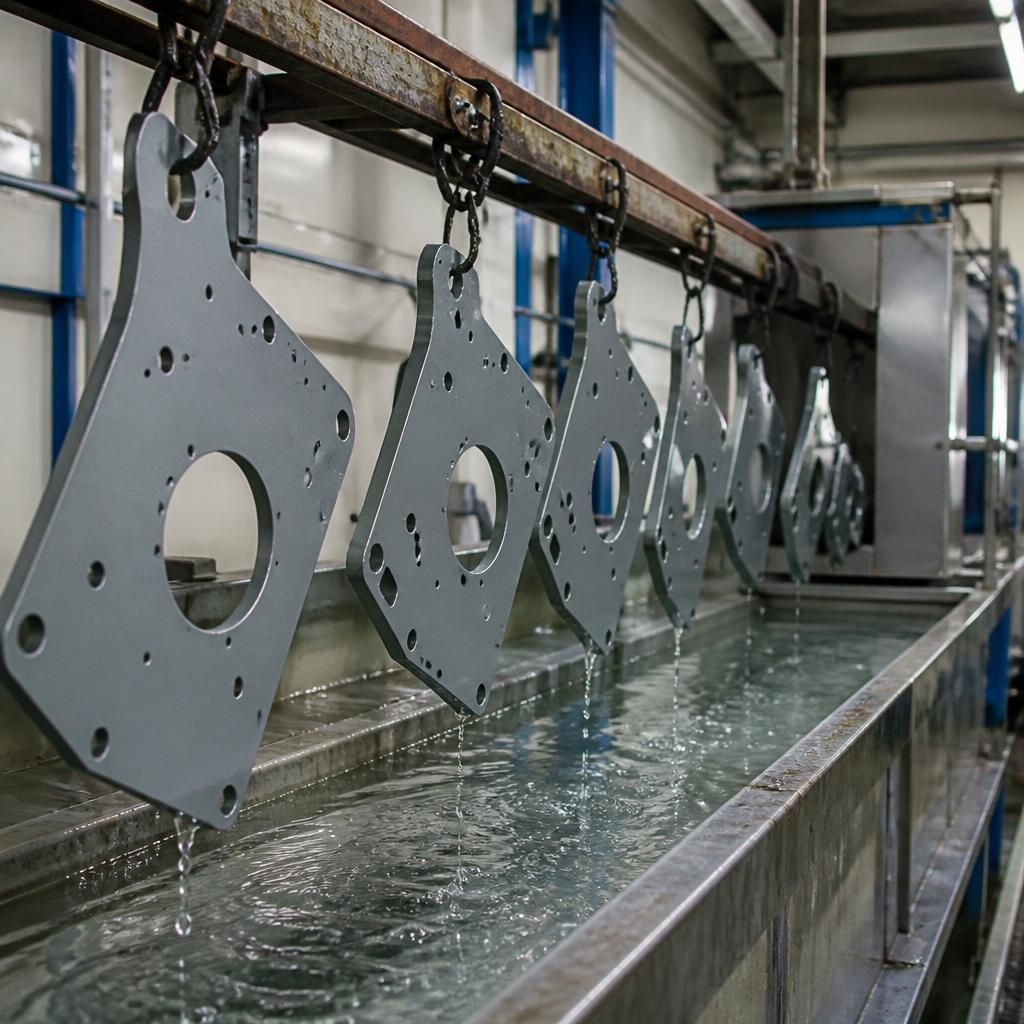
The treatment normally forms part of a controlled pretreatment sequence rather than operating as a standalone preparation method. A typical process may include:
- degreasing to remove oil, grease and handling residues;
- rinsing to prevent cleaner carry-over;
- phosphate application by spray or immersion;
- further rinsing where the process requires it;
- a final conditioning or sealing stage, if specified for the system; and
- thorough drying before powder is applied.
Every stage matters. Phosphate chemistry cannot compensate for heavy oil, mill scale, rust, blasting residue or other contaminants left on the metal. Where corrosion, scale or tightly bonded deposits are present, mechanical preparation such as abrasive blasting may be needed before chemical pretreatment. The correct combination depends on the substrate, its condition and the performance required from the finished component.
Different phosphate treatments have different roles. Iron phosphate is commonly used where a relatively straightforward pretreatment is required for general powder coating work. Zinc phosphate produces a more structured crystalline deposit and is often selected where a higher level of corrosion protection is required, particularly on steel components exposed to demanding service conditions. Aluminium, galvanised steel and mixed-metal assemblies may need a treatment designed specifically for those substrates, because a chemistry suitable for one metal may give inconsistent results on another.
The process must be controlled to suit the metal and the powder coating specification. Important variables include bath concentration, acidity, temperature, contact time, spray pressure where applicable, rinse quality and drying conditions. If these variables drift, the result may be an incomplete deposit, excessive residue, staining or poor compatibility with the coating. Excess treatment can be just as undesirable as insufficient treatment, so operators should follow the chemical supplier’s process requirements and maintain suitable records.
After treatment, the component should be inspected before coating. Useful checks include visual examination for missed areas, water-break testing to identify remaining contamination, and process checks on the condition of the treatment bath. For controlled industrial work, coating-weight or other agreed verification methods may also be used. Components should be handled in a way that avoids fingerprints, moisture and workshop contamination being reintroduced after preparation.
Phosphating is particularly valuable where components will encounter humidity, condensation, outdoor exposure or corrosive industrial environments. It supports the powder coating system at the interface with the metal, helping to limit the effects of small defects or localised damage. It is not, however, a substitute for correct powder selection, adequate film coverage, suitable curing or good design that prevents water becoming trapped in joints and recesses.
Phosphate treatment is also not appropriate in exactly the same form for every project. The substrate, previous coatings, weld areas, cast surfaces, galvanised sections and assembled dissimilar metals can all affect the result. Parts with complex geometry may require particular attention to drainage, rinsing and drying so that chemicals do not remain in seams or cavities. Weld contamination and residues from fabrication can also require additional cleaning before the chemical stage.
For a reliable powder coating specification, the pretreatment should therefore be agreed alongside the metal type, intended environment, coating system and preparation method. A suitable phosphate process provides controlled chemical preparation between cleaning and powder application, while blasting, rinsing, drying, application and curing must all work together to produce a dependable finished component.
Phosphate treatment does not create the same mechanical key as abrasive blasting. Blasting can remove firmly bonded corrosion and produce a controlled surface profile, while phosphating chemically conditions the clean metal that remains. Where both stages are specified, the phosphate layer works with the prepared profile rather than replacing it.
This distinction is important when assessing a component with corrosion, mill scale or an existing surface texture. The preparation method must first achieve the required physical condition, after which phosphate treatment can improve the consistency of the metal-to-powder interface. Selecting the sequence in this way helps avoid relying on a chemical conversion layer to solve a problem that requires mechanical preparation.
Discuss Your Phosphate Treatment Requirements
Discuss your phosphate treatment requirements with the powder coating team, providing details of the substrate, component condition and intended service environment. This helps establish whether chemical pretreatment, abrasive preparation or a combined process is appropriate for your components.