

How do different abrasive blasting techniques affect the surface texture and adhesion of powder coatings, and what should be considered when choosing a method?
Abrasive blasting cleans and profiles metal by removing rust, scale and contaminants while creating a surface texture that gives powder coating a mechanical key. The best method depends on the substrate, existing condition, required profile, component geometry and coating specification, as excessive or uneven blasting can damage the metal or impair adhesion.
The abrasive blasting technique affects powder-coating adhesion mainly through the type, depth and consistency of surface profile it produces. A suitable profile increases the available surface area and gives the cured coating a mechanical key; an unsuitable profile can leave the surface too smooth, excessively rough, contaminated or dimensionally altered. Method selection should therefore be based on the metal, component design, starting condition, coating specification and the level of process control available.
How different blasting techniques alter the surface
Compressed-air blasting uses a pressurised stream of abrasive and is highly controllable. The operator can vary the nozzle distance, angle, pressure, travel speed and media selection to work around welds, edges, recesses and irregular profiles. This makes it useful for fabricated components and parts with complex geometry. However, inconsistent nozzle movement can create areas with different profiles, while excessive pressure can round edges, remove too much material or drive abrasive into softer metals.
Wheel blasting projects abrasive using a rotating wheel rather than compressed air. It can produce a uniform finish efficiently on components with suitable size and shape, particularly where surfaces are relatively open and accessible. Its limitations are reduced flexibility around deep recesses and enclosed sections. Thin panels or lightly constructed parts also require careful control because repeated impact can cause distortion or peening.
Wet or vapour blasting combines abrasive with water. The liquid suppresses airborne dust and can produce a comparatively uniform, subdued texture. It may be appropriate where dust control or a less aggressive finish is important, but the component must be thoroughly rinsed or otherwise controlled where residues are possible, then dried correctly. Bare ferrous steel can develop flash rust if moisture remains before powder coating, so the process must include suitable drying and corrosion control.
Vacuum blasting captures much of the abrasive and debris at the point of use. It is useful for localised work or situations where containment is important, although it may be slower and less practical for large production volumes. The captured process can also make it easier to control contamination between different jobs.
Media shape, hardness and size
Angular media cut into the surface and generally create a more pronounced, irregular profile. This can support mechanical interlocking but may be unnecessarily aggressive for thin sheet, soft alloys or components with fine detail. Round shot tends to peen rather than cut, producing a more compacted surface with a different texture. It may be useful for robust ferrous parts, but it is not automatically interchangeable with an angular abrasive when a specified profile is required.
Glass bead and other relatively fine, rounded media can create a smoother, more uniform appearance, but the resulting surface may not provide enough profile for every powder system. Harder, angular abrasives can remove tenacious scale and existing coatings more effectively, while finer grades allow greater control on smaller features. Larger particles and higher impact energy usually produce a deeper profile, though the result also depends on pressure, angle and the number of passes.
Silica sand requires particular caution because respirable crystalline silica presents a serious health risk. Suitable blasting operations should use legally compliant media, equipment, extraction and respiratory protection rather than selecting sand simply because it is familiar or readily available.
Why the profile matters to powder coating
Powder coating does not rely only on chemical bonding. The cured film also conforms to microscopic peaks and valleys in the prepared surface. If the profile is too shallow, the coating has less opportunity to anchor mechanically. If it is too deep relative to the coating thickness, peaks may remain insufficiently covered, valleys may retain dust or abrasive, and the finished surface can show premature corrosion at exposed points.
A sharp, irregular profile is not always desirable. Jagged peaks can concentrate stress, remain visible through a thin coating or require more powder to achieve complete coverage. A surface that has been over-blasted may also have altered dimensions or softened edges. Conversely, shot-peened or smeared metal can appear clean while providing less effective anchoring than the visual finish suggests.
Factors to assess before choosing a method
- Substrate: Steel, stainless steel, aluminium, galvanised metal and softer alloys respond differently to impact. The media and energy must be hard enough to achieve the required preparation without embedding particles, gouging the surface or removing a protective metallic layer.
- Component thickness and geometry: Thin panels, sharp edges, threaded sections, holes and folded fabrications may need lower energy, finer media or localised application. Recesses must be checked because an apparently uniform blast may not reach them consistently.
- Existing condition: Heavy scale, corrosion, weld residues and old coatings may need a more aggressive initial treatment than lightly oxidised or previously prepared metal. Any remaining residue can affect the coating even where the exposed areas appear satisfactory.
- Required finish: The powder manufacturer or project specification may define a target profile, appearance or cleanliness level. The blasting method should be selected to achieve that requirement repeatably rather than relying on visual judgement alone.
- Production requirements: Wheel blasting can suit compatible batches, while air blasting offers more control over variable or complex parts. Media recovery, containment, dust extraction and the risk of cross-contamination should be considered alongside speed.
- Downstream coating thickness: A heavier coating can accommodate a different profile from a thin decorative film. The blast texture should be proportionate to the intended powder system and final appearance.
Controls that protect adhesion after blasting
Good blasting practice is only part of the preparation process. Abrasive residue and dust should be removed using clean, dry methods that do not introduce oil or moisture. Compressed air used for blow-down should be suitably clean and free from compressor oil and water. Components should be handled with clean gloves where fingerprints or salts could affect the surface, and they should be protected from condensation, handling contamination and renewed corrosion before coating.
Media must also be kept compatible with the work. Recycled abrasive can become rounded, contaminated or mixed with material from a previous substrate, changing the profile and potentially introducing unwanted particles. Regular checks of media condition, blast pressure, nozzle or wheel performance and operator technique help maintain consistency across a batch.
Verification and trial work
For a new component or coating specification, a representative trial piece can show whether the selected media and settings produce the required texture without distortion or excessive edge wear. Surface-profile comparators or suitable roughness instruments provide more reliable evidence than appearance alone. Checks for visible dust, flash rust, oil and other residues are also important before powder application.
Where adhesion is critical, the complete preparation and coating system should be assessed on representative material. Adhesion testing after curing can help distinguish a blasting problem from an issue with powder application, curing or contamination. The test method and acceptance criteria should come from the relevant project or coating specification rather than being chosen in isolation.
In practical terms, the best method is the least aggressive process that reliably achieves the required cleanliness and profile across the whole component. A controlled trial, documented operating settings and inspection of difficult areas provide a stronger basis for selection than choosing media by appearance, habit or removal speed alone.
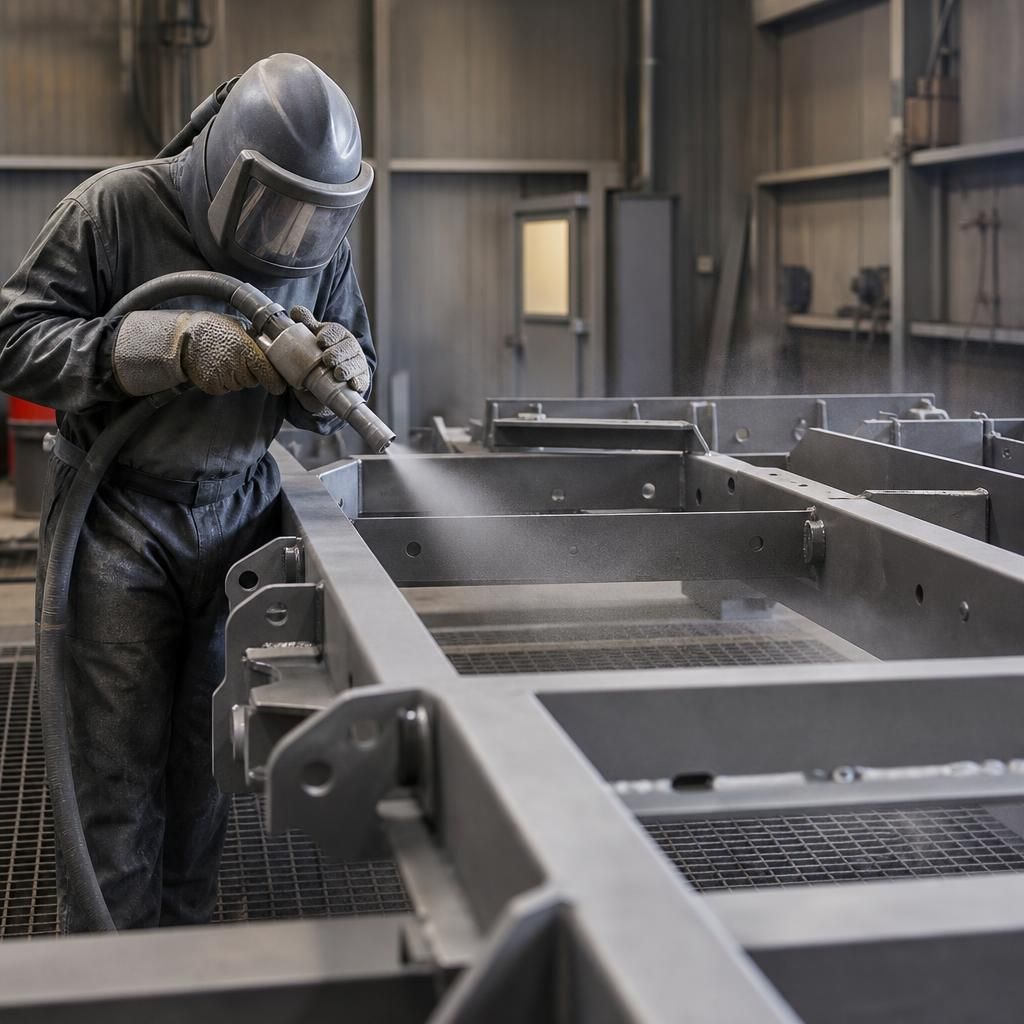
Abrasive blasting affects powder-coating adhesion through both mechanical profile and surface chemistry. Although a textured surface can provide mechanical anchoring, blasting may also expose fresh metal, alter an existing protective layer or leave the substrate in a condition that requires further treatment before coating.
This is particularly important for aluminium, galvanised steel and other substrates with naturally occurring or applied surface layers. The chosen process should therefore be compatible with any subsequent degreasing, conversion treatment or other pretreatment specified for the powder-coating system. Removing more material is not necessarily better if it interferes with corrosion protection or creates an unsuitable surface for the next stage.
- Confirm whether blasting is the complete preparation process or one stage in a wider pretreatment sequence.
- Check that the abrasive will not introduce particles or residues that interfere with later treatment.
- Assess the prepared surface for both the required profile and its condition before applying any chemical treatment or powder coating.