

What factors should I consider when choosing the right blasting media for rust removal?
Choose blasting media according to the metal substrate, the severity of the rust, the surface profile required for subsequent coating, and the finish you need to achieve. Also consider media recyclability, dust generation, equipment suitability and waste handling, as these affect process control and overall practicality.
The right blasting media for rust removal is the one that removes corrosion without causing unacceptable change to the metal, contaminating the surface or creating problems for the next process. Selection should therefore consider the part’s geometry, dimensional tolerances, required cleanliness, potential for media contamination, operating method and the type of coating or treatment that will follow.
Assess the part’s geometry and accessibility. Complex fabrications, recesses, drilled holes and narrow joints can be difficult to clean evenly. A media that works well on broad, accessible faces may be less suitable where it cannot reach effectively or where spent abrasive becomes trapped. Check whether the blasting nozzle, cabinet or automated equipment can direct media into these areas, and consider how the component will be supported and rotated during treatment.
Consider dimensional and edge sensitivity. Rust removal should not unnecessarily round sharp edges, enlarge holes, alter threads or affect close-tolerance interfaces. Aggressive media and high-impact blasting can remove sound metal as well as corrosion if the process is poorly controlled. Components with machined faces, thin sections or mating surfaces may require a more controlled approach than heavy structural parts. Masking or separate treatment may be appropriate where certain areas must remain unaffected.
Define the required cleanliness level. Removing visible rust is not always the same as preparing a surface for further work. Residual corrosion products, mill scale, old coating, oil or embedded debris can affect adhesion and cause defects later. Establish what the finished surface must be free from before choosing media and setting the process. Visual inspection may be sufficient for some work, while more demanding applications may require documented inspection against an agreed preparation standard.
Check the risk of media transfer. Some abrasive particles can become lodged in softer metals or remain in seams and cavities. This matters if the component will be powder coated, painted, welded, machined or used in an environment where foreign particles could cause a defect. The media should be chemically compatible with the metal and the following process. After blasting, parts may need thorough air cleaning, vacuuming or another approved cleaning step to remove loose residue.
Match the media to the material’s hardness and condition. Different metals respond differently to impact. A heavily corroded steel component may tolerate a more forceful process than a thin aluminium part, while softer or easily marked surfaces need tighter control. Consider not only the base metal but also welds, heat-affected areas, previous repairs and any remaining coating, as these may react differently during blasting.
Look at particle size and consistency. Particle size affects how readily media reaches small imperfections and how uniformly it acts across the surface. A consistent grade helps make the process more predictable, whereas worn or contaminated media can produce uneven results. Media should be checked during use and replaced or screened when its condition begins to affect cleaning performance. The correct grade also depends on the blasting equipment’s nozzle, pressure range and recovery system.
Take the complete process into account. The best choice is not determined by the abrasive alone. Consider:
- the type and condition of the blasting cabinet, room or automated line;
- the nozzle size, air supply and pressure control available;
- how parts will be loaded, handled and inspected;
- whether the process is intended for one-off components or repeat batches; and
- how the blasted surface will be protected from renewed corrosion before the next operation.
For repeat production, consistency is particularly important. A media that gives an acceptable result once may be unsuitable if its performance changes significantly as it becomes worn or mixed with removed rust and coating residues. Define the media specification, process settings, inspection method and replacement criteria so that results can be reproduced between batches.
Use a controlled trial where the choice is uncertain. A test on a representative component or an agreed sample can reveal whether the media reaches difficult areas, removes the corrosion evenly and leaves the metal in an acceptable condition. Inspect the trial for residual rust, embedded particles, edge damage, distortion and cleanliness after handling. This is more reliable than selecting media solely from its general description, particularly when the part combines different metals, thicknesses or surface conditions.
For components intended for powder coating, blasting is only one part of preparation. The selected media and process must leave a clean, stable surface that can be handled and transferred without introducing oil, moisture or loose contamination. Where the specification is critical, discuss the component material, inspection requirements and downstream coating process with the blasting or finishing specialist before work begins. This allows media selection to be judged against the complete preparation process rather than rust removal in isolation.
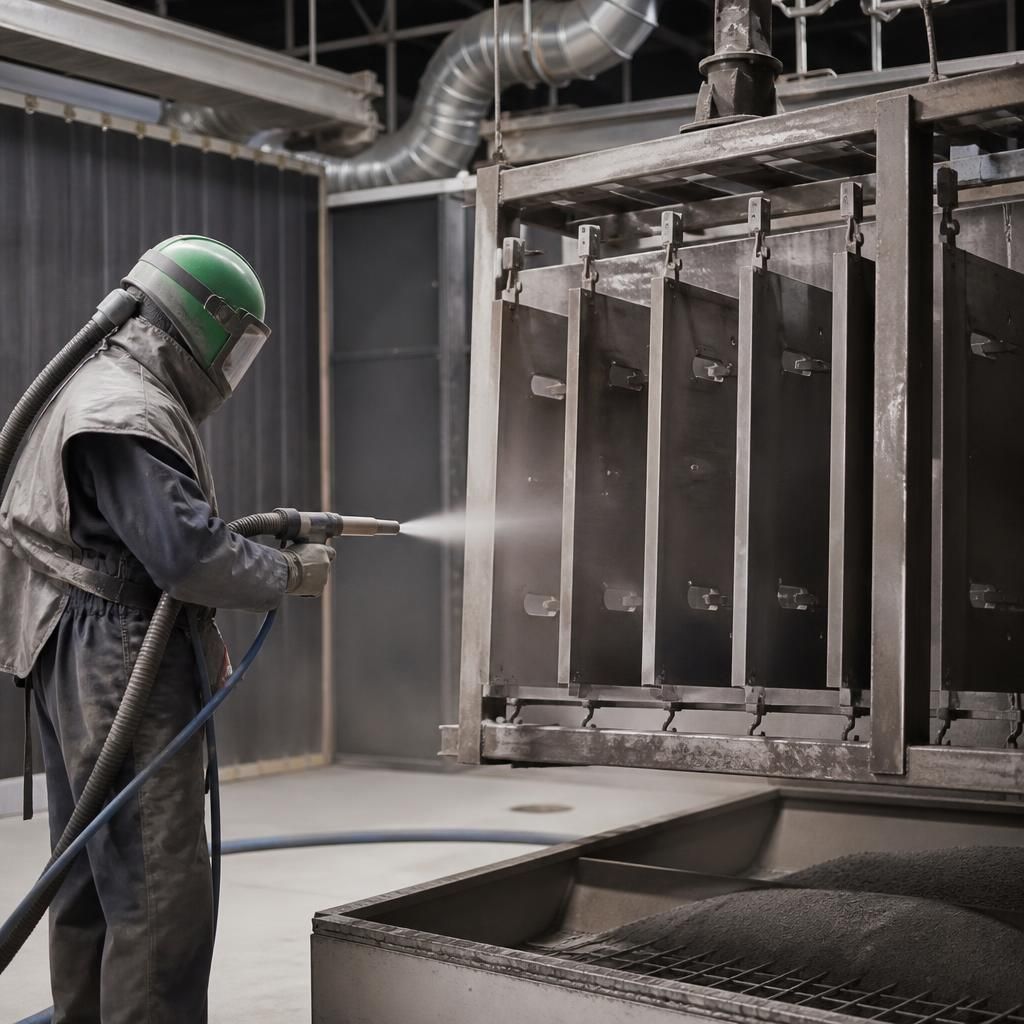
Media recovery, disposal and dust control should be considered alongside cleaning performance. Recyclable abrasives may be practical where equipment can separate and recirculate them, while expendable media may be more suitable for work where recovery is difficult. The resulting waste can contain rust, old coating and other removed contaminants, so its handling requirements should be established before treatment begins.
Also assess how much airborne dust the chosen media may generate and whether the blasting system provides suitable extraction. Excessive dust can reduce visibility, contaminate nearby surfaces and make inspection less reliable. A media that supports effective recovery and controlled working conditions can therefore be a better overall choice than one selected solely for its cutting power.