

What are the critical factors to consider when selecting blasting media for different types of metal surfaces?
Select blasting media by assessing the metal’s hardness and condition, the required surface profile, the level of rust or contamination, and the finish needed for the subsequent coating. Also consider the component’s shape and thickness, the risk of distortion or embedment, media recyclability, dust generation and operator safety to ensure the preparation method suits the surface.
The critical factors are the metal’s composition, the condition of any existing coating or corrosion, the surface finish required afterwards, and the risk of changing the component’s dimensions or chemistry. A suitable blasting medium should remove the unwanted layer without embedding foreign material, removing a protective coating unnecessarily or leaving a surface that is unsuitable for the next process.
Identify the substrate before choosing the abrasive. Carbon steel, stainless steel, aluminium, galvanised steel, cast iron, copper and brass all respond differently to blasting. The same abrasive and machine settings should not automatically be used across a mixed batch. Confirm the base metal, whether it has been heat-treated, and whether a zinc, anodised or other protective layer is intended to remain.
- Carbon steel: steel grit is often suitable where a pronounced mechanical cleaning action is required, particularly on robust fabricated parts. Aluminium oxide can be useful where a sharp, clean profile is needed without introducing ferrous particles.
- Stainless steel: use a dedicated non-ferrous or stainless-compatible medium. Carbon-steel grit can leave embedded iron, which may later appear as surface staining or undermine the appearance of the stainless surface.
- Aluminium: softer media, including glass beads or suitable plastic and nylon media, are generally considered where the aim is to clean or key the surface while limiting cutting action. Excessive blasting can alter edges, thin sections and visible texture.
- Galvanised steel: establish whether the zinc coating is to be retained. An aggressive abrasive can remove zinc as well as contamination, so preparation may require a controlled, low-impact approach rather than full removal.
- Cast iron: a more forceful abrasive may be appropriate for heavy corrosion and scale, but its porous surface and recesses require careful cleaning afterwards. Residual dust or spent media can interfere with subsequent coating.
- Copper and brass: these relatively soft, non-ferrous surfaces can be marked or distorted by an overly aggressive medium. A gentle cleaning medium is normally more appropriate when the original appearance or dimensional accuracy matters.
Consider what must be removed, not just how strongly it is attached. Loose rust, mill scale, old powder coating, paint, welding residues and grease present different challenges. A coarse, angular abrasive may be effective against hard scale, while a finer or less aggressive medium may be preferable for light oxidation or a sound coating that only needs preparation. Oil and grease should be dealt with before blasting where possible; otherwise, the abrasive can spread contamination across the workpiece and reduce the reliability of the final clean.
Match the media shape to the required surface action. Angular grit cuts into contamination and creates a mechanical key, whereas spherical bead media tend to clean and peen the surface with a less sharply cut texture. This distinction matters when the component will be painted or powder coated. A surface that is too smooth may not provide the intended key, while an unnecessarily deep or irregular texture can increase coating consumption and affect the final appearance. The appropriate result depends on the coating specification and the substrate, rather than on the abrasive name alone.
Prevent cross-contamination between metals. Media used on carbon steel should not automatically be reused on stainless steel, aluminium or other non-ferrous components. Spent abrasive can carry iron, old coating particles, salts or other residues from one job to the next. Dedicated media, separate blast equipment or thorough media management may be needed when surface cleanliness and appearance are critical. This is particularly important where the finished part will be exposed to moisture or where even small areas of discolouration would be unacceptable.
Check the condition and specification of the component. Thin sheet, folded edges, precision-machined areas, threads and close-tolerance interfaces need more control than heavy structural sections. Protect or mask surfaces that must not be blasted, including machined faces, bearing seats, electrical contact areas and identification marks. With fabricated parts, inspect welds and sharp corners because these areas can receive a different blast action from broad flat faces. The media choice should support the component’s functional requirements, not only its visual appearance.
Take the intended coating system into account. Powder coating, wet paint and specialist protective systems can have different requirements for cleanliness and surface texture. Determine whether the specification calls for a particular preparation grade, profile or visual standard, then select media and settings that can achieve that result consistently. The blast process may need to be followed by dust removal and inspection before coating; otherwise, residual abrasive or loose particles can become defects in the finished layer.
Evaluate the blasting equipment as part of the decision. Media performance depends on the machine, nozzle, pressure or wheel speed, air supply, recovery system and operator control. A medium that is suitable in one installation may produce a different result in another. Check that the equipment can handle the media size and type, that the recovery system separates broken-down abrasive effectively, and that the blast pattern can reach recesses without overworking exposed edges. Trial preparation on a representative section is preferable to making assumptions from a small sample of clean metal.
Use inspection to confirm the choice. Examine the prepared surface for remaining corrosion, embedded particles, flash rust, uneven texture and damage to edges or thin areas. Where the component is destined for a protective coating, inspect the surface profile and cleanliness against the relevant project specification rather than relying on appearance alone. Record the selected medium and process settings for repeat batches, while recognising that a change in substrate, contamination or existing coating may require a fresh trial.
In practice, the best selection is the least aggressive medium and process that achieves the specified cleanliness and surface condition without compromising the metal. For mixed or high-value components, separating materials, testing a small area and checking for contamination before full production can prevent an unsuitable abrasive from affecting the whole batch.
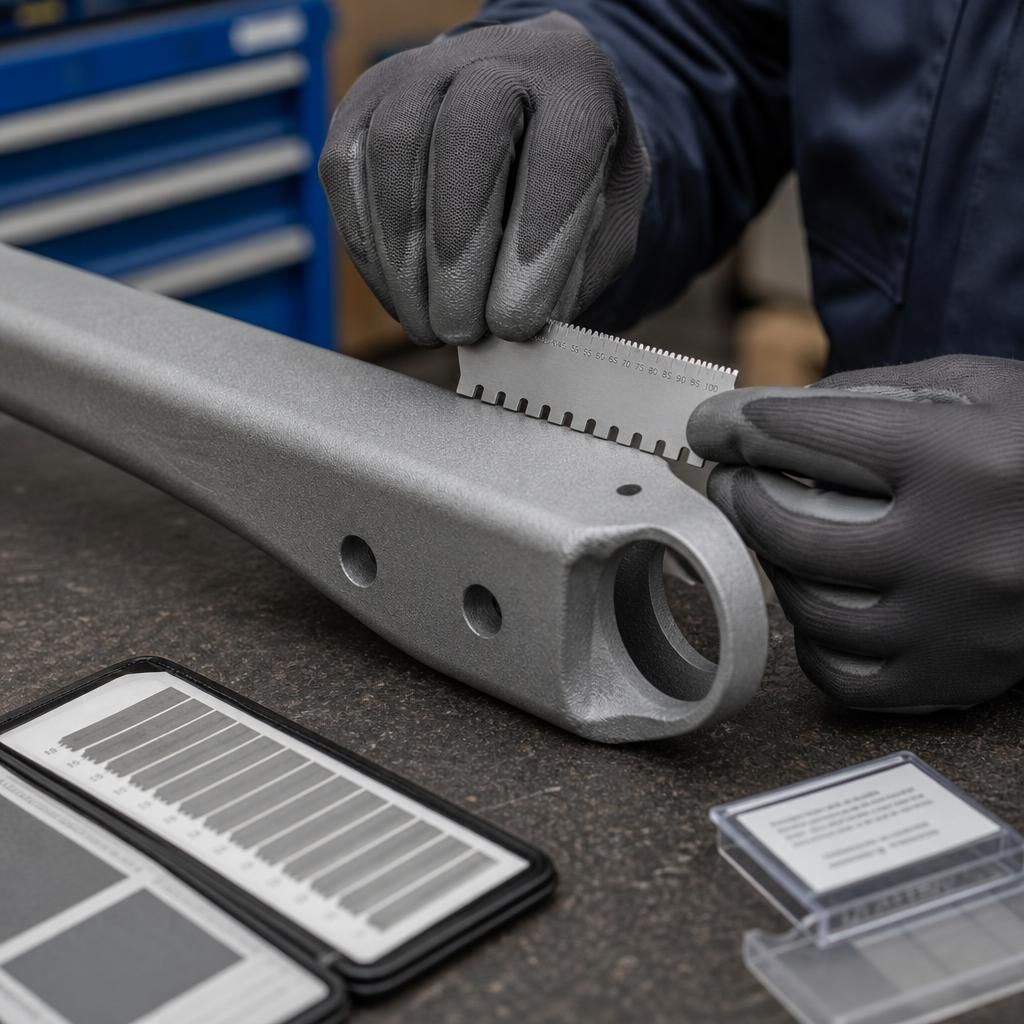
Surface profile should be verified rather than judged by appearance alone. After blasting, compare the texture across representative areas of the component and check that it matches the coating specification. A surface profile comparator or replica tape can help assess whether the prepared metal has the required degree of roughness, particularly where the finish will be exposed to wear or corrosion.
Record readings from flat areas as well as welds, corners and recesses, since blasting can produce an uneven profile across the same component. This check helps identify areas that are too smooth for reliable coating adhesion or so pronounced that they may affect coverage and final appearance.