

How does steel grit compare to glass beads in terms of effectiveness for rust removal?
Steel grit is generally more effective for removing heavy, firmly adhered rust because its angular particles cut into corrosion and surface scale. Glass beads provide gentler cleaning and a smoother, more uniform finish, making them better suited to light rust or metal surfaces where preserving the profile matters.
Steel grit is usually the more effective option for substantial rust removal, while glass beads are more effective when controlled cleaning and a consistent surface appearance are the priorities. The practical choice depends on the thickness and adhesion of the corrosion, the base metal, the required surface profile and what will be applied afterwards.
Effectiveness should therefore be judged against the intended result rather than cleaning speed alone. For a component that will be powder coated, the abrasive must remove corrosion and leave a sound, suitably keyed surface without causing distortion or unnecessary damage. For a visible component that needs cleaning with minimal alteration to its original surface, a gentler process may be preferable even if more passes are required.
Steel grit and surface preparation
Steel grit has a hard, angular structure that breaks down firmly attached corrosion and scale. It is suited to robust steel fabrications, structural components, machinery parts and other items where the rust has formed a substantial layer. Its impact can also produce a pronounced surface texture, which may help a subsequent coating mechanically bond to properly prepared steel.
That cutting action needs to be matched to the component. Excessive impact pressure, an unsuitable grit size or prolonged blasting can deepen the profile beyond what the coating system requires. It can also expose sharp edges, affect thin sections or make the finish unnecessarily rough. Steel grit is consequently most effective when the operator controls the abrasive grade, nozzle distance, blast angle and pressure rather than treating every rusty item in the same way.
Glass beads and controlled cleaning
Glass beads have a rounded particle shape and are generally used where the surface needs cleaning with a more uniform visual result. They can remove light corrosion, residues and surface discolouration while limiting aggressive cutting of the substrate. This makes them useful for components with a relatively sound underlying surface, parts with visible faces, and work where preserving existing contours is important.
The same characteristics that make glass beads suitable for controlled cleaning can limit their effectiveness against deeply bonded rust. They may clean the exposed surface without removing every corrosion pocket, particularly where rust has penetrated pits, seams or irregular edges. A component that appears clean immediately after blasting should therefore be inspected closely rather than assessed only by its overall colour or brightness.
Important comparison factors
- Condition of the rust: Thick scale, layered corrosion and tightly bonded deposits generally call for a more cutting abrasive. Thin surface oxidation may not justify such an aggressive approach.
- Base metal and thickness: Heavy steel can tolerate more force than thin sheet, delicate edges or components with close tolerances. The process must remove corrosion without altering dimensions or producing distortion.
- Required surface profile: Coating manufacturers specify suitable preparation requirements. A highly textured surface is not automatically better; the profile should be compatible with the planned powder coating and the component’s service conditions.
- Geometry: Recesses, welds, holes and corners may retain corrosion or receive uneven impact. Blast direction and coverage are important, particularly where rust is present in pits or around joints.
- Appearance: Glass beads can be considered when a consistent, less heavily abraded appearance is needed. Steel grit is more appropriate where the priority is thorough preparation of a robust steel surface rather than a decorative finish.
- Contamination control: Spent abrasive, rust residue, oil and moisture must be removed before coating. Any remaining contamination can interfere with adhesion regardless of which media was used.
Which produces the better result?
For heavily corroded steel that needs preparing for a protective coating, steel grit will normally provide the more effective cleaning action, provided the process is correctly controlled. For lightly rusted or more sensitive components where maintaining the existing surface is important, glass beads may provide the better overall result. “Better” in this context means achieving the required cleanliness and coating preparation without excessive metal removal or an unsuitable finish.
In some projects, a staged approach can be appropriate: a more cutting process may be used to deal with firmly attached corrosion, followed by a controlled finishing operation where the specification and component permit it. The media should not be selected in isolation. The operator should first assess the metal, the corrosion pattern, the required cleanliness standard and the coating system, then confirm that the chosen abrasive and blast settings can meet those requirements.
After either process, the prepared metal should be checked for remaining rust, embedded debris, sharp defects and areas that were shielded from the blast stream. Powder coating should follow the agreed preparation process without unnecessary delay, as freshly cleaned steel can be affected by handling, moisture and renewed surface contamination.
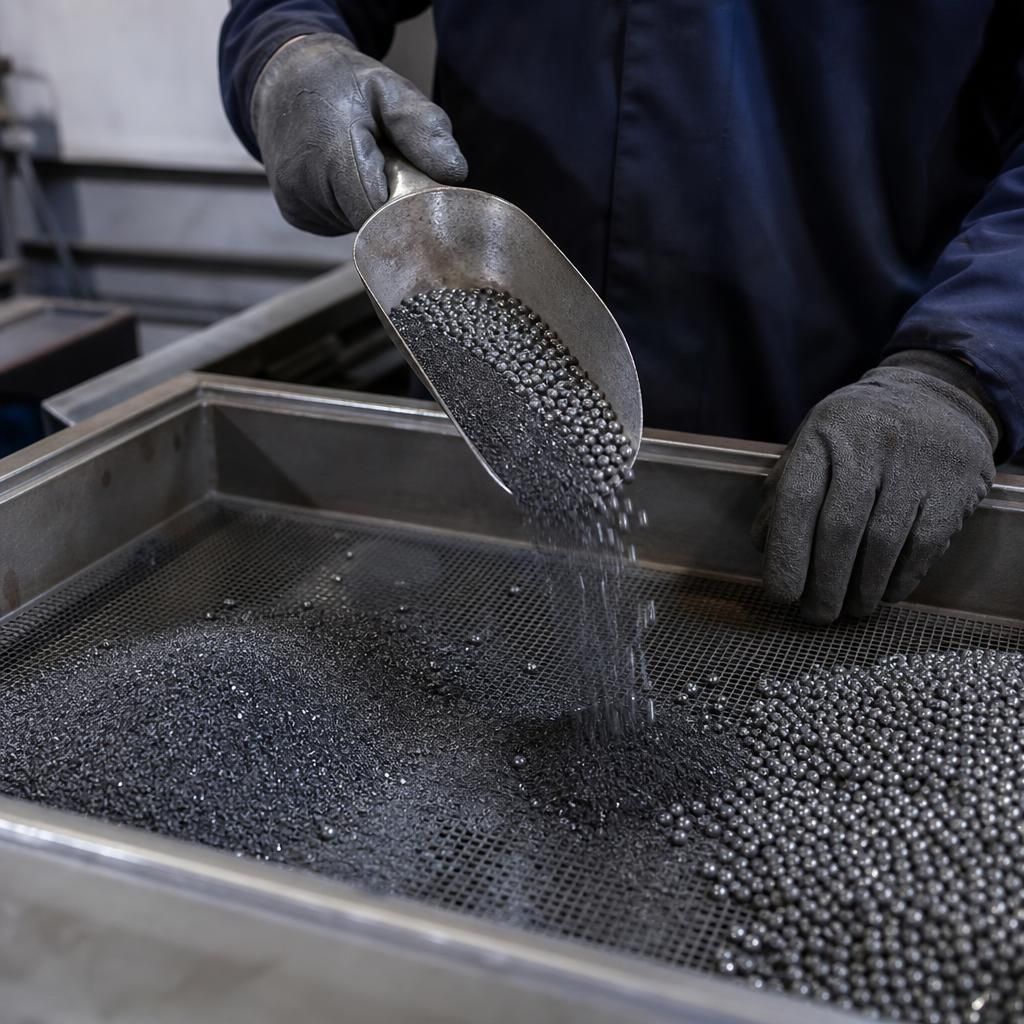
The condition of the abrasive can affect rust-removal effectiveness as much as its original type. Steel grit can retain its cutting action through repeated use, but worn particles gradually become less aggressive. Glass beads may also be reused, although fractured beads produce finer particles and a less consistent cleaning action. Abrasive that has become contaminated with rust, paint or other debris can further reduce process control.
For consistent results, blasting media should be assessed during the job rather than reused indefinitely. Removing spent material, checking the abrasive condition and replenishing it when necessary helps maintain a predictable cleaning rate and finish. This is particularly important when comparing steel grit and glass beads across a batch, because a change in media condition can make one part appear cleaner or rougher than another even when the equipment settings remain the same.
Discuss your rust-removal and coating preparation requirements
Discuss your component, corrosion condition and intended finish with Powder-coatings.co.uk to assess whether steel grit, glass beads or another preparation route is appropriate. Provide the relevant coating requirements so the surface preparation can be considered alongside the planned powder coating.