

What safety measures should be in place during abrasive blast cleaning operations?
Abrasive blast cleaning operations should be controlled through a task-specific risk assessment, suitable enclosure and ventilation, dust extraction, restricted access, and trained operators. Required controls also include appropriate respiratory and personal protective equipment, inspected hoses and blast equipment, safe handling of abrasive media, and clear procedures for equipment isolation, waste removal and emergencies.
Safe abrasive blast cleaning depends on controlling the blast system, the workpiece and the surrounding work area as one operation. In addition to the core controls for dust, access, operator protection and equipment condition, a robust arrangement should address pressure release, air quality, noise, static electricity, hazardous coatings, manual handling and emergency recovery.
Use fail-safe blast controls. The blast pot should have suitable pressure controls, correctly functioning valves and a remote deadman control that stops blasting when the operator releases it. The control should be positioned so that the operator can stop the abrasive stream without moving through the blast zone. Before any pot, hose connection or nozzle assembly is opened, the system must be depressurised and isolated in accordance with the equipment manufacturer’s instructions. No attempt should be made to clear a blockage by looking into a nozzle or by directing compressed air at a person.
Blast hoses should be secured against movement at connection points, with couplings and retaining arrangements suitable for the operating pressure. Nozzles need a secure holder or resting point when not in use. The compressor, blast pot and associated pipework should be arranged to prevent vehicle movement, sharp bends and trip hazards from affecting the system. Controls, gauges and warning devices should remain visible and accessible during the task.
Control compressed-air hazards. Compressed air can cause serious injury even when no abrasive is present. It should never be used to clean clothing, skin or a work area where it could propel dust towards people. The compressor should provide air suitable for the intended breathing-air system where supplied, with the relevant filtration and monitoring arrangements maintained separately from ordinary blast air. Compressor exhaust must not be able to enter the operator’s air supply or a nearby occupied area.
Manage noise as a separate risk. Blasting, compressors and impact from the workpiece can create high noise levels. Noise controls may include locating compressors away from occupied areas, using acoustic barriers or enclosures where practicable, limiting exposure through work planning and providing a hearing-conservation arrangement appropriate to measured conditions. Hearing protection should be selected to work with other protective equipment and should not prevent the operator from hearing essential alarms or instructions.
Prevent static and electrical incidents. The blast equipment, workpiece, extraction components and any conductive enclosure parts should be bonded and earthed where required. Electrical installations should be suitable for the conditions, protected from abrasive impact and kept clear of accumulated dust. Portable electrical equipment, lighting and inspection equipment should be selected for the environment and checked before use. Moisture, damaged cables and improvised connections can increase the risk of shock and should be dealt with before blasting begins.
Identify hazardous coatings before preparation. Old paint, corrosion products and residues may contain substances that create an additional exposure or disposal hazard when disturbed. The coating history should be established where possible, and suspect surfaces should be assessed before the cleaning method is chosen. If hazardous material is present, the work method, respiratory controls, decontamination arrangements and waste classification may need to change. Abrasive and removed coating should be collected, labelled and disposed of through an appropriate route rather than treated as ordinary workshop waste.
Protect people handling the workpiece. Components should be stable before blasting starts and supported so that they cannot roll, topple or swing. Lifting points, slings, hooks and stands should be suitable for the component and positioned to prevent unexpected movement. Heavy or awkward parts should be moved using appropriate mechanical assistance and a defined lifting plan. Operators should not place hands beneath suspended items or work between a component and a fixed object where movement could cause crushing.
Sharp edges, burrs and freshly blasted surfaces can also injure people during inspection and transfer. Components should be handled with suitable tools or gloves, and stable storage arrangements should prevent cleaned parts from falling or contacting contaminated surfaces. Good lighting is important for identifying defects, incomplete cleaning and unsafe component positioning without requiring an operator to approach an active nozzle.
Consider confined or enclosed spaces carefully. A blast room is not automatically a confined space, but tanks, vessels and other restricted locations may introduce separate risks from limited access, poor atmosphere or difficult rescue. Such work may require atmospheric testing, a permit system, an attendant and a rescue plan that does not rely on an unprotected person entering after an incident. Abrasive blasting should not proceed in a restricted space unless the access, communication and recovery arrangements have been specifically established.
Make procedures traceable. A safe system should set out the approved abrasive, equipment limits, start-up and shutdown sequence, inspection points, cleaning method and action to take if a control fails. Operators and supervisors should be able to confirm that pre-use checks have been completed and that defects have been reported and closed out. Maintenance records, exposure checks, equipment examinations and incident or near-miss reports provide evidence that controls are being kept effective rather than assumed to remain effective.
UK businesses should also consider the duties that apply to their operation under the Control of Substances Hazardous to Health, Provision and Use of Work Equipment, noise, workplace transport, lifting and confined-space requirements. The precise controls depend on the abrasive, coating, component size, equipment layout and work environment. A specialist industrial coating facility should be able to explain how these factors are incorporated into its blast-cleaning method before work begins.
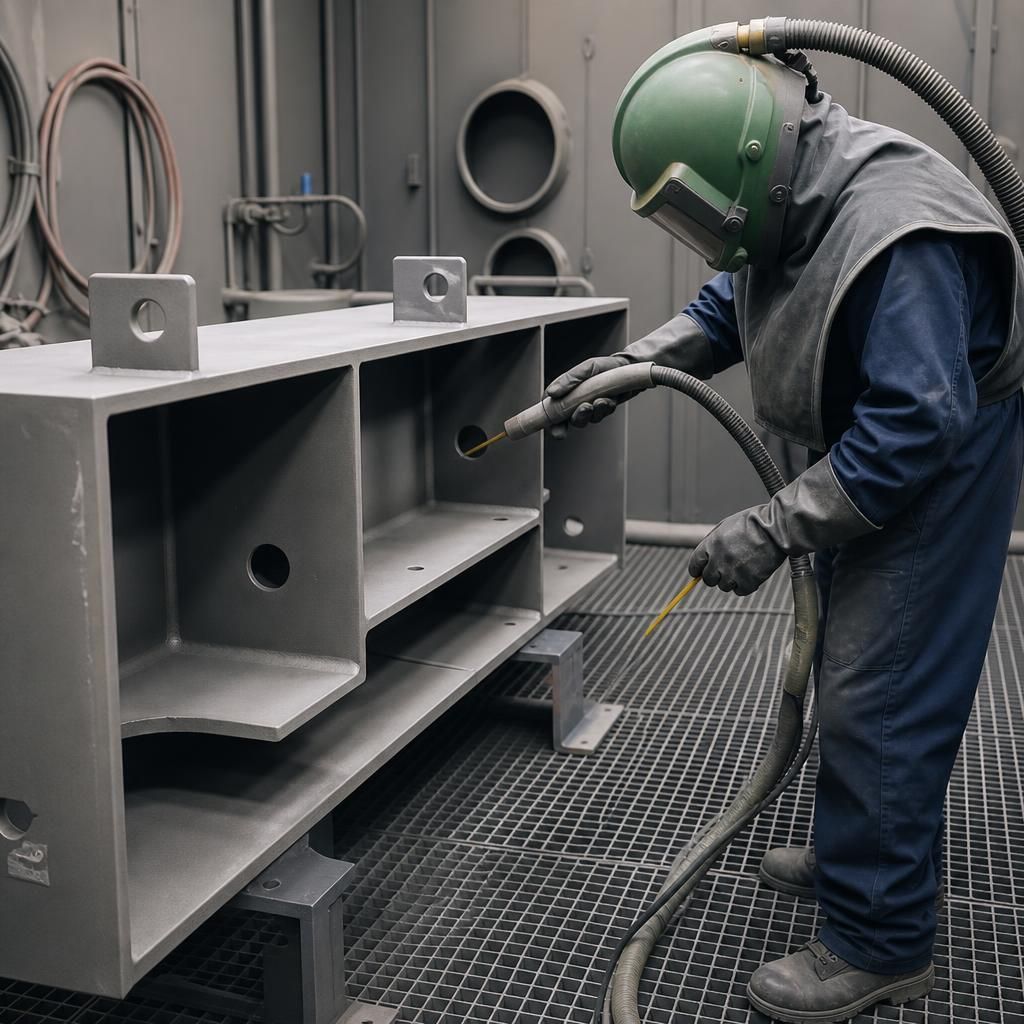
Hollow sections, recesses and overlapping parts require additional checks because abrasive can become trapped during blasting. Openings should be identified before work begins, with suitable plugs, drains or access arrangements used where necessary. After blasting, the component should be inspected and cleared using an approved method before it is lifted, rotated, moved or released for further processing. This prevents loose media from falling unexpectedly, obstructing moving parts or remaining inside a component where it could later contaminate a coating operation.
Discuss your abrasive blast cleaning safety requirements
Discuss your component, coating history and proposed blast-cleaning method with a specialist to identify the safety controls your operation requires. Share your handling, access and finish requirements so the process can be assessed before work begins.