

What are the benefits of using abrasive blast cleaning over chemical cleaning methods?
Abrasive blast cleaning removes rust, scale, old coatings and surface contamination mechanically, while creating a profiled surface that helps subsequent coatings adhere securely. Compared with chemical cleaning, it avoids chemical residues and can simplify preparation and waste handling, making it a practical option for consistent metal surface preparation.
Abrasive blast cleaning is often preferred to chemical cleaning because it provides more direct control over the condition of a metal surface before coating, without relying on the compatibility of acids, alkalis or solvents with the component. The process can be adjusted to suit the substrate and the level of contamination, making it suitable for removing corrosion, mill scale, existing finishes and tightly bonded deposits from industrial parts.
Key benefits compared with chemical cleaning include:
- Greater control over the preparation level: Blast pressure, nozzle distance, angle, dwell time and abrasive type can be selected for the metal and the condition of the surface. This allows an operator to remove unwanted material while limiting unnecessary treatment of sound areas.
- Reduced risk of chemical incompatibility: Chemical cleaners can react differently with different metals, alloys, welds, residues or previously applied finishes. Abrasive preparation avoids the need to select a chemical system that will work effectively without attacking or staining the underlying material.
- Better suitability for heavy contamination: Thick corrosion, scale and firmly attached coatings may require prolonged chemical contact or repeated cleaning stages. Abrasive action can break through these layers and expose the underlying surface for inspection and subsequent treatment.
- Useful preparation for coating inspection: Once the surface has been blasted, defects such as pitting, weld imperfections, sharp edges and remaining contamination are easier to identify. This gives fabricators and coating teams an opportunity to address problems before the component proceeds to the next stage.
- Less dependence on rinsing and neutralisation: Chemical processes commonly require controlled application, removal, rinsing and, where relevant, neutralisation. Any remaining product can affect later coating work. Blast cleaning does not create chemical residues in the same way, although dust and spent abrasive still need to be collected and managed correctly.
- Efficient treatment of varied components: A suitable blasting setup can be applied to individual parts, fabricated assemblies and production batches. The method can also be adapted for different shapes and levels of contamination, provided that access, masking and the sensitivity of the component are considered.
The surface profile produced by blasting is another important practical advantage. Rather than leaving a smooth or chemically altered surface, the process can create a controlled texture that gives a subsequent coating a suitable mechanical key. The required profile depends on the coating system, the metal and the specification, so the surface should not be made more heavily textured than necessary. Excessive blasting can increase media consumption, affect dimensions or make the finished surface unsuitable for a thin coating.
Abrasive blast cleaning can also simplify decisions where the original coating or contamination is unknown. Chemical cleaning normally depends on understanding how the substance will react with the material being treated. If the contamination contains several layers or includes substances that respond differently to the same chemical, the cleaning sequence may become more complex. Mechanical preparation is often more predictable in these circumstances, particularly when the operator can inspect the component throughout the process.
However, abrasive blasting is not automatically the correct choice for every component. Thin sheet, delicate edges, precision-machined areas and heat-sensitive parts may require reduced pressure, a finer or softer abrasive, careful masking or an alternative preparation method. Incorrect settings can cause distortion, embed abrasive or alter a critical surface. Chemical cleaning may be appropriate where blasting access is restricted, where a very delicate surface must be preserved, or where the specification requires a particular chemical treatment.
The two methods also have different control requirements. Blasting can generate airborne dust, noise and spent media, so suitable extraction, containment, personal protective equipment and waste procedures are essential. Chemical cleaning requires its own controls for handling, storage, exposure, ventilation, rinsing and disposal of contaminated liquid. The safer and more environmentally appropriate option depends on the material, the contamination, the chosen abrasive or chemical, and the arrangements in place to control the resulting waste.
For industrial metalwork, the best choice is therefore based on the complete preparation requirement rather than on the cleaning method alone. Abrasive blast cleaning is generally advantageous where the priority is controlled removal, clear surface inspection and a technically suitable finish for the next coating stage. A competent assessment should consider the substrate, component geometry, existing finish, required surface profile and final coating specification before work begins.
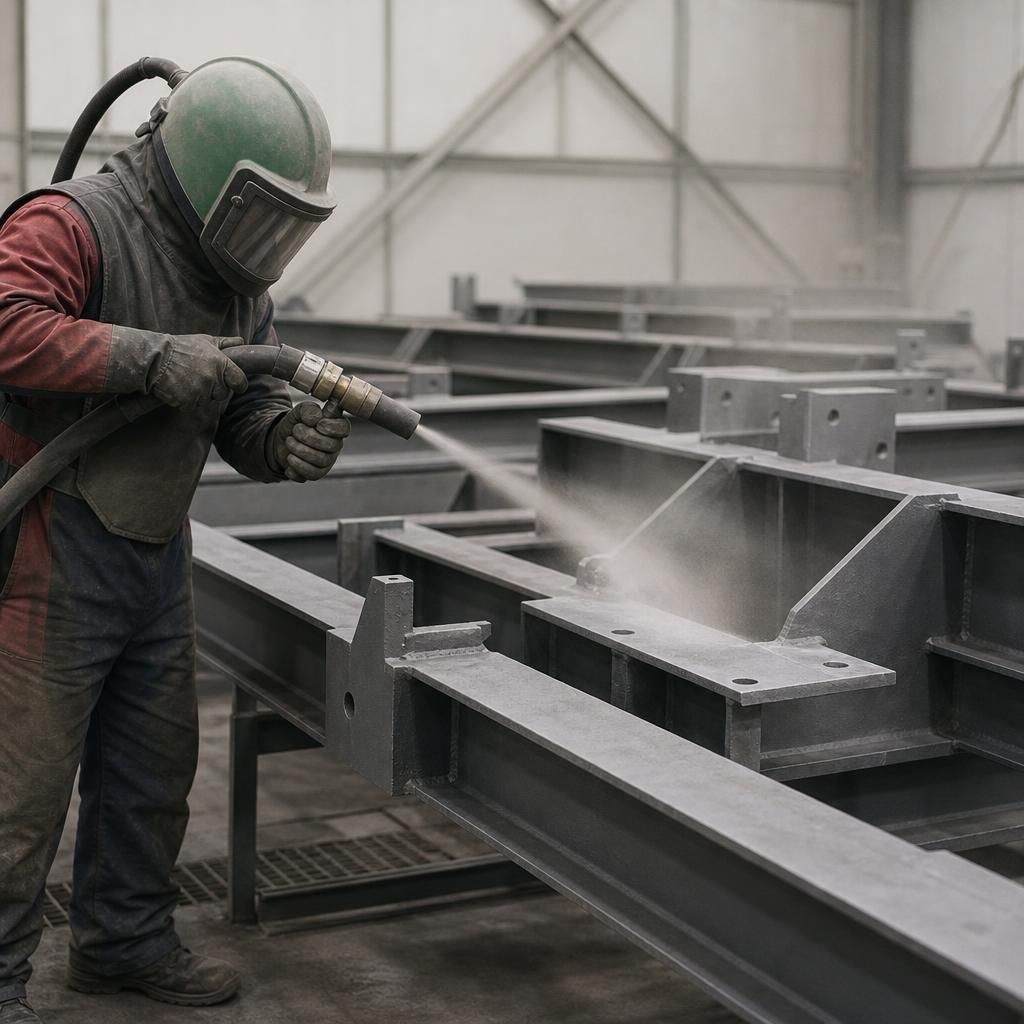
Abrasive blast cleaning can be advantageous for fabricated parts with seams, recesses, joints or enclosed features where liquid cleaning agents may be difficult to remove completely. Chemical cleaning may require thorough rinsing and drying to prevent trapped residues or moisture affecting the next process. A dry blasting process avoids introducing cleaning liquid into these areas, although dust and spent abrasive must still be removed carefully before coating.
This can make preparation more straightforward for welded frames, brackets and other complex metalwork. The operator can inspect awkward areas after blasting and confirm that loose corrosion, old coating and surface contamination have been removed before the component moves on to powder coating or another protective finish.
Discuss the right cleaning method for your metalwork
Discuss your component, existing finish and required coating specification with the team to establish whether abrasive blast cleaning is the appropriate preparation method. This assessment can help identify suitable blasting controls and any areas that require alternative treatment before coating.