

How does abrasive blast cleaning improve the longevity and performance of powder-coated surfaces?
Abrasive blast cleaning removes rust, mill scale, old coatings and other contaminants while creating a suitable surface profile for powder coating to grip. This stronger bond helps the finished coating resist peeling, corrosion and mechanical wear, supporting longer service life and more consistent performance.
Abrasive blast cleaning improves the service life and performance of powder-coated surfaces by providing a controlled, consistent foundation for the coating system. It helps expose sound metal, produces a more uniform surface condition and reduces the risk that defects in preparation will become coating failures during manufacture or service.
One important benefit is improved consistency across the whole component. Unprepared steel or aluminium can vary considerably in texture, oxidation and contamination, particularly around welds, corners, cut edges and recessed areas. Abrasive blasting treats these areas mechanically rather than relying solely on a liquid cleaner to reach and condition every part of the surface. When the preparation is carried out consistently, powder can be applied more evenly and the finished film is less likely to show isolated weaknesses.
The condition of the metal beneath the coating also affects long-term performance. Residual oxidation, embedded dirt or remnants of an earlier finish can provide starting points for defects beneath the powder film. Once moisture reaches such a point, deterioration may spread under the coating and create blistering, lifting or localised corrosion. Removing these unstable areas before coating gives the powder system a more dependable substrate and makes the final finish easier to assess during inspection.
Blast cleaning can be particularly valuable for fabricated components. Weld zones may contain heat-affected areas, weld spatter, residues and changes in surface texture that behave differently from the surrounding material. Cut edges and drilled holes can present similar preparation challenges. These features should be checked before blasting, as abrasive preparation is not a substitute for removing sharp burrs, correcting poor weld profiles or repairing unsuitable fabrication. Good design and fabrication practice remain part of the overall coating result.
The abrasive and process settings should be selected for the metal and the required finish. A treatment that is suitable for robust carbon steel may be too aggressive for thinner sections or softer non-ferrous metals. Excessive pressure or unsuitable media can alter dimensions, create an unnecessarily coarse surface or distort delicate components. Conversely, insufficient treatment may leave areas that are not suitable for coating. The objective is controlled preparation, not simply the most forceful cleaning possible.
Surface preparation also influences appearance as well as durability. Variations in the underlying surface can become visible through differences in texture, gloss or film coverage, especially on large panels and components with prominent faces. A uniform blasted condition helps powder coating produce a more consistent visual finish. This is relevant where coated parts are assembled together or where several components must present a matching appearance.
For corrosion-sensitive applications, the interval between blasting and powder application should be controlled. Clean metal can begin to oxidise again if it is exposed to moisture, condensation or unsuitable storage conditions. Handling should also avoid transferring oil, dirt or moisture back onto the prepared surface. Appropriate inspection and storage controls therefore form part of the longevity strategy; blasting alone cannot preserve the prepared condition indefinitely.
The finished result depends on more than preparation. Powder must be applied at the specified film thickness and cured according to the requirements of the coating system and the component. Insufficient or excessive curing can affect properties such as hardness, flexibility and resistance to chemicals or impact. Components should also be designed and handled with service conditions in mind, including exposure to water, salts, industrial contaminants, abrasion, temperature changes and mechanical contact.
Before coating, a practical quality check should consider:
- whether all required faces, edges, recesses and weld areas have been treated;
- whether the surface is free from visible residues, loose material and handling contamination;
- whether the resulting texture is appropriate for the metal and powder system;
- whether sharp edges, burrs, weld defects or fabrication problems need separate attention; and
- whether the prepared components can be kept dry and clean before powder application.
These controls make the coating process more predictable and reduce the likelihood of premature remedial work. For manufacturers, fabricators and other businesses coating batches of metal parts, repeatable preparation is especially important because inconsistent surface condition can lead to variable appearance and performance across the same production run. Abrasive blast cleaning therefore contributes to longevity not as an isolated treatment, but as one stage in a properly controlled preparation, coating, curing and inspection process.
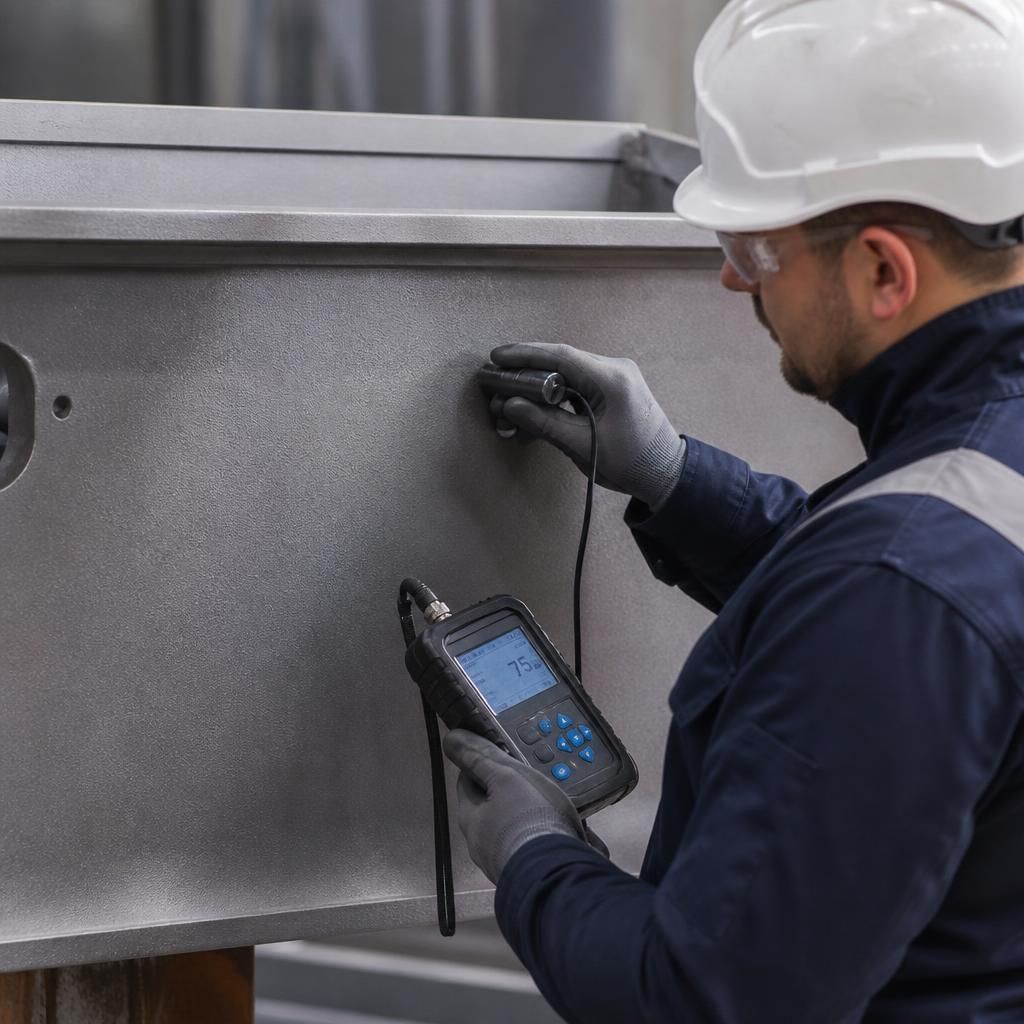
Abrasive blast cleaning supports powder-coating longevity by making the prepared surface measurable before coating begins. The operator can assess the visual cleanliness of the metal and check whether the blasted texture is suitable for the specified powder system, rather than relying only on the component’s appearance.
This provides a useful quality-control stage between preparation and coating. If the surface profile is too shallow, adhesion may be reduced; if it is unnecessarily coarse, the texture can affect powder coverage and the appearance of the cured finish. Recording these checks helps manufacturers and fabricators identify preparation issues before they become failures in service, particularly when the same components are processed in repeated batches.