

How does abrasive blast cleaning impact the efficiency and quality of subsequent powder coating applications?
Abrasive blast cleaning removes rust, scale, old coatings and other contaminants while creating a surface profile that helps powder coating bond securely to the metal. Consistent preparation supports more even coverage, reduces coating defects and helps subsequent applications achieve their intended durability.
Abrasive blast cleaning improves the efficiency and quality of a subsequent powder coating application by making the pre-treatment stage more controlled, repeatable and easier to inspect. It helps the coating team start with a consistent substrate, reducing avoidable preparation work and making powder application more predictable across individual parts and production batches.
How it improves process efficiency
Powder coating depends on effective preparation before the component reaches the spray booth. Abrasive blasting can remove several forms of surface contamination in one mechanical operation, including corrosion products, mill scale, aged coatings and firmly attached residues. This can be more efficient than relying solely on hand tools or localised preparation, particularly when components have extensive surface areas, awkward profiles or repeated batch requirements.
A consistent blast-cleaning specification also makes the workflow easier to reproduce. The operator can control factors such as abrasive type, pressure, nozzle distance, angle and dwell time according to the metal and the condition of the part. A repeatable preparation method reduces variation between components, which is important when a batch must have a uniform appearance and comparable performance.
Blast cleaning may also reduce interruptions later in the coating process. If loose scale, residual corrosion or unsound old coating is left in place, it can become a source of rework after powder application. Preparing the substrate properly at the start helps the coating team avoid processing parts that require stripping, local repair or re-preparation.
How it influences coating quality
The condition created by blasting affects how powder behaves during application and curing. A suitably prepared surface gives the coating a more consistent foundation, helping the finished film follow the underlying metal rather than highlighting loose material, flaking areas or abrupt transitions in the old surface.
Blast cleaning can also reveal issues that need attention before coating. It may expose weld spatter, sharp burrs, laminations, pitting, deep corrosion or defects in previous fabrication work. These findings allow the part to be assessed before powder is applied. Blasting does not correct dimensional faults or poor fabrication, so grinding, filling, welding or other remedial work may still be necessary where the specification requires it.
Surface appearance is affected by the relationship between the abrasive and the substrate. An abrasive that is too aggressive for a thin or softer component may create excessive roughness, distortion or visible texture. Conversely, an unsuitable or contaminated medium may leave an inconsistent finish. Media selection therefore needs to account for the metal, the required coating system, the component’s geometry and the appearance expected from the completed work.
Why preparation consistency matters in batch work
For manufacturers and fabricators, the main benefit is often consistency across a group of parts rather than the treatment of one isolated item. Differences in corrosion, previous coating thickness, weld areas and accessibility can cause parts to respond differently to blasting. Inspection between preparation and coating helps identify these differences before they affect the finished batch.
- Parts can be checked for remaining scale, corrosion, old coating and visible contamination.
- Edges, recesses, welds and difficult-to-reach areas can be examined for incomplete preparation.
- The surface can be reviewed for excessive roughness, embedded abrasive or blast-related damage.
- Components can be confirmed as dry and free from loose dust before powder application.
Consistent handling after blasting is equally important. Dust should be removed using a suitable method, and prepared metal should not be touched with contaminated gloves or exposed unnecessarily to moisture. Where the substrate is susceptible to flash rusting, the interval between blasting and coating should be managed as part of the process. The correct sequence prevents a well-prepared surface from deteriorating before it reaches the powder coating stage.
Important limitations and process controls
Abrasive blasting is not a universal substitute for every pre-treatment operation. Oil, grease and some chemical residues may need a separate degreasing or cleaning step, because blasting can spread contamination across the surface rather than remove it reliably. The preparation method should therefore be selected after considering the metal, existing finish, contamination, end use and powder coating specification.
Blast-cleaning equipment must also be set correctly. Excessive pressure, an unsuitable nozzle distance or prolonged treatment can damage thin sections and alter the surface beyond what the powder coating system is designed to accommodate. Inadequate treatment, on the other hand, may leave unstable material in place. Inspection and documented process controls help balance cleaning effectiveness with protection of the component.
Overall, abrasive blast cleaning contributes to a more efficient powder coating operation by moving avoidable problems into a controlled preparation stage. Its effect on quality is greatest when media selection, equipment settings, post-blast cleaning, inspection and transfer to coating are treated as one connected process rather than as separate tasks.
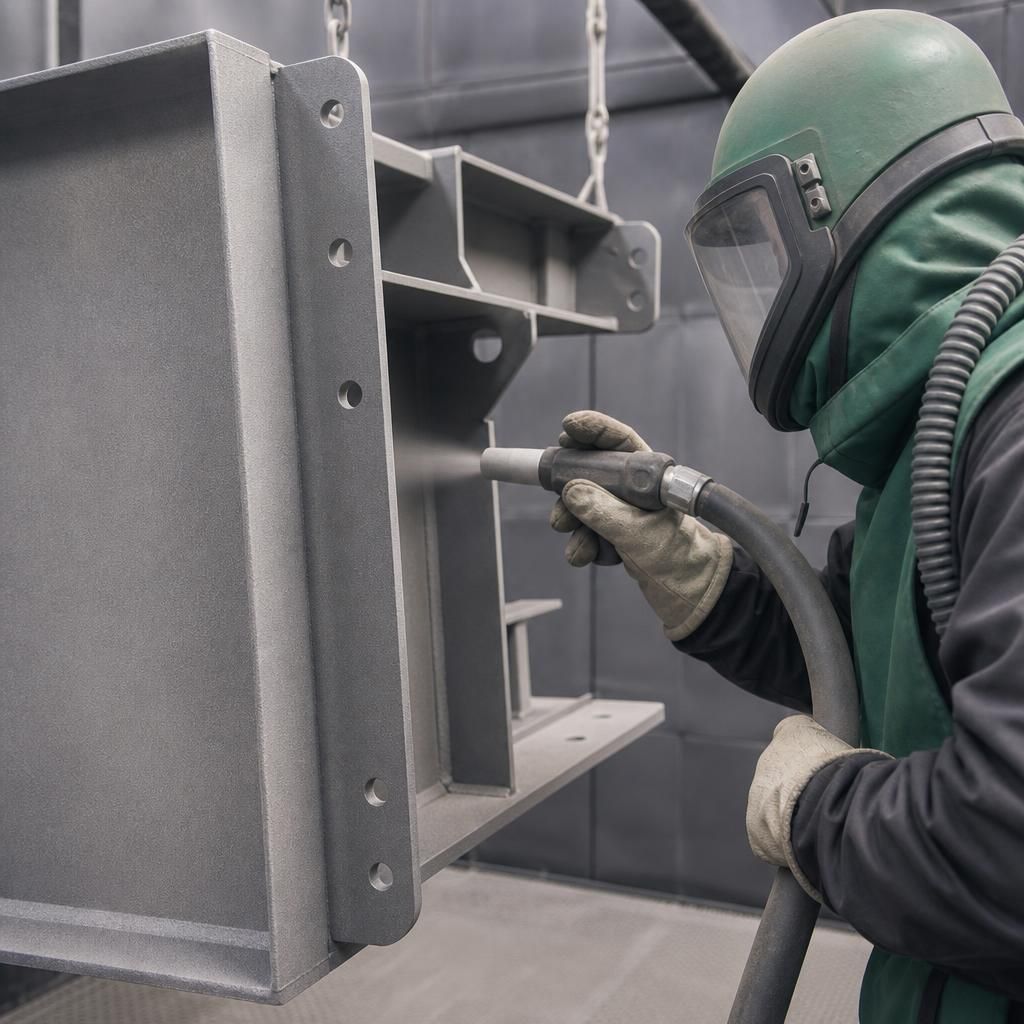
The blast profile must be suitable for the powder coating film that will be applied. A controlled profile provides mechanical keying without creating deep peaks and valleys that are difficult to cover evenly. If the profile is excessively coarse, the coating may need additional build to cover the surface consistently; if it is too shallow, the coating has less texture in which to anchor.
This relationship affects both finish quality and application efficiency. Matching abrasive treatment to the metal and coating specification helps the powder form a more uniform film, reducing the risk of thin areas over surface peaks or an unnecessarily heavy application across recessed areas. The result is a more predictable cured finish, provided the powder system, film thickness and curing conditions are also correctly controlled.
Assess your blast cleaning and powder coating requirements
Review your component material, condition, geometry and required finish before specifying the preparation process. Discuss your blast cleaning and powder coating requirements with the team to identify suitable preparation and coating controls for your parts or batch.