

How does abrasive blast cleaning enhance the durability of powder-coated steel components?
Abrasive blast cleaning prepares steel for powder coating by removing rust, mill scale, old coatings and other contaminants while creating a controlled surface profile. This textured, clean surface improves powder adhesion, helping the finished coating resist impact, moisture ingress and corrosion-related failure.
Abrasive blast cleaning enhances the durability of powder-coated steel by creating a consistent, inspectable substrate on which the coating system can perform as intended. Its value is not limited to making steel look clean: the process also helps control surface condition, identify defects before coating and establish a suitable foundation for long-term resistance to mechanical and environmental stresses.
The prepared surface affects how effectively the powder coating forms a continuous protective film during curing. A suitable blast profile gives the coating a stable mechanical key, while excessive or uneven blasting can create peaks, recesses or thinly covered areas. The abrasive, air pressure, stand-off distance and blasting angle therefore need to be selected in relation to the steel grade, component geometry and coating specification.
Consistent preparation is particularly important for components with welded areas, cut edges, corners, folded sections or areas affected by fabrication. These zones can have different surface conditions from the surrounding steel. Weld spatter, heat-affected areas and sharp transitions may interfere with uniform coating coverage or create points where damage begins. Abrasive blasting helps bring these variations under control, although fabrication defects and excessively sharp edges may still require mechanical treatment before blasting.
Blast cleaning can also improve the reliability of the complete coating system by making the substrate condition more predictable. Powder coating is only one part of steel protection; its performance depends on the relationship between the steel, the preparation method, any pretreatment and the selected powder. Where a component will face outdoor exposure, moisture, chemicals, abrasion or repeated handling, the preparation standard should be chosen as part of the overall specification rather than treated as an isolated production step.
Its contribution to corrosion resistance is especially important at vulnerable locations. Corrosion can develop beneath a damaged or poorly bonded coating and spread from a local defect. A properly prepared surface reduces the likelihood of weak interfaces and supports more reliable protection around welds, joints and fabricated sections. It cannot, however, compensate for unsuitable coating thickness, incomplete curing, contamination after blasting or design features that retain water.
Durability also depends on preserving the prepared condition between blasting and powder application. Steel should be handled in a way that avoids fingerprints, oil transfer, dust deposition and renewed oxidation. If the surface becomes contaminated or develops visible flash rust before coating, it may need reassessment and further preparation. Applying powder to a surface that no longer meets the specified condition can undermine the benefits of the original blast-cleaning operation.
Quality checks help confirm that preparation is suitable before coating begins. Depending on the project requirements, these checks may include:
- visual assessment of the cleaned steel for remaining scale, rust, residues or other surface defects;
- verification that the blast profile is within the range required by the coating specification;
- inspection for abrasive dust or loose particulate matter;
- assessment of visible flash rust or moisture-related deterioration;
- checks on edges, welds, recesses and other difficult-to-coat areas; and
- confirmation that the prepared parts are protected from recontamination before powder application.
For larger batches, repeatability is as important as the result on an individual component. Consistent blast parameters and inspection procedures help prevent variation between parts, which can otherwise lead to different coating performance across the same assembly. Component design, loading arrangements and access for the blast equipment should also be considered because shadowed or enclosed areas may receive less uniform treatment.
Abrasive blast cleaning therefore improves powder-coated steel durability through controlled preparation, better process consistency and earlier identification of conditions that could shorten service life. It is most effective when matched to the exposure environment, the steel component and the powder-coating specification, with surface condition verified before coating and the finished coating checked for continuity and coverage.
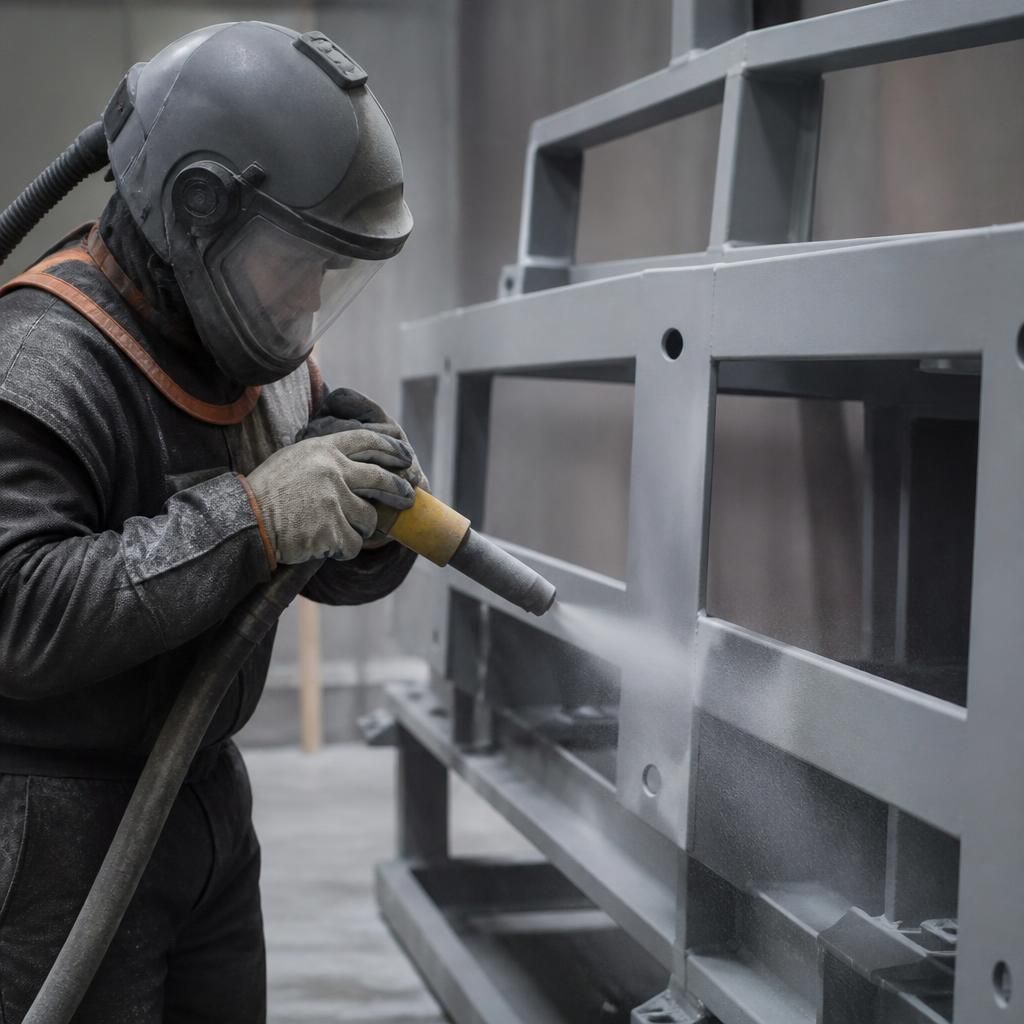
One often overlooked factor in powder-coated steel durability is the removal and control of corrosion-active residues. Soluble salts, oil and processing contaminants can remain in pits, weld areas or surface irregularities and may attract moisture beneath the coating. This can contribute to blistering, underfilm corrosion and local loss of adhesion.
Abrasive blast cleaning removes many surface contaminants and exposes areas that require further treatment. However, blasting alone should not be treated as proof that the steel is free from soluble salts or other residues. Where exposure conditions are demanding, the prepared surface may need additional cleaning and verification before powder application. Controlling these residues reduces the risk of hidden corrosion developing beneath an otherwise continuous coating.