

What innovative technologies are currently available in electrostatic powder coating that enhance its application efficiency and final output quality for industrial uses?
Current electrostatic powder coating technology includes digitally controlled spray guns, automatic reciprocators and robotic application systems that regulate powder flow, voltage and gun movement for more consistent coverage. Advanced booth and recovery systems can also improve transfer efficiency and powder reclaim, while precise curing controls help produce an even, durable finish with fewer coating defects.
Innovative electrostatic powder coating technologies now improve industrial results through developments in powder chemistry, substrate preparation, process monitoring, curing methods and quality inspection. These technologies complement the application equipment itself, helping coaters achieve the required film thickness, adhesion, appearance and durability while reducing rework caused by unsuitable materials or process conditions.
Advanced powder formulations are one of the main areas of development. Low-temperature and fast-cure powders can reduce the thermal load placed on components and may support more efficient oven operation, provided the powder and substrate are compatible. Thin-film formulations are designed to produce an even finish with less material, while high-flow powders can help improve appearance on visible panels and fabricated parts. Specially engineered powders are also available for specific requirements, including enhanced weathering, chemical resistance, abrasion resistance and electrical insulation.
Metallic and mica-effect powders have also benefited from improved particle engineering. Bonded metallic powders hold decorative particles more consistently within the coating material, helping reduce visible variation between batches. However, metallic finishes remain more sensitive to application conditions and part orientation than standard solid colours, so a production trial and an agreed visual standard are important before volume work begins.
Improved electrostatic charging methods can assist with difficult component geometries. Corona charging remains widely used, while triboelectric systems charge powder through friction rather than relying on the same electrode arrangement. These approaches can behave differently around corners, recesses and enclosed sections. The correct choice depends on the powder, component shape, required finish and the extent of the Faraday cage effect, where charged powder is naturally repelled from deep recesses or internal angles.
Grounding verification is another useful development. Monitoring the electrical path between the component and the coating equipment can identify poor contact caused by hooks, masking, contamination or accumulated coating. A reliable earth is necessary for consistent powder attraction and also forms part of safe process operation. Ground-contact checks are particularly relevant where reusable fixtures are used across repeated batches.
Modern pre-treatment technologies can improve both coating adhesion and corrosion protection before powder is applied. Nanoceramic conversion systems based on zirconium or silane chemistry are alternatives to some traditional phosphate processes, although the appropriate treatment depends on the metal type, service environment and specification. Automated chemical dosing, conductivity monitoring and controlled rinsing help maintain repeatable bath conditions. For certain components, laser cleaning or other dry-cleaning methods can remove local contamination without introducing additional liquid treatment, but these methods require careful assessment of the surface profile and production rate.
Alternative curing technologies provide further options for industrial work. Infrared curing can transfer heat directly to suitable surfaces and is often considered for shorter heating zones or hybrid oven designs. Induction heating can heat conductive metal rapidly, although component geometry, mass and coating formulation affect its suitability. Ultraviolet-curable powder systems are available for selected applications where the coating can receive sufficient UV exposure; recessed areas and shadowed surfaces can limit their use on complex fabrications. Low-temperature, infrared and UV systems should therefore be selected from the complete cure specification rather than by energy consumption alone.
In-process measurement and inspection make it easier to identify variation before finished parts leave production. Eddy-current and magnetic-induction gauges can check cured film thickness on appropriate metal substrates, while gloss meters and colour spectrophotometers provide objective checks for appearance. Digital microscopy can help investigate inclusions, pinholes, craters, orange peel and insufficient coverage. For repeat work, recording these results against a batch or job reference creates a useful quality history and helps distinguish material, preparation and application faults.
Machine-vision inspection is increasingly used where components have repeatable shapes and defined cosmetic requirements. Cameras can identify missed areas, colour differences, edge coverage issues and certain surface defects, reducing dependence on visual inspection alone. Vision systems are most effective when lighting, viewing angles and acceptance limits are standardised; they do not replace engineering judgement for adhesion, corrosion performance or cure validation.
Digital process integration is also changing how coating operations are controlled. Electronic job records can link the component specification with the powder reference, pre-treatment conditions, cure schedule, inspection results and any approved deviations. This improves traceability for manufacturers and fabricators, particularly when the same part is produced in multiple batches or when coating forms part of a wider quality-management system.
When selecting among these technologies, the main considerations are the substrate, component dimensions, geometry, expected exposure, colour and gloss requirements, production volume, powder formulation, available curing method and inspection standard. A low-temperature powder may be unsuitable if the finished coating needs a particular chemical or abrasion resistance. Similarly, a sophisticated inspection system cannot compensate for poor preparation or inadequate grounding. The best result comes from matching each technology to the complete coating specification and validating it on representative parts before routine production.
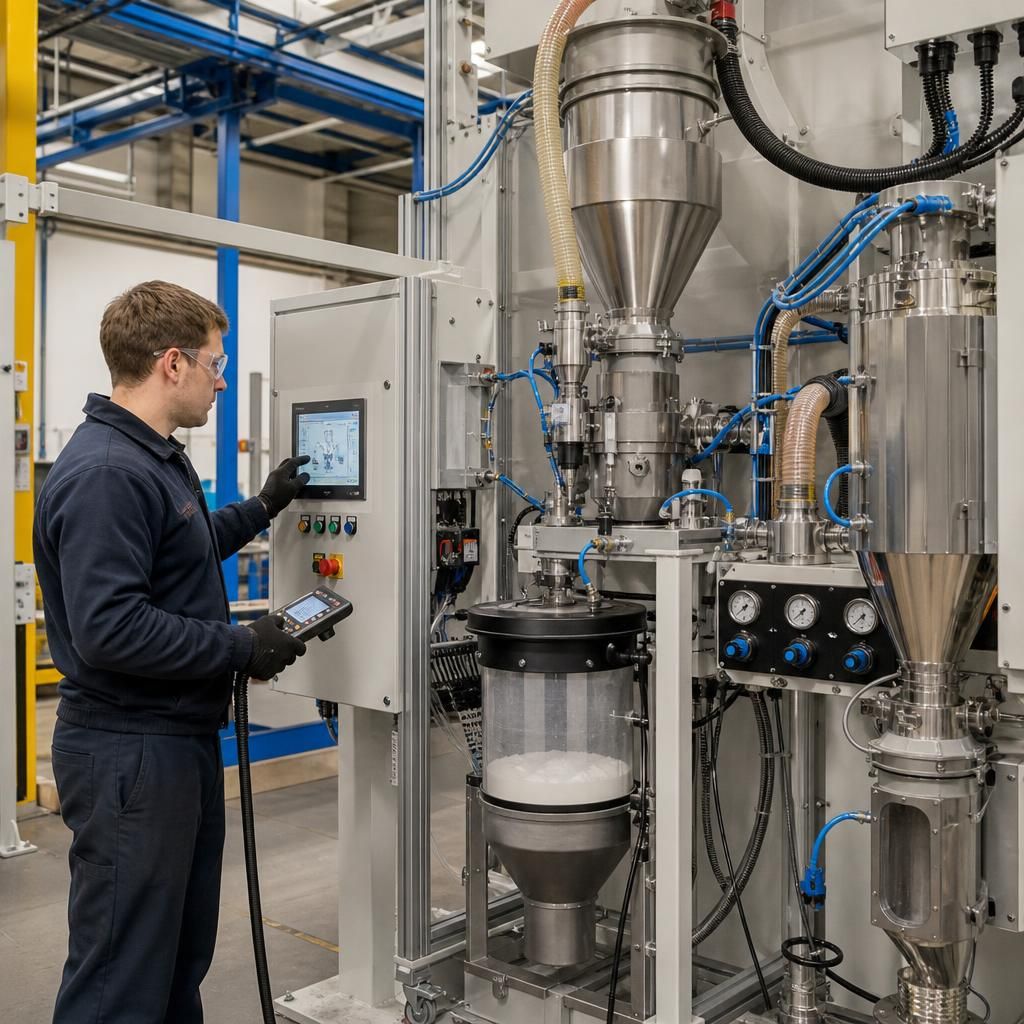
Automated powder-handling technology improves application efficiency by controlling how coating material is fluidised, transported and delivered to the spray equipment. Stable powder density helps maintain consistent feed rates, reducing fluctuations in film build and limiting interruptions caused by blocked hoses, uneven flow or manual adjustment.
Modern systems can also support controlled powder recovery. Reclaimed material may be sieved or filtered before reuse, with its suitability assessed against the colour, finish and performance requirements of the job. This is particularly important for industrial batch work, where uncontrolled mixing of colours or incompatible formulations could affect appearance. Automatic cleaning and colour-change functions can further reduce contamination between production runs, while recipe-based settings help operators repeat an approved powder-delivery configuration.
These systems are most effective when powder condition, equipment settings and reclaim practices are managed as one process. They should be validated with the chosen formulation and component specification rather than treated as a standalone upgrade.
Discuss innovative electrostatic powder coating options for your components
Discuss your component geometry, substrate, finish requirements and production volumes with our coating team to identify suitable electrostatic powder coating technologies. We can help assess which options are appropriate for your specification before production work begins.