

What role does degreasing play in surface preparation for powder coating?
Degreasing removes oils, grease and other contaminants from metal before powder coating, giving the coating a clean surface to bond to. Without effective degreasing, residues can cause poor adhesion, surface defects and reduced finish durability.
Degreasing is the controlled removal of oils, grease and other organic residues from a metal substrate before powder coating. Its role is to create a chemically clean starting surface so that subsequent preparation, such as rinsing, conversion treatment or abrasive blasting, can work consistently rather than being obstructed by residues left from manufacturing and handling.
Metal components can carry several types of contamination, including cutting fluids, drawing compounds, machining oils, polishing residues, waxes, release agents and fingerprints. These substances may be present as a visible film, or as a thin layer that is not obvious during a visual inspection. Handling after degreasing can also transfer contamination back onto the surface, particularly through unclean gloves, tools, storage racks or packing materials.
The correct degreasing method depends on the substrate, the type of contamination and the rest of the preparation process. Common approaches include:
- Aqueous alkaline cleaning: water-based alkaline solutions break down and lift many oils and grease residues. The concentration, temperature, contact time and agitation must suit the metal being treated.
- Solvent cleaning: suitable solvents can dissolve particular oils, waxes or residues, but the solvent must be compatible with the substrate and fully removed before coating.
- Mechanical assistance: brushing, wiping or agitation can help a cleaning solution reach recesses, joints and textured areas. Mechanical action should not spread contamination across an otherwise clean surface.
- Multi-stage cleaning: heavily contaminated components may require an initial removal stage followed by a more controlled wash and rinse before further preparation.
Degreasing is not a substitute for every other preparation stage. It does not normally remove corrosion, mill scale, weld discolouration or deeply embedded inorganic contamination. Where those conditions are present, degreasing may be used first to prevent oils from interfering with blasting or other treatment. Abrasive preparation can then address the remaining scale or create the required surface profile. On some projects, a chemical conversion treatment follows cleaning to provide an additional prepared surface before powder application.
Rinsing is an important part of the process. Cleaning chemicals and loosened contamination must be removed rather than allowed to dry on the component. Residual alkalinity, salts or detergent can interfere with later stages and may be particularly difficult to identify once the powder has been applied. Components should therefore be rinsed with suitable water, drained effectively and dried thoroughly, including inside holes, folded sections and joints where liquid can collect.
Process control also involves preventing recontamination. Cleaned parts should be handled with appropriate gloves and kept away from dirty work areas, unclean fixtures and airborne oil. Masking, racking and orientation should be planned so that degreased surfaces are not touched unnecessarily and trapped solution can escape. For complex fabrications, attention to seams, boxed sections and crevices is essential because these areas are easy to miss during manual cleaning.
A simple water-break inspection can help assess whether a surface is uniformly clean. When water forms a continuous film across the metal, the surface is generally more evenly wettable; beading or isolated breaks in the film can indicate remaining oily contamination. This check is an aid rather than a complete validation, so it should be combined with control of the cleaning process and inspection of representative areas.
Effective degreasing therefore depends on more than applying a cleaner. It requires identifying the contaminants, selecting a compatible method, controlling contact conditions, rinsing and drying correctly, and protecting the prepared surface until powder coating begins. The result is a more predictable foundation for the later preparation stages and for consistent coating application on manufactured metal components.
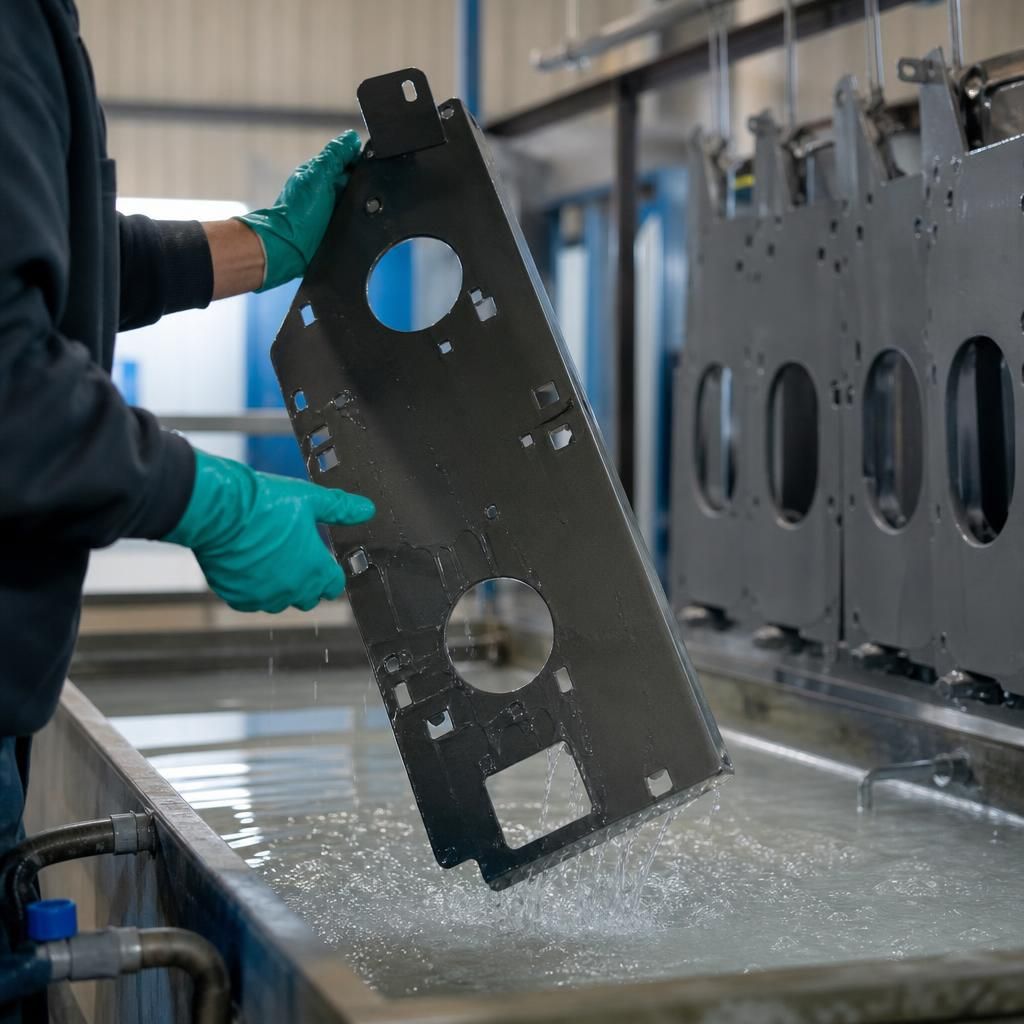
Degreasing matters because oil and grease residues can become coating defects during curing, not merely affect the appearance of the bare metal. As the component heats, trapped organic contamination may migrate or volatilise beneath the powder film, contributing to pinholes, blisters, craters or localised loss of adhesion.
These defects can be unevenly distributed, particularly where contamination has accumulated around handling points, machined areas or component features. A part may therefore look clean before coating while still carrying enough residue to disrupt the finish during curing. When defects correspond to contact points or contaminated zones, the preparation process should be reviewed before altering powder selection or oven settings. Effective degreasing removes a potential source of failure before it becomes concealed beneath the cured coating.
Discuss your degreasing and powder coating requirements
Discuss your components, existing contamination and required finish with the powder coating team to determine the most suitable degreasing and preparation approach. Share drawings or sample parts where relevant so the preparation requirements can be assessed accurately.