

What is the importance of selecting the right abrasive media for surface preparation?
Selecting the right abrasive media is essential because its hardness, shape and size determine how effectively contaminants and existing coatings are removed without damaging or distorting the metal substrate. The correct choice produces a suitable surface profile for powder coating, supporting consistent adhesion, finish quality and long-term durability.
Selecting the right abrasive media matters because it determines whether the prepared component is chemically clean, mechanically suitable and consistent from one area to the next. Media that is inappropriate for the substrate or the required coating system can leave embedded residue, create an uneven texture, round sharp details or produce a surface that is difficult to inspect and coat reliably.
Substrate compatibility
The first consideration is the material being prepared. Carbon steel, stainless steel, aluminium, galvanised components and castings respond differently to abrasive treatment. A media suitable for robust steelwork may be unnecessarily aggressive for aluminium or thin-gauge sections. Softer or more controlled media can be preferable where preserving edges, threads, machined faces and close tolerances is important.
Stainless steel and aluminium also require particular care to prevent contamination. Abrasive previously used on ordinary carbon steel can transfer ferrous particles to a non-ferrous surface. Those particles may later oxidise or discolour, undermining the appearance and corrosion performance of the finished coating. Dedicated media, appropriate equipment cleaning and controlled handling may therefore be needed for sensitive substrates.
Required level of cleaning
Media should be selected according to what must be removed, not simply according to the visual appearance required after blasting. Loose mill scale, tightly bonded oxides, old coatings, weld residues, corrosion products and accumulated dirt do not all respond in the same way. A process intended only to remove light contamination may use a different approach from one required to strip a firmly adhered coating.
Using media that is too mild can leave residues or coating remnants in pits, around welds and within difficult-to-reach details. Using a more aggressive option than necessary can increase the risk of unnecessary substrate alteration and create additional cleaning or inspection work. The chosen process should remove the relevant contamination while remaining proportionate to the condition and construction of the part.
Component geometry and construction
Part design affects media selection as much as material does. Open structural sections may tolerate a more forceful process, whereas folded sheet, perforated panels, narrow channels and fabricated assemblies can trap abrasive or receive uneven treatment. Intricate components may need media and blasting parameters that provide access without obstructing apertures or damaging delicate features.
Welds, corners and transitions deserve particular attention. These areas can retain residues and may have different surface characteristics from the surrounding parent metal. A suitable abrasive process should allow the operator to treat these locations consistently without excessive attack on adjacent edges. The method may also need to account for distortion risk in thin sections and heat-sensitive assemblies.
Controlling contamination and residue
Cleanliness is not determined solely by the abrasive itself. Media must be dry, free from oil and kept in a condition that does not introduce new contamination. Breakdown of worn abrasive can generate dust and fines, while unsuitable storage can expose it to moisture or other contaminants. Recycled media should be monitored so that changes in its condition do not lead to inconsistent preparation.
After blasting, loose dust and spent abrasive need to be removed using a suitable method. Residue left on the surface can interfere with electrostatic coating, become visible in the finish or create weak areas where the powder does not bond as intended. Components should also be protected from handling contamination between preparation and coating; clean gloves, suitable coverings and controlled transfer can be as important as the blasting operation.
Surface texture and coating requirements
The required surface texture should be established from the coating specification and the substrate rather than selected by habit. A surface that is too smooth may provide insufficient mechanical keying for the coating system, while an excessively rough surface can increase powder consumption, make coverage over peaks and recesses less uniform and affect the visual finish.
The profile should be considered alongside the powder coating thickness and the part’s service conditions. Components exposed to handling, moisture, chemicals or outdoor environments may require a preparation process that supports more demanding protective performance. Decorative parts may place greater emphasis on uniformity and the avoidance of visible blasting marks. The correct abrasive media helps balance these requirements, but the result still depends on equipment settings, operator technique and subsequent cleaning.
Process consistency
Media selection should be documented as part of the preparation specification. Relevant controls include the media type, condition, blasting pressure, nozzle distance, angle of application, travel speed and the areas requiring particular attention. Keeping these factors consistent makes it easier to compare batches and identify whether a problem arose during preparation, handling or coating.
Inspection should cover the whole component rather than relying on a single easily accessible area. Operators can check for remaining scale, rust, old coating, visible contamination, uneven treatment and trapped abrasive. Where the project requires it, surface-profile and cleanliness checks can provide more objective evidence that preparation is suitable for the intended powder coating system.
How the choice should be made
- Identify the substrate, thickness, geometry and any areas with tight dimensional requirements.
- Define the contaminants or existing coatings that must be removed.
- Confirm the surface condition required by the powder coating specification.
- Exclude media that could introduce unacceptable contamination or damage.
- Carry out a controlled trial on representative material where the substrate or finish is sensitive.
- Inspect the prepared surface before coating and adjust the process if the result is inconsistent.
In practice, the best abrasive media is not necessarily the most forceful or the most readily available. It is the option that matches the metal, contamination, component design and coating requirements while producing a repeatable prepared surface. That considered choice reduces avoidable preparation defects and gives the subsequent electrostatic coating process a sound, controllable foundation.
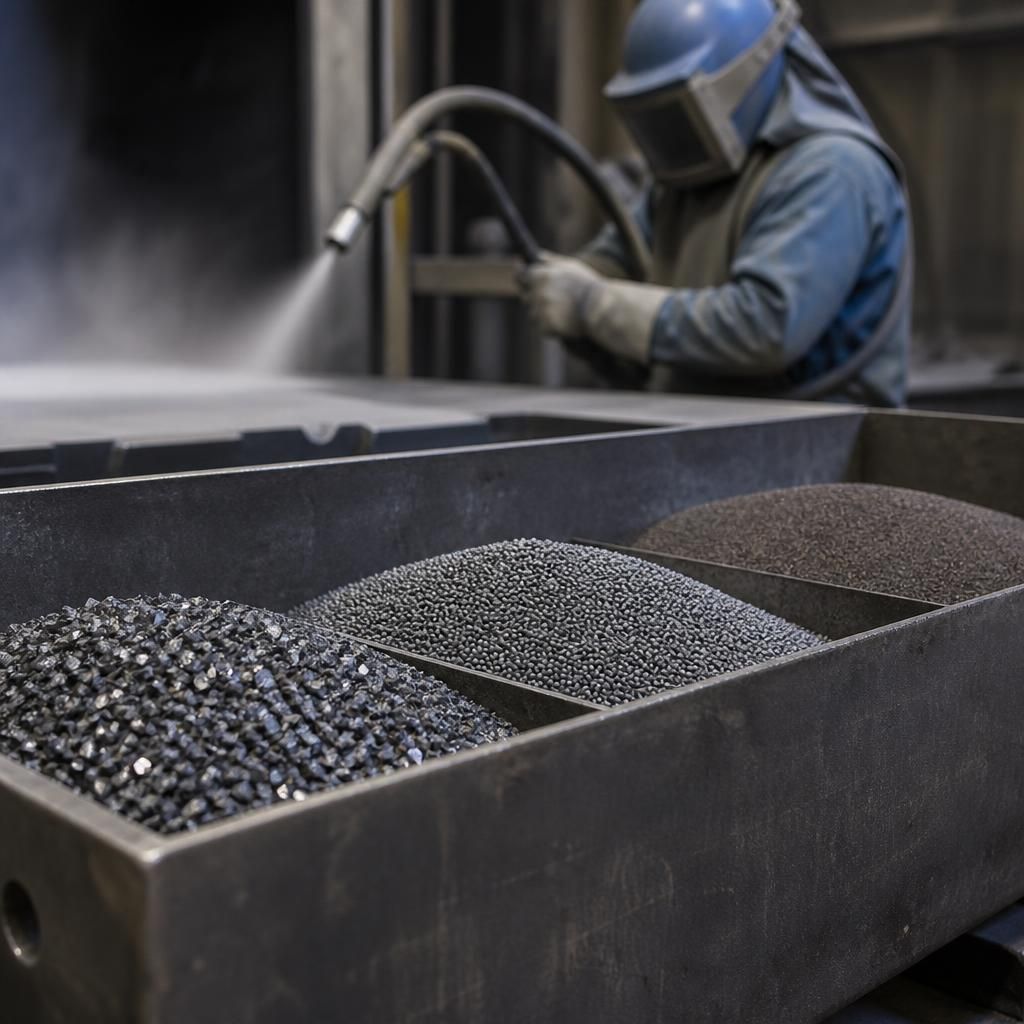
The shape of abrasive media affects how it interacts with the substrate. Angular particles tend to cut into contamination and create a more defined mechanical key, while rounded particles distribute impact more evenly and are more likely to clean or peen the surface than produce sharp profile peaks. This distinction matters when preparing metal for electrostatic powder coating because the same blasting pressure can produce different results with different media shapes.
Media shape should therefore be considered alongside the required finish and the condition of the component. A cutting action may be appropriate for firmly attached residues, whereas a less aggressive impact can be preferable where the surface must remain uniform and dimensional features need protecting. Selecting the right shape helps avoid relying on excessive blasting force to achieve cleanliness, reducing the risk of an unnecessarily harsh or inconsistent surface before coating.