

How does surface profiling impact the adhesion of powder coating?
Surface profiling creates a controlled pattern of peaks and valleys on the metal, giving the powder coating greater surface area and a mechanical key for stronger adhesion. An insufficient profile can reduce grip, while an excessively rough or uneven profile may remain visible through the finish and require more coating to cover.
Surface profiling affects powder coating adhesion by controlling how consistently the coating anchors to the prepared metal and how evenly it forms across the component. The profile must suit the substrate, coating system and service conditions; an apparently clean surface can still produce poor adhesion if its texture is inconsistent, contaminated or incompatible with the specified finish.
Profile consistency is as important as profile depth. Areas that receive different blasting intensity, contain tightly packed abrasive residue or remain relatively smooth may respond differently during coating. This can create local variations in adhesion, particularly around welds, corners, folded sections, recesses and areas that were difficult to access. A controlled, uniform texture gives the coating a more consistent foundation across the whole part.
The profile also affects the way the powder coating covers the substrate. A coarse or irregular surface can require careful control of powder deposition and curing to avoid visible texture, thin coverage on high points or incomplete coverage in recessed areas. If the surface texture is too pronounced for the specified coating, the finished appearance may become uneven and the coating may not provide consistent protection at every point.
Surface profiling must be considered alongside the condition of the base metal. Blasting can expose rust, mill scale, fabrication marks and weld-related contamination, but it does not correct every underlying defect. Deep pitting, sharp burrs, laminations and poorly prepared welds can remain potential weak points after blasting. These defects may interrupt coating continuity or create areas where moisture and contaminants are more likely to become trapped.
The substrate material and its previous treatment also influence the required preparation. Mild steel, galvanised steel and other metals may need different preparation controls because their surfaces react differently to blasting, handling and coating. A method that is suitable for one substrate may produce excessive roughness, distortion or inadequate preparation on another. The selected abrasive, blasting pressure, working distance and angle should therefore be agreed with the coating specification rather than chosen in isolation.
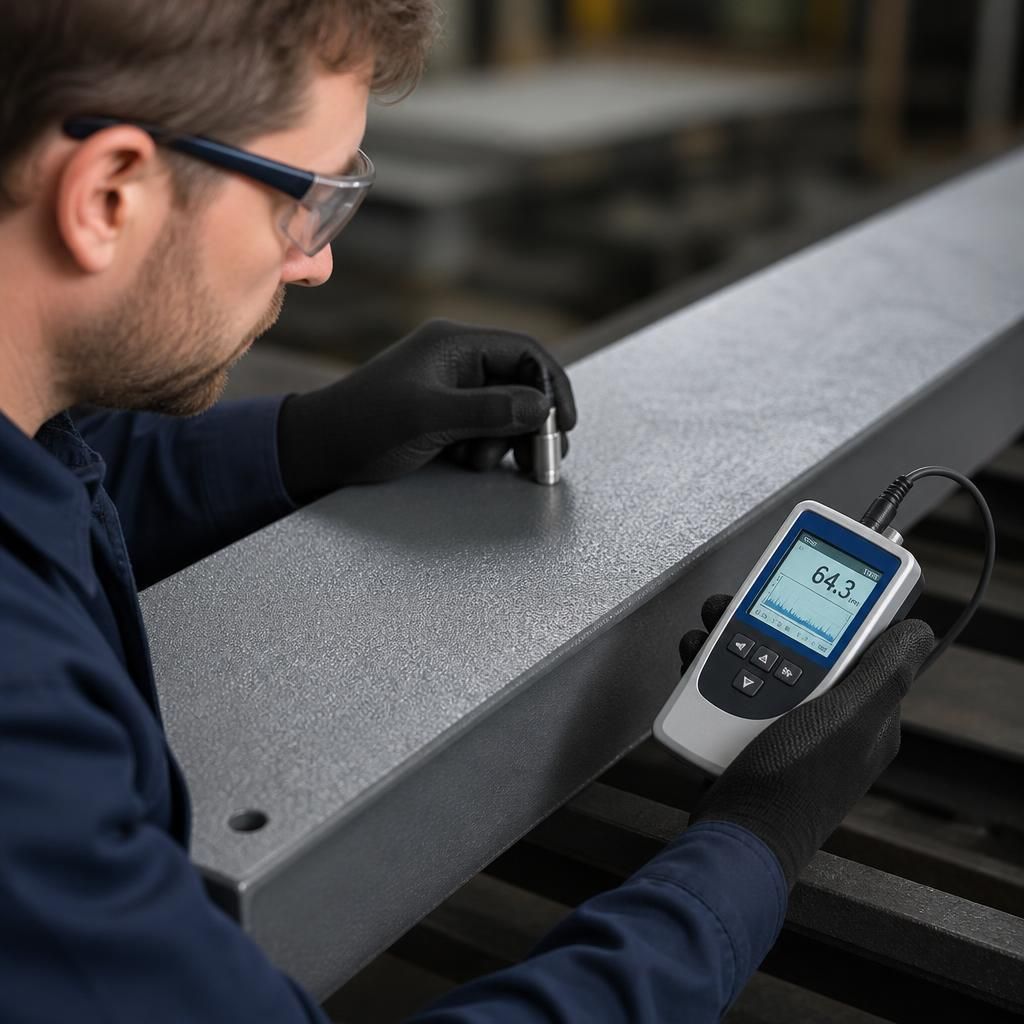
Profile verification is normally based on the preparation specification for the job. Depending on the component and required finish, checks may include visual examination, comparison with approved reference surfaces and measurement using a suitable surface-roughness instrument. The surface should also be checked for dust, loose residue and visible contamination after profiling. Measurement is most useful when taken at representative locations, including difficult areas, rather than relying on one accessible section of the component.
Handling after preparation can reduce the benefit of a correctly produced profile. Bare hands, dirty slings, unclean benches and airborne contamination can transfer substances to the prepared surface. Parts should be protected from further contamination and coated within the agreed process controls. If flash rusting, visible dust or other contamination develops, the surface may require additional preparation before powder application.
Where adhesion is unsatisfactory, the failure pattern can help identify whether profiling was involved. Peeling across broad areas may indicate inadequate preparation or contamination, while isolated defects may point to missed sections, weld contamination or handling damage. Cross-cut or pull-off testing can be used where the project specification requires objective confirmation, although test results should be interpreted alongside the substrate, coating thickness and curing conditions.
In practice, effective profiling is not simply a matter of making metal look rough. It is a controlled preparation stage that must produce a clean, compatible and repeatable surface without damaging the component. Correct specification, even blasting, suitable abrasive selection, careful handling and documented inspection all contribute to reliable powder coating adhesion and a consistent finished surface.
Surface profiling also affects the stresses transferred through the coating as it cures and later expands or contracts with the metal. A sharply irregular profile can create local differences in film thickness and stress concentration, particularly at exposed peaks, which may encourage cracking or loss of adhesion when the component experiences movement or temperature change.
For this reason, the most suitable profile is not necessarily the deepest one. It should provide enough texture for the specified powder system to anchor while remaining sufficiently controlled for the coating to form a continuous film over the whole surface. Matching the preparation standard to the coating specification helps balance mechanical keying, film uniformity and long-term adhesion.
Discuss your surface profiling requirements
Discuss your component, substrate and coating specification with our Midlands powder coating specialists to establish suitable surface profiling requirements. Collection and delivery options are available for businesses across the Midlands and surrounding areas.