

How does abrasive blasting enhance the adhesion of powder coating to metal surfaces?
Abrasive blasting enhances powder coating adhesion by removing rust, mill scale, old coatings and other contaminants from the metal surface. It also creates a controlled surface profile, giving the powder coating a textured key that helps it bond mechanically to the substrate.
Abrasive blasting enhances powder coating adhesion by preparing a chemically clean, suitably keyed and uniformly active metal surface for the coating system. Its value is not simply the removal of visible dirt: the blasting process also exposes sound substrate, breaks down weak surface layers and establishes conditions that allow the powder to form a continuous, well-bonded film during curing.
It improves surface cleanliness. Oils, grease, corrosion products, residues from fabrication and loosely attached surface material can interfere with wetting and bonding. Blasting provides a consistent method of removing these substances from areas that may be difficult to clean by wiping alone, including edges, recesses and textured regions. Any remaining contamination can create local defects such as pinholes, craters, blistering or areas where the coating lifts from the substrate.
It exposes a more reliable bonding surface. Steel and other metals may have weak outer layers formed during manufacture, storage or previous service. If powder is applied over such a layer, the coating may appear sound while the underlying interface remains weak. Abrasive treatment removes unstable material and leaves the coating relying on the condition of the metal beneath it rather than on a poorly bonded residue.
It creates a controlled surface texture. The abrasive impacts produce microscopic peaks and valleys. Once the powder melts, flows and cures, the coating can conform to this texture, increasing the available contact area and supporting mechanical interlocking. The profile must be controlled: an insufficient profile may provide too little key, while an excessively aggressive profile can increase powder consumption, leave a visibly coarse finish or create high points that are less thoroughly covered.
The correct blasting specification depends on the substrate, its condition and the powder coating system. Important variables include:
- Abrasive type: the media must be suitable for the metal and the required finish. Different abrasives vary in hardness, shape, cleanliness and the profile they produce.
- Particle size and condition: media that is too coarse, too fine, contaminated or excessively worn may produce an inconsistent result.
- Blast pressure and angle: these affect the intensity and uniformity of surface preparation, particularly around edges, welds and formed sections.
- Coverage: the entire coating area needs consistent treatment, not just the most visibly corroded sections.
- Part geometry: corners, holes, joints and recessed areas may require careful handling to avoid shadowing or uneven preparation.
Blasting should form part of a controlled preparation sequence rather than being treated as an isolated operation. Fabrication residues, weld spatter and sharp edges may need attention before blasting. After treatment, the surface should be checked for remaining dust, embedded media, flash rust, oil transfer and other contamination. Powder application should follow without unnecessary delay, because a freshly prepared metal surface can be affected by handling, moisture and airborne contaminants.
Surface temperature and environmental conditions also matter. If condensation forms on the prepared metal, the interface may become contaminated before coating begins. Parts should therefore be handled with clean equipment and kept in conditions that prevent moisture from settling on the surface. Blasting media and equipment must also be maintained so that previously removed contaminants are not reintroduced.
Good adhesion is ultimately assessed alongside the complete coating process. The powder must be applied at the specified film thickness and cured according to the coating manufacturer’s requirements. Even an accurately blasted surface can give poor results if the film is uneven, the powder is contaminated or the curing cycle is unsuitable. Conversely, a correctly prepared surface gives the coating a stable foundation on which the specified cure and film build can perform as intended.
For industrial metal components, abrasive blasting is therefore most effective when the preparation standard, abrasive media, surface profile, cleanliness and subsequent handling are defined before processing begins. This approach makes adhesion more consistent across batches and helps reduce failures caused by contamination, weak surface layers or uneven preparation.
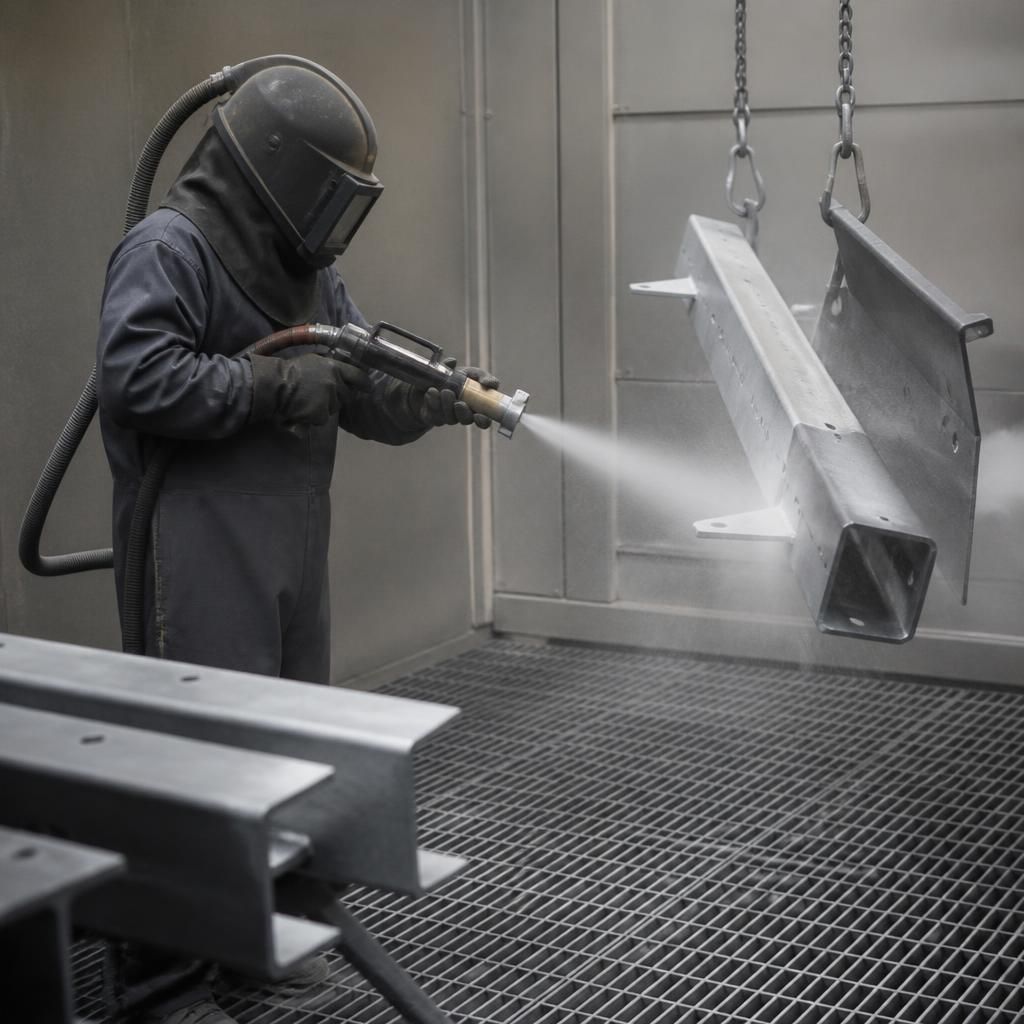
Abrasive blasting improves powder coating adhesion only when the blasting method suits the substrate. The objective is to prepare the surface without damaging, embedding contamination into or removing a protective layer from the metal.
- Mild steel: Blasting can remove corrosion and mill scale, leaving a suitable surface for the coating system.
- Aluminium: Less aggressive treatment is normally required because excessive blasting can distort the surface or produce an unsuitable texture.
- Galvanised steel: Controlled sweep blasting can clean and lightly key the zinc layer while avoiding unnecessary removal of the corrosion protection.
- Stainless steel: Clean, compatible media and well-maintained equipment help prevent the transfer of ferrous particles that could later cause surface staining or corrosion.
This substrate-specific approach is important because a surface can look uniformly rough while still being unsuitable for coating. Checking the prepared metal for damage, embedded particles and changes in the protective layer helps confirm that blasting has improved the bonding conditions rather than introduced a new adhesion risk.