

What preparations are necessary before applying electrostatic powder coating to stainless steel?
Before electrostatic powder coating, stainless steel must be thoroughly cleaned and degreased, with oils, dirt, oxides and other contaminants removed. The surface is then prepared to promote adhesion, inspected for defects, and any areas that must remain uncoated are carefully masked before the powder is applied.
Preparing stainless steel for electrostatic powder coating involves more than making the surface clean. The component must be assessed for its stainless grade, condition, geometry, dimensional requirements and intended service, then given a compatible pre-treatment and arranged so that the powder can be applied and cured without affecting critical features.
Confirm the component specification first
Before preparation begins, the coater should have clear information about the stainless steel grade, the required colour and finish, the operating environment and any areas that must retain precise dimensions. Components exposed to moisture, chemicals, outdoor conditions or frequent handling may require a different powder system from parts used indoors. The powder manufacturer’s technical data should be checked for suitability with stainless steel and for its curing requirements.
Drawings should identify threaded holes, bearing seats, sliding faces, electrical contact points and other functional surfaces. Powder adds a measurable film thickness, so close-fitting parts and mating surfaces need suitable allowances. Plugs, caps or other temporary protection can then be selected to suit the feature rather than improvised after coating.
Assess fabrication quality
Welds should be continuous where required, free from loose residue and finished to a profile that will not create a weak edge in the coating. Burrs, sharp corners, weld spatter, deep scratches and raised tool marks should be dealt with before the component reaches the coating line. Powder follows the underlying profile; it will not reliably conceal major fabrication defects.
Welded stainless assemblies also need attention to enclosed sections. Trapped moisture, cutting fluids or gases can be released during heating and cause pinholes, blistering or surface defects. Where hollow sections are being coated, the design may need suitable drain and vent holes. These openings should be considered before fabrication, particularly where the component will be heated in a curing oven.
Choose a stainless-compatible pre-treatment
Stainless steel develops a passive oxide layer that supports its corrosion resistance but can also influence coating adhesion. The preparation route therefore needs to be controlled rather than treated like ordinary mild steel. Depending on the grade, finish and intended use, this may involve a suitable abrasive treatment, chemical pre-treatment or a combination of processes specified for the coating system.
Abrasive equipment and handling tools must not transfer ferrous particles from carbon steel onto the stainless surface. Cross-contamination can create brown staining or local corrosion beneath or around the coating. Separate tooling, suitable abrasives and controlled handling are important where appearance and corrosion performance matter.
Any chemical pre-treatment must be compatible with both the stainless substrate and the chosen powder. Residual chemicals, salts or moisture can interfere with the finish, so the prepared component must be fully suitable for the next stage before it is loaded for application.
Plan racking and electrical contact
Electrostatic coating depends on the component being electrically connected to earth so that charged powder is attracted to the metal. Racking points should therefore be selected in advance, taking account of the component’s weight, shape and centre of gravity. The contact area must provide a dependable electrical path, while its location should be chosen where a small uncoated mark can be accepted or subsequently dealt with.
Complex assemblies may need more than one hanging position or a revised orientation to prevent shadowing and improve access to recessed areas. The planned orientation also affects how the component is handled through the oven and whether powder can collect excessively on lower edges, internal corners or enclosed features.
Account for heat and assembly details
All components, inserts and temporary fixtures should be checked for compatibility with the curing temperature. Items that cannot tolerate the required heat, or that may release gases when heated, should be removed before coating where the design allows. Bearings, seals, lubricants, electronic parts and other heat-sensitive elements require particular consideration.
Assemblies are often easier to coat as separate parts. This can improve access, avoid uncoated contact areas and reduce the risk of powder bridging between moving or mating components. If an assembly must remain together, clearances, vents and the effect of film thickness should be agreed before processing.
Carry out a trial where the geometry or finish is demanding
A sample, test coupon or first-off component can be useful for complex stainless parts, unusual finishes and assemblies with tight tolerances. This allows the proposed pre-treatment, hanging method, powder coverage and curing schedule to be checked before a full batch is processed. Testing may include visual examination, film-thickness checks, adhesion assessment and confirmation that critical dimensions remain within specification.
The finished requirements should be recorded in a coating specification. It should identify the powder type and colour, gloss or texture, acceptable contact marks, critical dimensions, no-coat features, inspection method and any performance testing required. A clear specification prevents preparation decisions from being made solely on appearance and helps ensure that the coated stainless components are suitable for their intended industrial use.
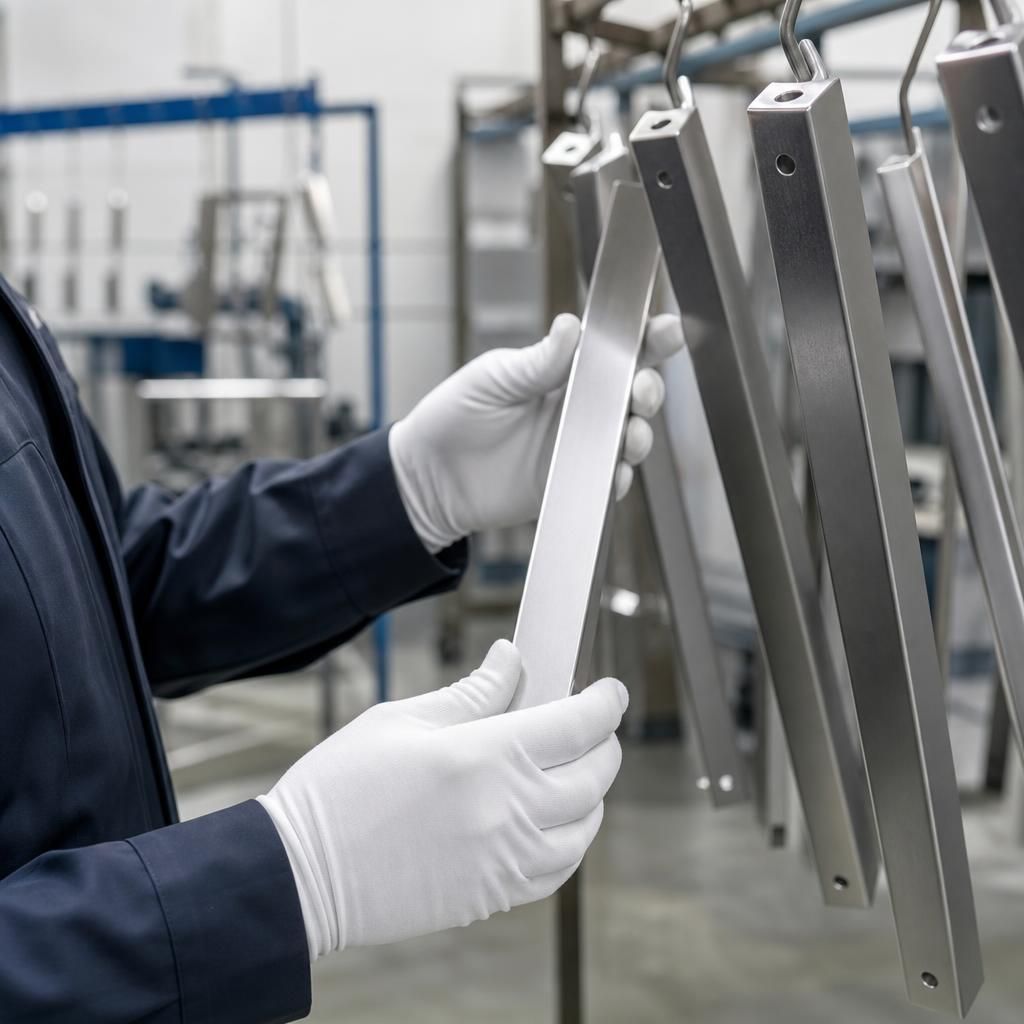
After pre-treatment, stainless steel must be protected from recontamination before powder application. Handling with clean gloves, using clean racks and avoiding contact with bare hands helps prevent fingerprints, salts and oils from returning to the surface. Prepared parts should also be kept away from grinding dust, workshop spray and other airborne contaminants.
The surface should be completely dry before entering the spray area. Particular care is needed around seams, recesses, threaded features and hollow sections, where moisture or treatment residue can remain unnoticed. A final check under suitable lighting can identify marks, dust, loose particles or areas that need further preparation before coating begins.
Discuss your stainless steel preparation requirements
Discuss your stainless steel preparation requirements with the powder-coating team, including the component specification, finish and any critical features that need protection. This helps establish a suitable preparation and coating approach before processing begins.