

What factors should be considered when selecting an electrostatic coating finish for specific industrial applications?
Select an electrostatic coating finish by matching its chemical, mechanical and environmental resistance to the component’s working conditions. Also assess the required appearance, substrate preparation, coating thickness, curing requirements, production volume and whole-life cost.
The most suitable electrostatic coating finish is the one that meets the component’s functional, dimensional, compliance and production requirements as a complete system. Selection should therefore begin with how the finished part will operate, how it interfaces with other components and what the coating process must achieve, rather than with colour or surface texture alone.
Define the component’s functional role
Establish whether the finish must provide electrical insulation, controlled conductivity, low friction, improved grip, hygiene support or a specific thermal function. A coating that is appropriate for a structural bracket may be unsuitable for an earthing point, sliding interface or component that must dissipate static charge. Any areas requiring electrical contact should be identified before coating so that they can be left uncoated or treated separately.
Check dimensional and assembly requirements
Coating can affect the fit of threaded holes, press fits, bearing seats, hinges, shafts and mating faces. Drawings should identify critical dimensions, masking requirements and surfaces that must remain clear. Consider also whether parts will be assembled before or after coating, since this can affect access, handling and the risk of damage at contact points.
Assess the component’s geometry
Complex shapes require more careful assessment than flat or open sections. Recesses, internal corners, deep cavities and closely spaced features can restrict the electrostatic field and make it harder to deposit powder evenly. This is commonly referred to as the Faraday cage effect. Racking position, gun access, part rotation and application settings may all influence the result. A trial piece or representative sample is useful where the design contains deep recesses or concealed faces.
Identify masking, racking and contact points
Decide which surfaces must remain free from coating for assembly, earthing, welding or identification. Masking materials must tolerate the process and leave a clean boundary. The hanging method also matters: suspension points need to provide reliable electrical contact while causing as little visible or functional interruption as possible. These details should be agreed from the engineering drawing rather than left to production.
Specify the required quality standard
A coating specification should state the acceptance criteria clearly. Depending on the application, this may include adhesion, cure verification, visual consistency, edge coverage, surface defects, colour identification and inspection records. It should also define how samples are approved and which test methods apply. This prevents subjective decisions at receipt and gives the coater a measurable target.
Consider regulatory and sector requirements
Parts used in construction, automotive production, machinery or manufactured assemblies may need to meet customer-specific specifications or sector documentation requirements. Confirm whether the coating system needs declarations, batch traceability, restricted-substance information or evidence from a particular test regime. Requirements can apply to the powder, pretreatment, application process and final inspection, so reviewing only the product data sheet may be insufficient.
Match the finish to cleaning and service procedures
Consider how the finished component will be cleaned, inspected and handled throughout its service life. Frequent contact, abrasive handling, pressure washing, steam cleaning or exposure to particular maintenance products may influence the appropriate coating system and surface profile. Where parts are likely to be repaired, specify whether recoating is permitted, how damaged areas will be prepared and whether a compatible touch-up method is available.
Review process compatibility and repeatability
The selected finish should be suitable for the available application and curing process, including the component’s mass, shape and method of loading. Large or thermally uneven parts may require particular attention to temperature measurement and process control. Consistency is especially important when components are supplied in batches or form part of the same assembly. Representative production samples can help confirm that the chosen specification is practical before full-scale work begins.
Compare standard and specialist systems where necessary
A standard powder finish may be suitable for general industrial components, while specialist systems should be considered when the part has an unusual functional requirement or difficult service duty. Nylon powder coatings, for example, may be relevant where a tough, low-friction or impact-tolerant surface is required. Protective systems may be more appropriate where the primary objective is to shield the underlying metal from a defined operational hazard. The choice should be based on documented performance requirements rather than assuming that a specialist coating is automatically preferable.
Use a documented selection process
- Record the component’s function, interfaces and critical surfaces.
- List any electrical, dimensional, regulatory and inspection requirements.
- Identify difficult geometry, masking points and racking constraints.
- Shortlist coating systems supported by relevant technical information.
- Confirm the specification with a representative sample or trial part where risk justifies it.
- Approve the inspection criteria before production and retain the agreed record.
For industrial parts, this approach produces a coating specification that is practical to apply and straightforward to verify. A specialist powder-coating provider can review drawings, part geometry and intended use before recommending whether a standard, nylon or other protective electrostatic finish is appropriate for the application.
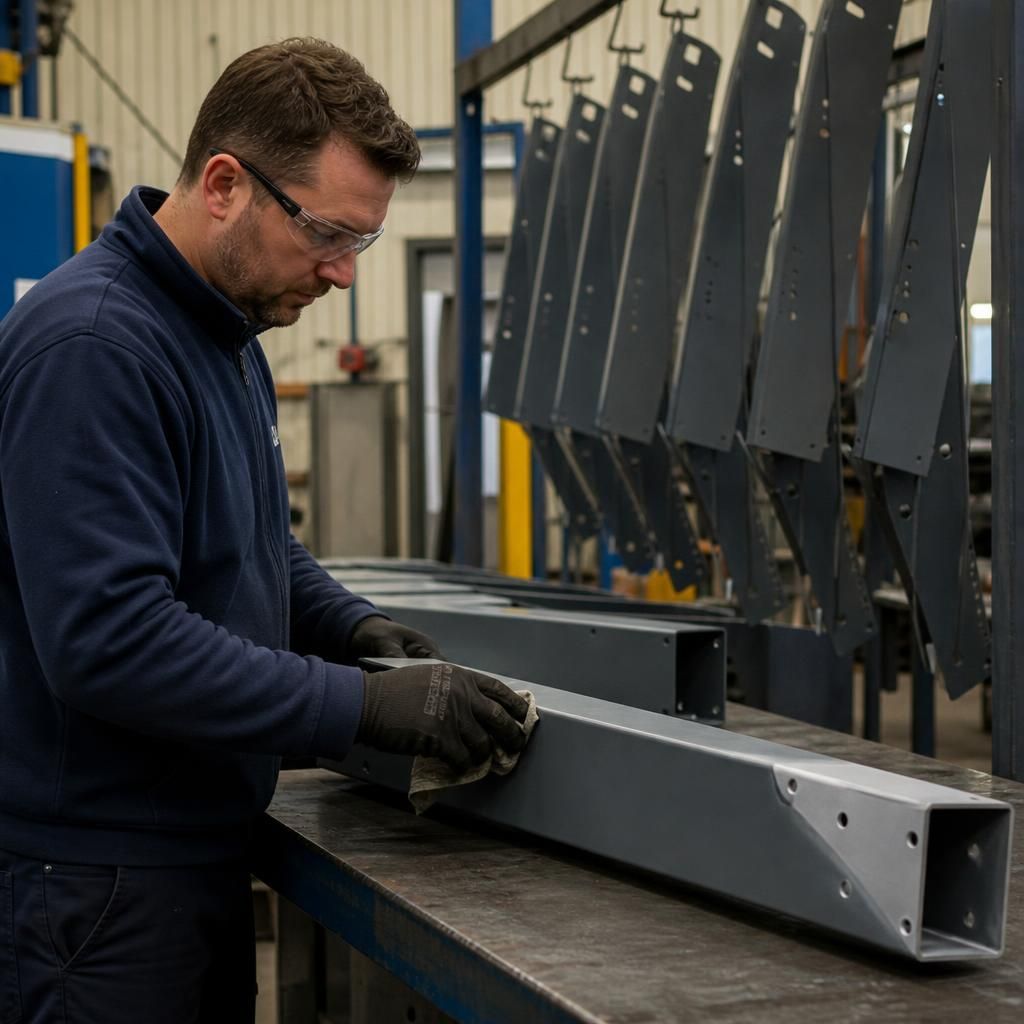
Substrate condition and pretreatment should be considered before selecting an electrostatic coating finish. The same powder system may perform differently on mild steel, aluminium or galvanised metal because surface chemistry, oxidation and contamination affect adhesion and corrosion protection.
Confirm that the preparation method is suitable for the base metal and the intended service environment. Remove oil, rust, scale and residues before coating, and establish whether cleaning, abrasion or chemical pretreatment is required. The coating specification should also account for weld areas, sharp edges and previously treated surfaces, as these can create local variations in finish quality. A compatible pretreatment and powder system provides a more reliable basis for evaluating the chosen finish during sample approval and production.
Discuss Your Electrostatic Coating Finish Requirements
Discuss your electrostatic coating finish requirements with a specialist powder-coating provider, supplying details of the component, its operating conditions and the required finish. This allows suitable coating options and practical production considerations to be reviewed before specification.