

What considerations should guide my choice of electrostatic coatings for environments with extreme temperature fluctuations?
Choose an electrostatic powder coating by matching its documented service-temperature range and resistance to thermal cycling with the component’s operating conditions, including peak temperatures, cooling rates and frequency of fluctuation. Also assess adhesion, substrate movement, chemical exposure and the required finish, then confirm that the specified powder can be correctly applied and cured for the metal part and intended environment.
Choosing an electrostatic powder coating for severe temperature fluctuation is a compatibility assessment, not simply a matter of selecting the coating with the highest stated temperature limit. The specification should account for the coating’s behaviour at low and high temperatures, the rate of change, mechanical loading, exposure to chemicals or moisture, and the way the finished component will be manufactured, installed and maintained.
Consider the full temperature profile. A component may experience several different conditions rather than one constant temperature. These can include cold storage, start-up, normal operation, shutdown, cleaning and exposure to heated process equipment. Record the lowest and highest temperatures, how long the part remains at each condition, and whether the change is gradual or abrupt. A coating suitable for a steady elevated temperature may not be suitable where the part repeatedly moves between hot and cold conditions.
The temperature of the surrounding air is not always the temperature of the coated metal. Direct contact with heated machinery, radiant heat, sunlight, liquid cooling or an insulated enclosure can create localised hot and cold areas. Measure or estimate the temperature at the coating surface wherever possible, particularly around joints, brackets, edges and areas in contact with other materials.
Assess low-temperature performance as carefully as high-temperature performance. Some coatings become less flexible as temperatures fall. If the coated part is struck, fastened, flexed or subject to vibration while cold, embrittlement can lead to cracking or loss of protective continuity. A coating intended for refrigerated equipment, external plant or cold-process applications therefore needs suitable flexibility and impact performance across the complete operating range.
At elevated temperatures, consider more than whether the coating remains attached. Heat can affect colour, gloss, surface hardness, flexibility and resistance to chalking. If appearance is important, ask whether the finish is expected to retain its original visual properties or whether functional protection is the primary requirement. A coating can remain present on the metal while its decorative properties change.
Match the coating to the mechanical duty at temperature. Thermal movement can coincide with vibration, abrasion, impact, pressure, clamping or repeated contact. High temperatures may soften some finishes, while low temperatures may reduce flexibility. Parts that rub against one another, carry loads or receive regular handling require a coating whose hardness, toughness and flexibility remain appropriate under those conditions. This is especially relevant to fabricated components with moving interfaces or exposed edges.
Review the complete chemical environment as well. Temperature can increase the effect of oils, fuels, cleaning agents, salts, process fluids and condensation. Vapours may also be present even where the coated surface is not directly immersed. Identify the chemicals, their concentration, contact time and temperature, then specify resistance against the actual combination rather than considering chemical exposure and heat as separate issues.
Check the substrate and component design. Steel, aluminium and other metals transfer and retain heat differently, and a large fabricated part may develop temperature gradients between thin and thick sections. Welds, corners, recesses and assembled interfaces can behave differently from broad, flat surfaces. These features affect the consistency of the finished film and should be included when assessing the coating system.
Also consider whether the part contains cavities, threaded sections, inserts, seals or dissimilar materials. Trapped gases, moisture or residues can create defects during the coating process, while different materials may move differently as temperatures change. Masking, drainage, venting and the order of assembly can therefore be important parts of the specification for components destined for severe thermal conditions.
Separate service temperature from process temperature. The coating must tolerate the intended use, but the metal part must also withstand preparation and curing without distortion, contamination or damage to heat-sensitive features. This is particularly important for thin sections, assemblies containing non-metallic components, and parts with tight dimensional tolerances. Confirm that the proposed coating process is suitable for the whole component, not only for a flat test panel.
Film thickness and coverage should be controlled consistently. Excessive or uneven film can affect appearance, edge performance and the way the coating responds to temperature changes. Thin areas, sharp edges and recessed sections may provide less protection than the main face of the component. A defined coating specification should therefore state the required finish, acceptable visual variation and inspection points.
Use testing that represents the real duty. Where the application is critical, test coated samples made from the same or a comparable substrate and processed using the intended preparation and curing method. Expose them to representative heating and cooling cycles, then inspect for:
- cracking, flaking, blistering or loss of continuity;
- changes in colour, gloss, hardness or surface texture;
- loss of adhesion or damage around edges and fixings;
- corrosion developing at defects or exposed areas; and
- changes in performance after chemical, moisture or abrasion exposure.
Testing should reflect the most demanding combination of conditions, such as temperature change alongside vibration, condensation, cleaning or chemical contact. A coating that passes a simple heat exposure may still be unsuitable when the component is repeatedly heated, cooled and mechanically stressed.
For unusually demanding applications, compare standard and specialist powder coating options rather than relying on a generic specification. Specialist protective or nylon coatings may be relevant where the main requirement is particular resistance to impact, abrasion, chemicals or environmental attack, but their suitability still depends on the complete temperature and processing profile. The final choice should be based on documented technical information and, where necessary, representative trials.
Provide the coater with the operating temperature range, cycle description, substrate, component dimensions, chemical exposures, mechanical stresses and appearance requirements. This information allows the coating system, preparation method and process controls to be considered together, reducing the risk of selecting a finish that appears suitable on paper but performs poorly in the finished application.
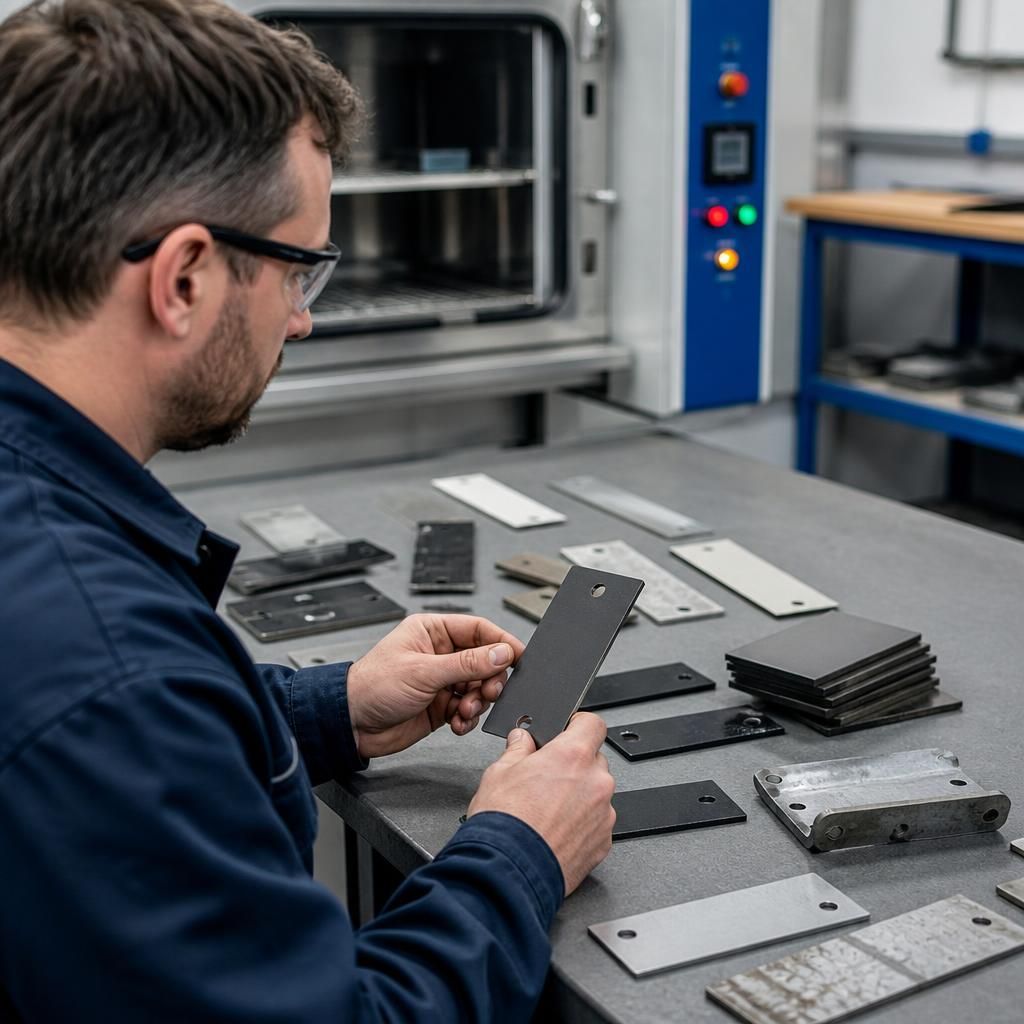
Define what “failure” means before testing a coating for severe temperature fluctuation. A minor change in colour or gloss may be acceptable on a concealed structural component, while cracking, blistering, loss of adhesion or exposed metal may be unacceptable on a corrosion-critical part. Separating cosmetic limits from functional limits helps the coating specification reflect the component’s actual duty rather than applying the same acceptance criteria to every application.
Record the condition of the test pieces before and after thermal exposure, including photographs of edges, fixings, joints and concealed faces. This creates a useful baseline for comparing coating options and identifying gradual deterioration that may not be obvious during a visual inspection of the main surface.
Discuss Your Extreme-Temperature Coating Requirements
Discuss your extreme-temperature coating requirements with our team and provide the component’s temperature profile, substrate, dimensions and exposure conditions. This information can help identify a suitable electrostatic powder coating system and determine whether representative testing is appropriate.