

What are the common challenges faced when powder coating over galvanised steel and how are they overcome?
Common challenges when powder coating over galvanised steel include poor adhesion, surface contamination, uneven zinc surfaces and outgassing during curing, which can cause pinholes or blistering. They are overcome through thorough cleaning, suitable abrasion and pretreatment, controlled drying and curing, and selecting a powder system suited to the galvanised substrate.
The main difficulties in powder coating galvanised steel arise from the interaction between the zinc coating, the component’s design and the powder-coating specification. A durable result depends not only on applying powder correctly, but also on controlling the condition of the galvanised surface, accommodating its dimensions and geometry, and agreeing how the finished part will be inspected and handled.
Variation in the galvanised coating
Galvanised steel is not always uniform from one component to the next. Zinc thickness, texture, crystal pattern and the condition of the surface can vary according to the steel grade, fabrication method and galvanising conditions. Large fabricated items may also contain areas with a different appearance or surface profile from the rest of the part. Treating every component as though it has an identical substrate can therefore produce inconsistent results across a batch.
This is overcome by assessing representative parts before production and setting a consistent preparation and coating specification for the actual substrate. Where the appearance of the galvanised layer is unusually coarse, heavily patterned or locally different, the process may need to be adjusted rather than relying on a standard setting. Batch inspection is also important because a change in steel source or galvanising practice can affect the finished appearance.
Complex shapes and difficult-to-coat areas
Fabricated galvanised components often include folded sections, brackets, recesses, narrow gaps, internal corners and overlapping joints. Powder can build up at edges and corners while producing a thinner film on recessed faces or in areas that are shielded during electrostatic application. The result may be an appearance that is acceptable on exposed faces but less consistent around the complete component.
Good results depend on considering the component’s geometry before coating. Parts should be positioned so that important faces are accessible, and racking should provide a reliable electrical connection without creating unacceptable contact marks. Where possible, the design should avoid closed pockets, inaccessible faces and unnecessary overlaps. Drainage and access also need to be considered so that the component can be processed, rinsed and dried consistently.
Masking, threads and dimensional tolerances
Powder coating adds a measurable film to the substrate. This can affect threaded holes, close-fitting interfaces, bearing seats, hinge points and other accurately manufactured features. If these areas are coated unintentionally, assembly may become difficult or the component may no longer meet its required fit.
Critical features should be identified before coating, with suitable masking, plugs or process exclusions specified where necessary. Masking materials must tolerate the curing cycle and be applied in a way that leaves a clean boundary. The required coating thickness should also be considered alongside the engineering tolerance, rather than treating the coating as having no effect on the finished dimensions.
Heat-sensitive assemblies and mixed materials
Powder coating requires a controlled oven cycle, so assemblies containing seals, plastics, adhesives, lubricants or other heat-sensitive materials may not be suitable for coating as a complete unit. Different metals within one assembly can also heat at different rates, affecting how the coating reaches its required cure condition.
The practical solution is often to coat individual components before assembly. If that is not possible, the materials, construction and maximum permitted temperature should be reviewed before processing. The cure requirement must be based on the temperature reached by the metal part, not simply the oven air temperature, because a heavy galvanised component may take longer to reach the specified condition than a lighter section.
Colour and appearance differences
Galvanised steel can show through visually in places where the powder film is thin, particularly on edges, corners or recessed features. Differences in the underlying zinc texture may also influence the apparent smoothness and gloss of the finished coating. Dark or highly gloss-sensitive colours tend to make variation more noticeable than textured or lower-gloss finishes.
The finish should therefore be specified in practical terms, including colour, gloss, texture, acceptable contact marks and the viewing conditions for inspection. A sample or approved reference panel can help establish what is acceptable before a full batch is processed. This is especially useful where components have prominent visible faces or must match other coated items.
Handling and damage after coating
Even a correctly applied coating can be damaged by unsuitable racking, stacking, transport or assembly. Freshly coated contact points may mark when parts are placed directly against one another, while chains, hooks and lifting equipment can chip edges or leave impressions. Damage is more likely at sharp projections and around holes used for handling.
Protection should be planned as part of the process. Components can be separated with suitable packaging, supported at robust locations and handled so that coated faces do not rub together. Any damage found during inspection should be assessed and repaired using a method compatible with the specified finish and the service conditions. Exposed steel should not simply be concealed without establishing whether the repair restores the required protection.
Inspection and acceptance criteria
Inspection should cover more than colour and general appearance. Depending on the application, relevant checks may include coating continuity, film thickness, curing, coverage of difficult areas, masking boundaries and the condition of critical dimensions. The galvanised substrate and the powder system should be considered together when defining the acceptance criteria.
Clear documentation reduces disputes, particularly where the item will be used outdoors, exposed to chemicals, or assembled with close tolerances. The specification should identify the required pretreatment and powder system, but also the areas that must remain uncoated, the permitted visual variation and the method for dealing with repairs or rejected parts.
Managing the process as a complete system
Powder coating over galvanised steel is most reliable when design, galvanising, preparation, application, curing, inspection and handling are treated as connected stages. Problems often arise when the coating operation is expected to correct a substrate condition or component design that was not considered earlier.
For manufacturers and fabricators, the most effective approach is to provide accurate drawings, identify critical surfaces and tolerances, disclose any heat-sensitive materials, and agree the required finish before production. Trial processing may be appropriate for unusual geometries or demanding specifications. This allows the process to be confirmed on the actual galvanised component rather than inferred from a different steel section or a simple test panel.
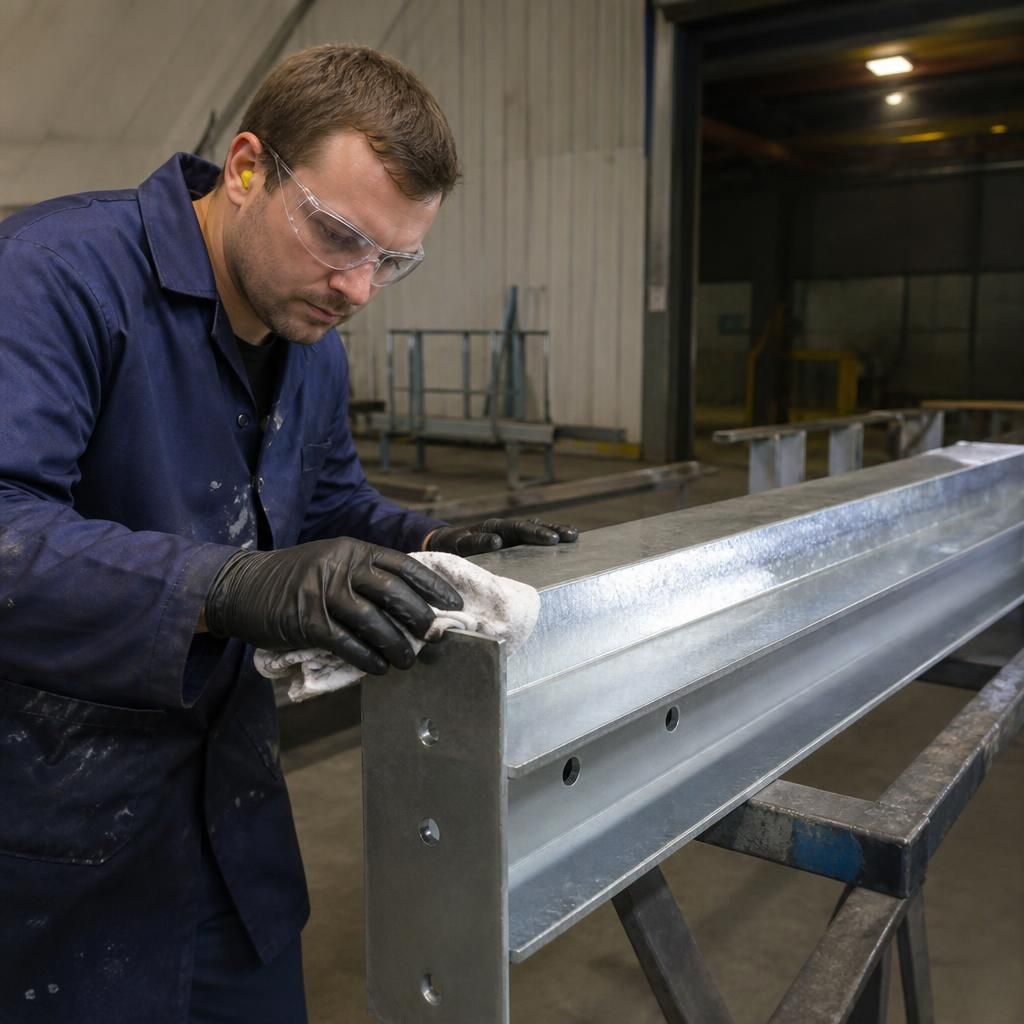
Adhesion can fail when the galvanised surface carries oils, dust, zinc residues or remnants of storage contamination. Preparation must remove these materials without unnecessarily damaging the protective zinc layer. The cleaning method, light abrasion and any conversion treatment should therefore be selected for galvanised steel rather than copied from an untreated mild-steel process.
Thorough rinsing and drying are equally important. Cleaning or pretreatment residues left beneath the powder can interfere with bonding and may contribute to blistering during curing. For a demanding application, a trial area or representative sample can confirm that the chosen preparation produces a clean, suitably keyed surface and a consistent bond with the specified powder system.