

What are the advantages of using a phosphate treatment before powder coating on galvanised steel?
Phosphate treatment creates a conversion layer on galvanised steel that helps powder coating adhere more consistently to the zinc surface. It can also improve corrosion protection, reduce the risk of premature coating failure and support a more uniform, durable finish.
Phosphate treatment is advantageous before powder coating galvanised steel because it chemically conditions the zinc surface and makes the pretreatment stage more controlled and repeatable. It is particularly useful where components will face outdoor exposure, handling, condensation or demanding industrial conditions, although the correct treatment depends on the condition of the galvanised coating, the powder system and the intended service environment.
It stabilises the galvanised surface
Newly galvanised steel can retain oils, handling marks, alkaline residues and zinc salts. Stored or weathered material may also develop surface oxidation or white corrosion products. A properly controlled cleaning and phosphating sequence removes or conditions these contaminants, giving the powder coating a more consistent surface to work with. This is important because galvanised steel is not chemically uniform from one component to another: surface age, zinc chemistry, storage conditions and manufacturing history can all affect the result.
It creates a controlled conversion layer
Phosphate reacts with the prepared zinc surface to form a thin conversion layer rather than simply leaving a deposited film. This layer provides a more suitable foundation for the subsequent coating system and can help reduce variation between batches. Zinc phosphate is commonly selected where a higher level of pretreatment is required, while iron phosphate may be suitable for less demanding applications. The choice should be based on the coating specification and exposure conditions rather than on the substrate description alone.
It supports a more consistent appearance
Inconsistent preparation can contribute to differences in gloss, colour perception, texture or coverage across a batch of galvanised parts. Phosphating helps standardise the surface condition before powder is applied, which can make the finished appearance more predictable. It does not, however, remove deep scratches, runs in the galvanising, weld spatter, heavy white rust or significant surface roughness. Those issues need to be assessed and dealt with separately.
It improves process control for production work
For manufacturers and fabricators processing repeated batches, a defined phosphate stage makes pretreatment easier to monitor. Cleaner concentration, bath temperature, contact time, rinse quality and drying can be specified and checked. This provides a clearer route for investigating defects such as cratering, blistering, poor coverage or localised coating breakdown. The benefit is not simply the chemical itself; it is the greater control offered by a documented preparation sequence.
It complements the galvanised coating
Galvanising and powder coating perform different roles. The zinc layer protects the underlying steel, while the powder coating provides the visible, sealed outer finish. Phosphate treatment helps these layers function as part of a duplex system by preparing the interface between them. If the powder coating is damaged, the zinc coating can still provide a degree of protection to the exposed steel, provided the galvanised layer remains sufficiently intact.
Good preparation remains essential
Phosphating should not be treated as a substitute for cleaning or inspection. Galvanised components should be checked for oil, grease, storage staining, loose corrosion products, sharp edges and fabrication residues before treatment. Inadequate rinsing can leave salts on the surface, while insufficient drying can cause defects when the powder is cured. Excessively aggressive cleaning may also attack the zinc unnecessarily.
The treatment should therefore be selected as part of the complete system, including galvanising quality, cleaning method, phosphate chemistry, powder formulation, curing conditions and expected exposure. Where components have unusual dimensions, welded areas, cast features or a particularly demanding duty, a trial panel or representative test piece can help confirm that the chosen sequence produces the required result.
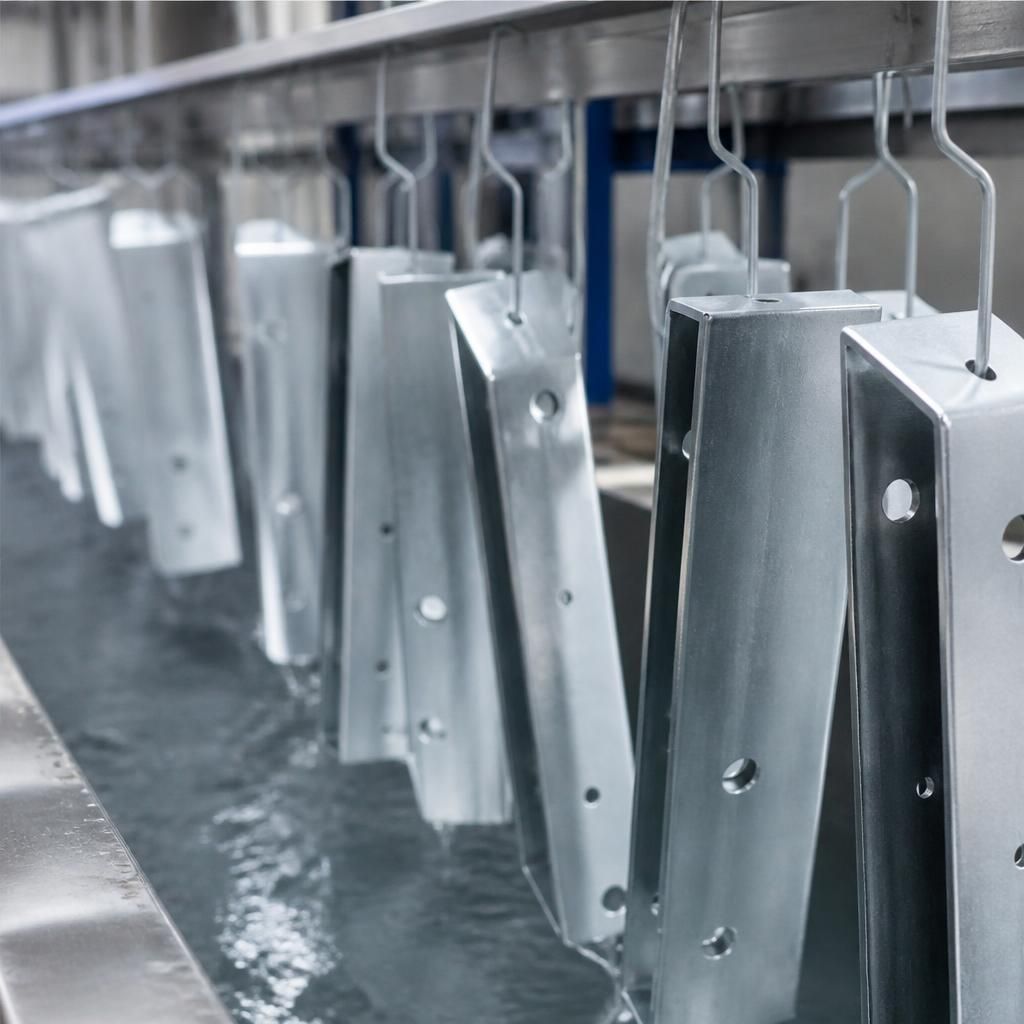
A further advantage of phosphate treatment is that it conditions the galvanised surface without relying on aggressive abrasion to create a key. This can help preserve the zinc layer on profiles, edges and formed sections where excessive mechanical preparation could remove or thin the underlying protection. When the surface is cleaned, rinsed and dried correctly, the conversion layer provides a chemically prepared interface for the powder coating while leaving the galvanised coating largely intact.
Discuss phosphate treatment for powder coating galvanised steel
Discuss your galvanised steel components with Powder-coatings.co.uk to establish whether phosphate treatment is appropriate for the substrate, powder system and intended service conditions. The preparation sequence can then be considered alongside the component design and production requirements.