

What technical considerations should be made when selecting powder coating for specific types of chassis and frames?
Selecting powder coating for a chassis or frame requires assessing the substrate, operating environment, required corrosion and impact resistance, component geometry, coating thickness and dimensional tolerances. The specification should also account for service temperature, exposure to chemicals, UV or moisture, electrical requirements, and whether concealed areas, joints and drainage points can be coated consistently.
Selecting powder coating for a chassis or frame is an engineering decision based on the component’s duty, construction, interfaces and required service life, rather than a choice of colour alone. The coating specification should define how the finished part will withstand flexing, vibration, abrasion, contamination and repeated assembly, while remaining compatible with the metal and any components connected to it.
Consider the type of chassis or frame. Different applications impose different failure risks:
- Road-going vehicle frames are commonly exposed to stone impact, road salt, water spray and repeated vibration.
- Off-road, agricultural and plant equipment may require greater resistance to mud, grit, abrasion, hydraulic-fluid contamination and frequent cleaning.
- Trailer and transport frames can experience impact at loading points, localised wear and outdoor exposure during storage.
- Industrial equipment frames may be primarily indoors but still encounter oils, solvents, process chemicals or elevated temperatures.
- Lightweight aluminium structures and high-strength steel assemblies may have different pretreatment, curing and masking requirements from conventional mild-steel fabrications.
The selected coating system should reflect the most severe credible exposure, not just the environment in which the frame is normally stored.
Account for movement and structural duty. A frame can flex under load even when the movement is not visible. Chassis members subject to vibration, torsion or repeated loading need a coating system and film build that will not become unnecessarily brittle or crack at highly stressed areas. Welded corners, brackets, gussets and sharp transitions deserve particular attention because coating defects or local damage at these points can expose the underlying metal. Where a frame is designed to move relative to another component, the coating must not be allowed to act as a substitute for a bearing, shim or correctly specified joint.
Assess mixed-metal construction. Steel and aluminium may be used in the same assembly, along with stainless steel, zinc-coated parts or plated fixings. These combinations can create galvanic corrosion if moisture and an electrically conductive path are present. Powder coating can provide a barrier, but it should not be treated as the only control at bolted joints, damaged edges or concealed contact areas. The design may need suitable isolation, sealing, compatible fasteners and a defined approach to areas where the coating is deliberately removed for assembly or earthing.
Define functional areas that must remain uncoated. Chassis and frames often include more than visible outer surfaces. The specification should identify:
- threaded holes, bores and bearing seats;
- machined faces, press-fit locations and locating dowels;
- hinges, sliding interfaces and adjustment points;
- brake, earth or bonding contact points;
- identification plates, sensor seats and welded attachment faces; and
- drain or inspection openings that must remain clear.
Masking must be agreed before processing because coating deposited in a bore or on a mating face can affect assembly, electrical continuity or alignment. Critical tolerances should be identified on the drawing, with allowance made for the specified coating build and for any subsequent removal from contact areas.
Check the effect of heat on the complete assembly. Powder coating requires a controlled curing cycle, so the relevant requirement is the temperature reached by the metal and the time it remains at that condition. Large, heavy chassis sections and lighter brackets attached to the same frame may heat at different rates. Assemblies containing seals, bushes, adhesives, wiring, sensors or heat-sensitive inserts must be assessed before coating. These items may need to be fitted afterwards, protected during processing or specified in materials suitable for the curing cycle.
Specify performance tests that match the duty. A useful technical specification should state how the finish will be assessed, rather than relying only on a visual colour match. Depending on the application, this can include requirements for coating adhesion, film thickness, impact resistance, flexibility, abrasion resistance, chemical resistance and corrosion performance. The relevant test methods and acceptance criteria should be agreed before production, particularly where the frame forms part of a regulated vehicle, safety-related assembly or customer-controlled product.
It is also important to distinguish a coating requirement from a structural requirement. Powder coating protects and finishes the fabricated surface, but it does not restore a frame that has inadequate weld design, fatigue damage, poor drainage or insufficient section strength. The engineering drawing and coating specification should therefore identify which characteristics belong to the fabrication and which belong to the finish.
Plan for inspection and repeatability. For batch-produced chassis and frames, consistency depends on controlling more than the powder colour. The process record should relate the approved coating material to the relevant curing conditions, surface condition, masking arrangement and inspection checks. Particular attention is needed where frame size, wall thickness or hanging position changes between batches. A first-off inspection or representative test piece can confirm that concealed faces, contact areas and high-risk joints meet the agreed requirements before a larger production run proceeds.
Allow for repair and service damage. Frames used in demanding environments may eventually suffer stone chips, impact marks, gouging or damage around fasteners. The original powder specification should be accompanied by a practical repair method that is compatible with the service environment. This may involve cleaning and preparing the damaged area, removing corrosion, applying a suitable repair coating and restoring any required sealing or electrical connection. If the assembly will be repaired in the field, the specification should state which areas are critical and how repaired zones will be accepted.
For a technically sound selection, provide the coating specialist with the frame drawings, material details, intended use, joining method, operating environment, critical interfaces and any customer or industry requirements. This information allows the coating system, masking plan, curing approach and inspection criteria to be considered together, which is more reliable than selecting a finish after the chassis design has been completed.
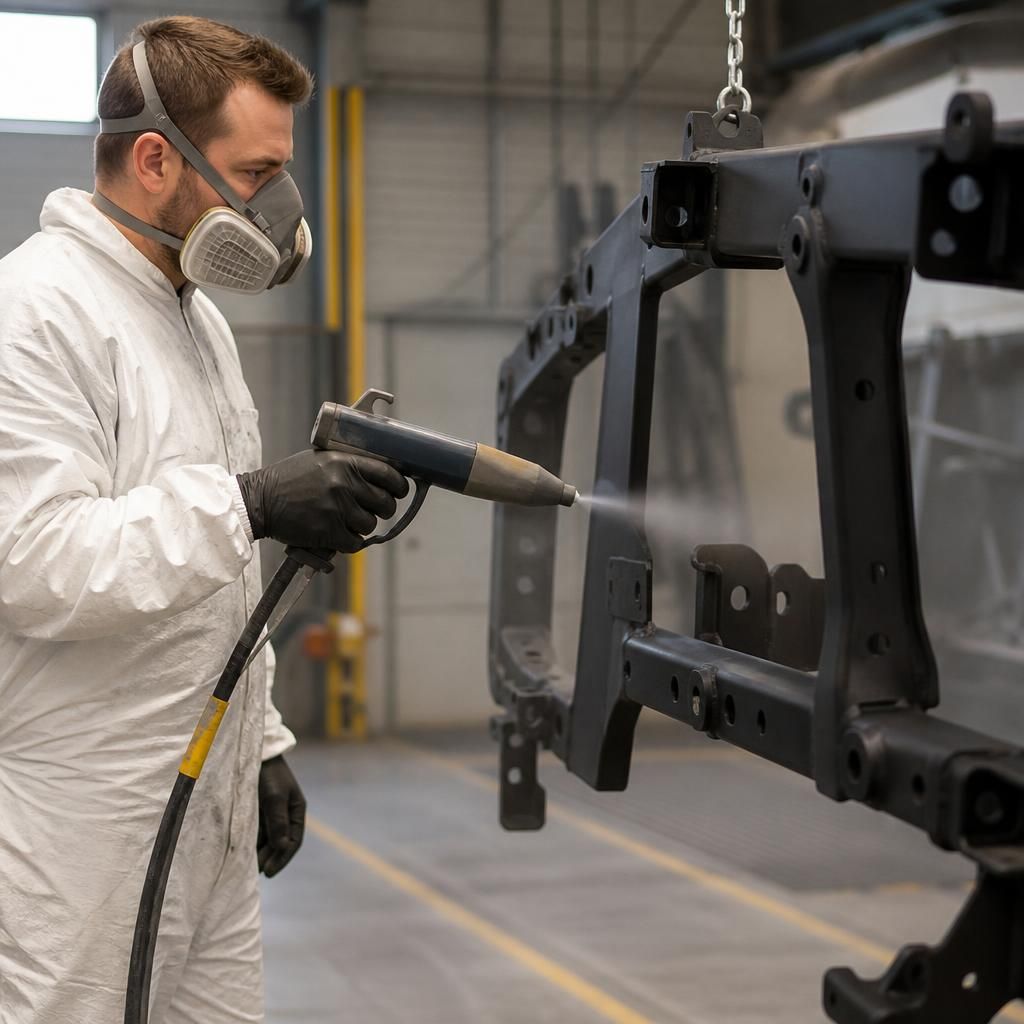
A key technical consideration is whether the chassis or frame needs a single powder coat or a multi-layer system. A single-layer finish may be suitable where exposure is moderate and the substrate is well prepared, while a compatible primer and topcoat can be specified where additional corrosion protection, edge coverage or resistance to aggressive contamination is required.
The layer arrangement must be assessed against the metal, curing conditions and intended service environment. The specification should define:
- which layer provides the primary corrosion barrier;
- how the primer and topcoat will adhere to one another;
- the required total film build at edges, corners and welded areas;
- whether the finish must tolerate abrasion, cleaning chemicals or outdoor exposure; and
- how damaged areas can be repaired without creating an incompatible patch.
Using a multi-layer system is not automatically better: additional material can affect dimensions, masking and curing requirements. The most suitable arrangement is the one that meets the frame’s exposure and performance requirements while remaining practical to apply, inspect and maintain.
Discuss the technical requirements for your chassis or frame
Discuss your chassis or frame drawings, materials and service conditions with the powder-coating specialist before finalising the specification. This allows the proposed coating system and processing requirements to be reviewed against the component’s intended use.