

What safety and compliance standards are met by using powder coating on chassis and frames?
Powder coating can support safety and compliance requirements for chassis and frames when the coating system, pretreatment, curing and inspection process are selected to meet the project specification and applicable industry requirements. Compliance depends on the finished component’s intended use, the required corrosion protection and the quality records demonstrating that the process has been controlled.
Powder coating can help chassis and frames meet specified safety and compliance requirements, but it is not automatically a compliance certificate. The applicable standard depends on the component’s material, service environment, end use and the performance level stated by the manufacturer, engineer or approving body. The coating is one part of the finished product’s conformity assessment; it does not replace structural design checks, weld quality requirements or vehicle and machinery regulations.
Relevant coating standards
Industrial powder coatings may be specified with reference to standards such as BS EN 13438, which covers organic powder coatings for application to galvanised or sherardised steel products. Where corrosion protection is the main concern, BS EN ISO 12944 can help classify the corrosivity of the environment and select a suitable protective paint system. Its use is particularly relevant to frames exposed to moisture, road salts, industrial pollutants or outdoor weathering.
Other standards may apply to individual performance characteristics rather than to the whole coating system. Examples include:
- BS EN ISO 2409 for assessing coating adhesion by the cross-cut method.
- BS EN ISO 2808 and related methods for determining dry-film thickness.
- BS EN ISO 9227 for laboratory salt-spray testing, where this test is appropriate to the specification.
- BS EN ISO 6272 for resistance to rapid deformation or impact.
- BS EN ISO 2815 or equivalent methods for assessing coating hardness where surface durability is important.
These tests provide evidence about particular properties. Passing one test does not demonstrate that a chassis or frame complies with every requirement, and laboratory salt-spray results should not be treated as a direct prediction of service life in every environment.
Corrosion protection and environmental classification
For a meaningful compliance assessment, the expected exposure should be defined before the coating is selected. An indoor plant frame, an agricultural chassis and an externally mounted transport component may require different levels of preparation, coating thickness and edge protection. Areas such as welds, sharp corners, drain holes, joints and recessed sections can be more vulnerable than broad, accessible faces.
Where a corrosion category or durability class is specified, the evidence should relate to the complete system rather than the powder product alone. This normally includes the substrate condition, preparation method, pretreatment, primer or topcoat arrangement where used, nominal film thickness and cure requirements. Any departures from the approved system should be recorded and assessed by the responsible technical authority.
Process control and inspection records
Traceable records help demonstrate that the finished work matches the approved specification. Depending on the project, useful records can include:
- identification of the steel, aluminium or galvanised substrate;
- surface preparation and pretreatment details;
- powder product identification, batch information and technical data;
- oven temperature and part-temperature records demonstrating the required cure;
- dry-film thickness readings from representative areas;
- visual checks for runs, pinholes, contamination, exposed metal and incomplete coverage;
- adhesion, impact or corrosion testing where required by the contract; and
- details of non-conforming work, rework and final release.
Inspection should account for the geometry of a chassis or frame. A single thickness reading on an easily accessible face cannot confirm coverage inside box sections, around brackets or at difficult-to-reach welds. Design features that trap pretreatment chemicals or interfere with drainage can also affect the finished result and should be addressed before coating.
Workplace health and environmental duties
Powder coating avoids the solvent emissions associated with many conventional liquid coating systems, but the process still requires controlled handling. Powder dust can present an inhalation risk and, in certain conditions, a combustible-dust hazard. Suitable extraction, housekeeping, protective equipment, storage controls and ignition-source management are therefore part of safe operation. In the UK, the relevant duties may include the Control of Substances Hazardous to Health Regulations and the Dangerous Substances and Explosive Atmospheres Regulations, subject to the process risk assessment.
Powder products and pretreatment chemicals should also be managed in line with applicable chemical-safety obligations, including UK REACH requirements where relevant. Restrictions on substances can affect the selected powder, pigments, primers, cleaning agents or conversion coatings. The product’s current safety data sheet and technical documentation should be reviewed rather than relying on a generic statement that powder coating is environmentally compliant.
Relationship with product and sector regulations
A coated chassis used in a vehicle, machine, lifting application or construction product may be subject to separate legislation, type-approval rules or customer standards. For example, the responsible manufacturer may need to demonstrate conformity of the complete assembly under applicable machinery, vehicle or construction requirements. The coating contractor can provide process and inspection evidence, but responsibility for the finished product’s design and legal conformity normally remains with the manufacturer or assembler.
Coated surfaces must also remain compatible with safety-critical features. Bonding points, earthing locations, bearing seats, threaded holes, braking or suspension interfaces and identification plates may need masking, controlled removal of coating or post-coating inspection. Coating over a functional interface without engineering approval can create a fit, electrical or assembly problem even when the visible finish is acceptable.
What should be agreed in the specification?
Before work begins, the purchaser and coating provider should agree the substrate, exposure category, preparation standard, coating system, colour and finish, target film thickness, masking requirements, cure conditions, acceptance criteria and required test documentation. The specification should also identify whether the component is safety-critical and whether any independent inspection or witness testing is required.
In practical terms, powder coating supports compliance when it forms part of a controlled, documented specification that is appropriate to the chassis or frame’s use. A certificate of conformity, inspection report or test result should be interpreted alongside the engineering drawings and applicable product regulations; none of these documents, by itself, proves that the complete chassis or frame is safe for every intended application.
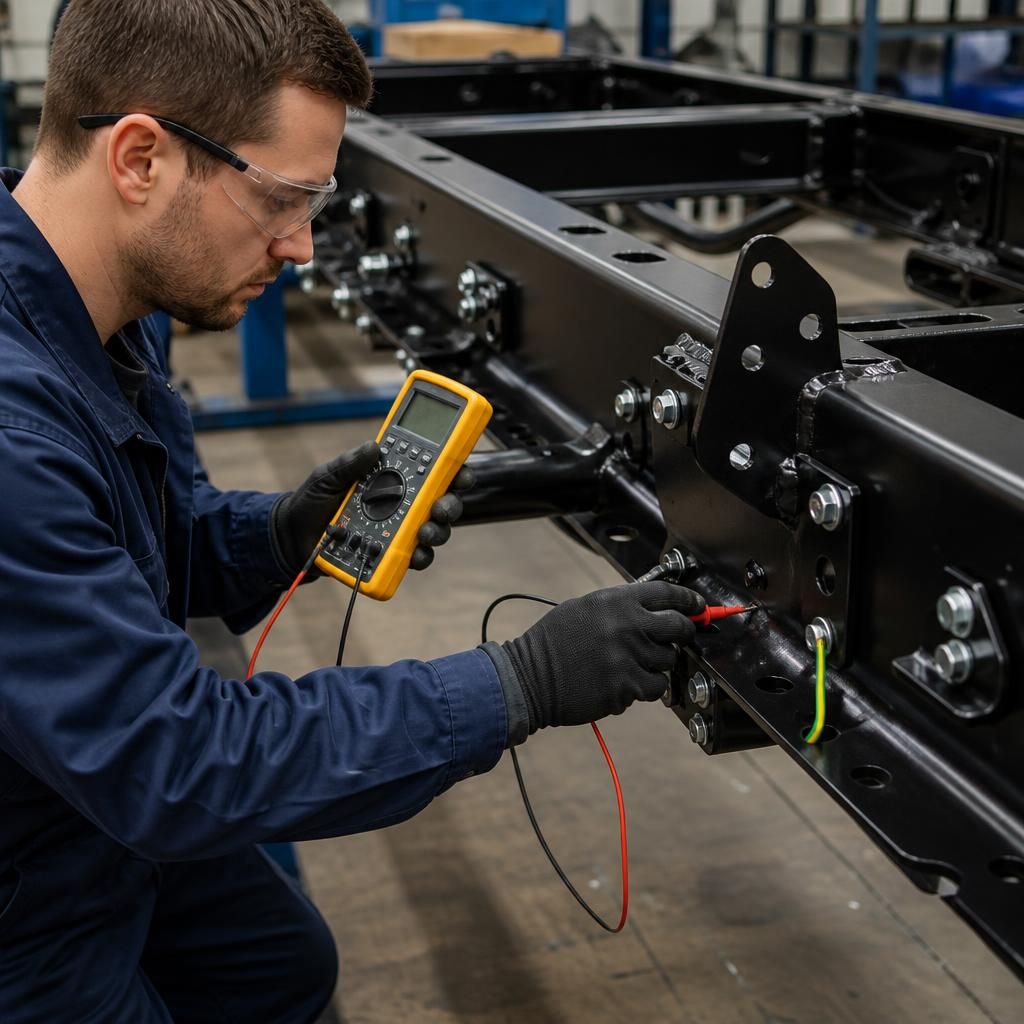
Powder coating is electrically insulating, so frames that form part of an earthed or bonded assembly need specific controls. Required earth paths should be identified before coating, with approved bare-metal contact areas or bonding hardware retained. After finishing, electrical continuity should be checked at the defined connection points rather than assumed from the visual appearance of the coating. Recording these checks helps demonstrate that the finish has not compromised an essential electrical safety function.
Discuss your chassis and frame compliance requirements
Discuss your chassis or frame drawings, intended service environment and required compliance evidence with the powder-coating team. This helps establish the appropriate coating specification, inspection requirements and documentation before work begins.