

What maintenance practices are recommended to ensure the longevity of powder coated chassis and frames?
Maintain powder coated chassis and frames by washing them with mild detergent and clean water, inspecting regularly for chips, scratches, corrosion or damaged joints, and repairing exposed metal promptly. Keep drainage points clear, avoid abrasive tools and aggressive solvents, and investigate any impact or coating breakdown before moisture can reach the substrate.
Long-term care of powder coated chassis and frames involves more than preserving the visible finish. The coating should be supported by good control of mechanical loads, chemical exposure, moisture traps, fasteners, storage conditions and any local damage. A planned maintenance regime should therefore assess both the coating system and the condition of the underlying frame.
Control mechanical damage during use and handling. Chassis and frames can be damaged by fork tines, chains, clamps, loading equipment and contact with adjacent components. Use suitable lifting points and protective separators where practical, and avoid dragging coated members across hard surfaces. Repeated rubbing can wear through the coating even when there is no obvious impact mark. Any change in fit, alignment or movement at a frame joint should also be investigated as a possible structural or mounting issue, rather than treated only as a cosmetic defect.
Manage contact points and interfaces. Areas beneath brackets, rubber mounts, clips and bolted joints can retain moisture and debris or experience fretting. During planned servicing, check that these components remain correctly seated and that seals, grommets and isolators have not deteriorated. Replace damaged isolation materials and refit loose hardware correctly. Where dissimilar metals meet, suitable separation should be maintained to reduce the risk of galvanic corrosion at the interface.
Limit chemical exposure. Oils, fuels, hydraulic fluids, battery electrolyte, road salts, de-icing residues and process chemicals should not be allowed to remain on the coating. Spills should be dealt with using a method confirmed as compatible with the particular powder system. Do not assume that a product is suitable because it is safe for bare metal; solvents and chemical cleaners can soften, stain or embrittle some finishes. Follow the coating supplier’s care instructions where the frame operates in a specialised industrial or automotive environment.
Preserve drainage and ventilation by design and use. Water can remain inside hollow sections, behind brackets or at lap joints even when the external surface appears sound. Drain holes, vent paths and access points should remain unobstructed, while modifications should avoid creating new pockets or trapping points. If a frame is stored outdoors, position it so water can run off rather than collect against horizontal members or covered joints. For extended storage, use a breathable cover and avoid wrapping a damp frame in impermeable material.
Use a controlled repair method when the coating is breached. Small local defects should be assessed according to their depth, location and exposure. A suitable repair normally requires removal of loose coating and corrosion, preparation of a sound edge, and application of compatible touch-up materials in accordance with the coating system’s instructions. Touch-up paint may not match the original texture, gloss or colour exactly, and it should not be used to conceal distortion, cracking or damage to a structural member. Larger areas of breakdown, widespread underfilm corrosion or repeated damage may justify removing the component and arranging professional preparation and recoating.
Keep maintenance records linked to the frame. Record the coating specification where known, the operating environment, repairs, replacement parts, chemical incidents and any changes to the frame. This helps identify recurring damage, such as a bracket that rubs against a member or a joint that repeatedly retains moisture. It also gives engineers a reliable basis for deciding whether a local repair is appropriate or whether the coating system and substrate require more extensive treatment.
A practical maintenance schedule should combine routine care with periodic engineering checks. The frequency should reflect exposure to salt, moisture, chemicals, abrasion, ultraviolet light, temperature changes and heavy loading. Frames used in harsh conditions need a more rigorous regime than those kept in a dry, low-contact environment. Maintenance should be brought forward after an impact, chemical spill, overload, modification or prolonged exposure to standing moisture.
- Use lifting, storage and transport methods that avoid scraping or point loading.
- Check brackets, isolators, seals, clips and fasteners as part of normal servicing.
- Deal with chemical contamination using coating-compatible procedures.
- Keep hollow sections, joints and drainage features free from obstructions.
- Record defects and repairs so recurring causes can be corrected.
- Obtain technical advice before repairing extensive coating failure or damage to a load-bearing member.
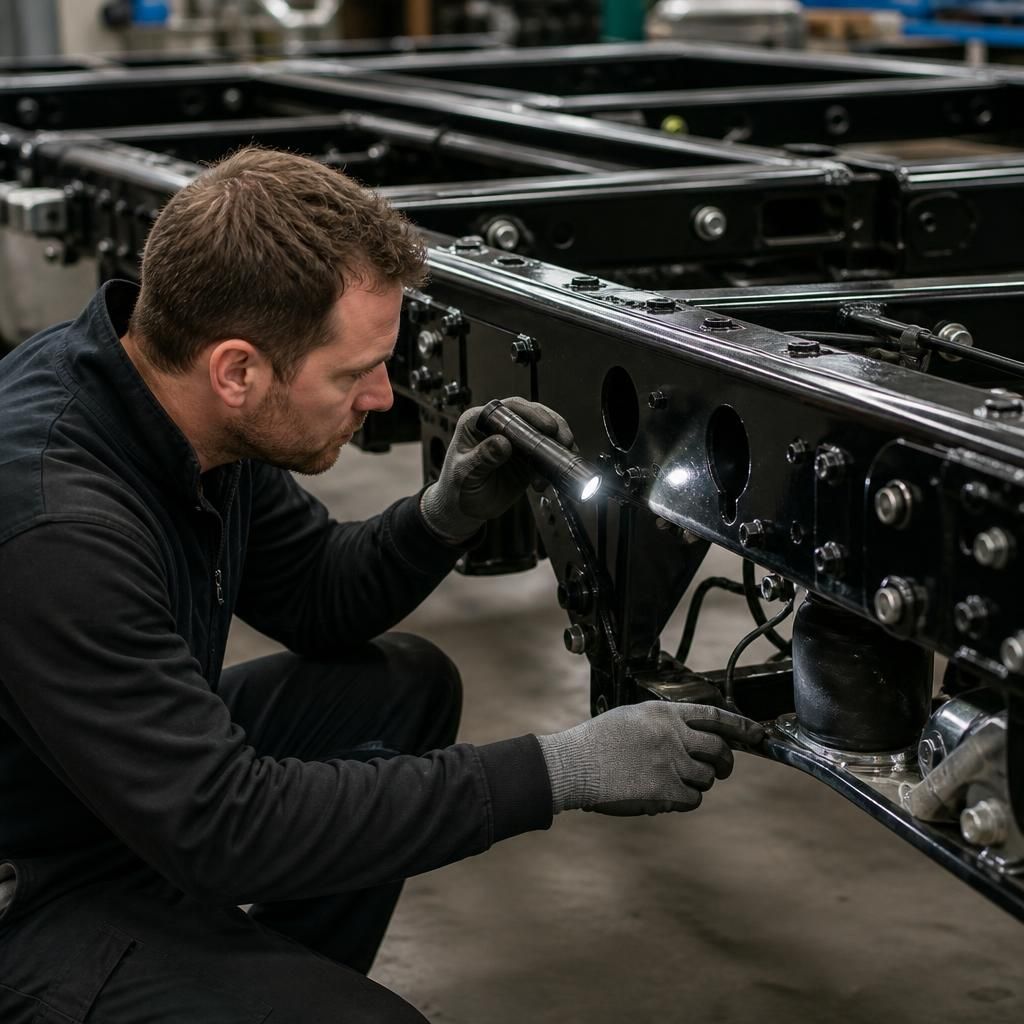
Routine inspections should assess changes in the coating beyond obvious chips and scratches. Fading, loss of gloss, chalking, blistering, flaking or bubbling can indicate weathering, chemical attack, poor adhesion or corrosion developing beneath the film. A change in colour alone may be cosmetic, but lifting edges, rust staining or expanding defects warrant closer investigation because moisture may already be reaching the metal.
Inspect welds, corners, edges, fastener locations and sheltered faces particularly carefully, as these areas can experience greater coating stress or retain contamination. Photograph significant defects and compare them during later inspections. This helps establish whether a mark is stable or spreading, supporting a reasoned decision between monitoring, local repair and professional recoating.