

How does powder coating enhance the structural integrity and longevity of chassis and frames under extreme conditions?
Powder coating helps preserve the structural integrity of chassis and frames by forming a strongly bonded protective layer that resists corrosion, abrasion, impact, moisture and selected chemicals. By limiting deterioration of the underlying metal in demanding environments, a correctly specified and cured coating can extend the component’s service life and reduce the risk of premature failure.
Powder coating enhances the longevity of chassis and frames mainly by preserving the condition of the metal around load-bearing features, joints and exposed edges. It is not a structural reinforcement and cannot compensate for inadequate material thickness, poor welds, distortion or existing fatigue cracks. Its contribution is to maintain the original condition of a correctly designed and manufactured component, helping it remain serviceable when exposed to vibration, temperature changes, weather and demanding handling.
Structural deterioration often begins at vulnerable details rather than across broad, accessible surfaces. Weld toes, seams, apertures, brackets, folded edges and fastener interfaces can become points where moisture or contaminants are retained and where local damage is more likely. A continuous, well-adhered coating helps isolate these areas from the surrounding environment. The benefit is greatest when the component is designed and prepared so that the powder can reach relevant surfaces and the finished film is not broken by sharp defects, trapped residues or uncoated recesses.
Chassis and frames also experience repeated loading. Vibration and cyclic movement can gradually expose weaknesses at welds, joints and mounting points. Powder coating does not remove this fatigue loading, but maintaining a sound surface can help prevent small areas of deterioration from becoming larger defects. For this reason, coating should form part of a wider engineering and inspection regime that includes checking weld quality, alignment, fastener condition, joint design and any evidence of cracking or distortion.
Performance under extreme conditions depends heavily on preparation and curing. Oil, mill scale, weld residues, oxides and other contaminants can prevent the coating from bonding properly. Inadequate curing can leave the film with reduced mechanical performance, while excessive or unsuitable heat can affect the substrate, existing components or dimensional tolerances. The coating system therefore needs to be matched to the metal, component geometry and specified cure conditions rather than selected by colour alone.
Temperature cycling is an important consideration for frames used outdoors, in plant, transport equipment or industrial settings. Metal and coating expand and contract as temperatures change. A suitable powder system, correctly applied and cured, should accommodate the expected service conditions without premature loss of adhesion. Designers and finishers should consider the operating temperature range, heating method, mass of the component and whether different metals or attached materials will respond differently to heat.
Maintaining dimensional accuracy is also part of preserving structural function. Excess coating on mating faces, earth points, bearing seats, threaded holes or close-fitting interfaces can interfere with assembly or alter the position of a component. These areas may need masking, controlled application or post-coating inspection. Drainage and ventilation openings should remain clear so that water or vapour is not retained inside hollow sections, where it can create concealed deterioration that is difficult to detect.
A practical specification for chassis and frames should address:
- the base metal, thickness and condition of the component;
- expected vibration, loading, temperature variation and environmental exposure;
- welded seams, folded edges, cavities, drain holes and other difficult-to-coat details;
- surfaces that must remain free from coating for assembly, electrical continuity or dimensional control;
- the required preparation method, powder type, application process and curing requirements; and
- inspection of coverage, adhesion, finish consistency, masking and critical dimensions after coating.
Before coating, existing cracks, deformation, poor welds and weakened sections should be assessed and rectified by the appropriate engineering process. Applying powder over a defect can conceal it without resolving the cause. Once finished, the chassis or frame should still be inspected at service intervals, particularly around mounting points, welds and areas subject to repeated movement. With sound design, suitable preparation and controlled application, powder coating supports longer service life by helping the component retain its intended physical condition under demanding use.
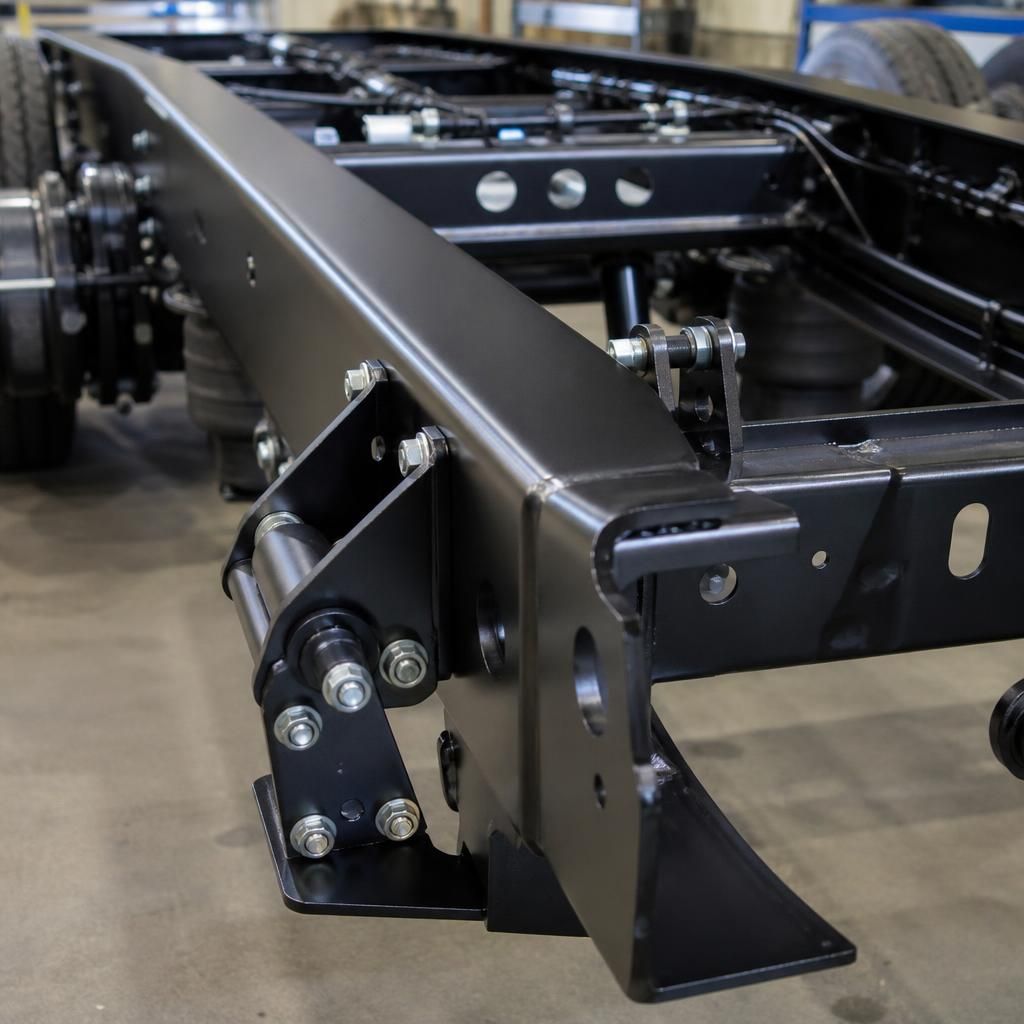
Powder coating can help protect chassis and frames where dissimilar metals meet by acting as an insulating barrier between the metal surfaces. This can reduce the risk of galvanic corrosion, in which moisture and electrical contact between different metals accelerate local material loss around brackets, fixings and mounting interfaces.
The coating specification must account for electrical continuity, earthing points and areas where fasteners or close-fitting parts make direct contact. These locations may require controlled masking, compatible fixings or an additional protection method, because damage or exposed edges can allow corrosion to begin beneath the finish. Used as part of a suitable interface design, powder coating helps preserve the metal around connections that are important to the frame’s long-term serviceability.
Discuss powder coating for your chassis and frames
Discuss your chassis or frame’s material, geometry and operating conditions with the powder-coating team to identify a suitable coating specification. Sharing drawings, component details and any critical masking or dimensional requirements can help inform the next stage.