

What types of powder coatings are best suited for large-scale industrial applications?
Large-scale industrial applications are typically best served by durable polyester powders for external parts, epoxy-polyester powders for balanced internal and external performance, and epoxy powders where chemical and corrosion resistance is the priority. Specialist nylon and protective coatings may be more suitable for components requiring enhanced wear resistance, impact protection or a particular functional finish.
For large-scale industrial work, the most suitable powder coating is selected according to the component’s operating environment, substrate, required film properties, curing conditions and production method. The coating must perform consistently across the full batch, while also being practical to apply to the component sizes, shapes and quantities involved.
External exposure and general industrial use: Polyester-based systems are commonly selected for components exposed to weather, sunlight and changing temperatures. They are appropriate where colour retention, surface appearance and resistance to general atmospheric conditions are important. The grade should still be matched to the expected exposure, because a finish intended for sheltered equipment may not be suitable for continuously exposed architectural or industrial parts.
Mixed indoor and outdoor requirements: Hybrid systems can be useful where components experience a combination of internal industrial conditions and limited external exposure. Their suitability depends on the balance required between appearance, corrosion protection, chemical resistance and cost. They should not be treated as interchangeable with a fully exterior-grade system without considering the component’s location and expected service life.
High chemical or corrosion demands: Epoxy-based systems are generally considered when resistance to chemicals, moisture and corrosion is more important than long-term colour stability in direct sunlight. They can be appropriate for internal plant, machinery parts, brackets, housings and other components operating in controlled or sheltered environments. Where ultraviolet exposure is significant, the specification should account for the possibility of surface chalking or colour change.
Wear, impact and functional performance: Specialist coatings are chosen when the finish must do more than protect against ordinary atmospheric exposure. Nylon coatings, for example, can be considered for parts subject to friction, abrasion, repeated handling or impact. Protective formulations may also be specified where the coating needs to provide a particular barrier, insulation or resistance characteristic. The correct choice depends on the type of contact and the severity of the duty rather than on the component’s appearance alone.
Thermosetting and thermoplastic powders: Most industrial powder coatings are thermosetting. During curing, the resin forms a permanent cross-linked film, so the finished coating cannot simply be melted and reapplied. Thermoplastic powders behave differently: they soften when heated and can be selected for specific requirements such as toughness, thickness or resistance to wear and chemicals. Nylon is one example of a thermoplastic coating, although the application process and component requirements must be assessed carefully.
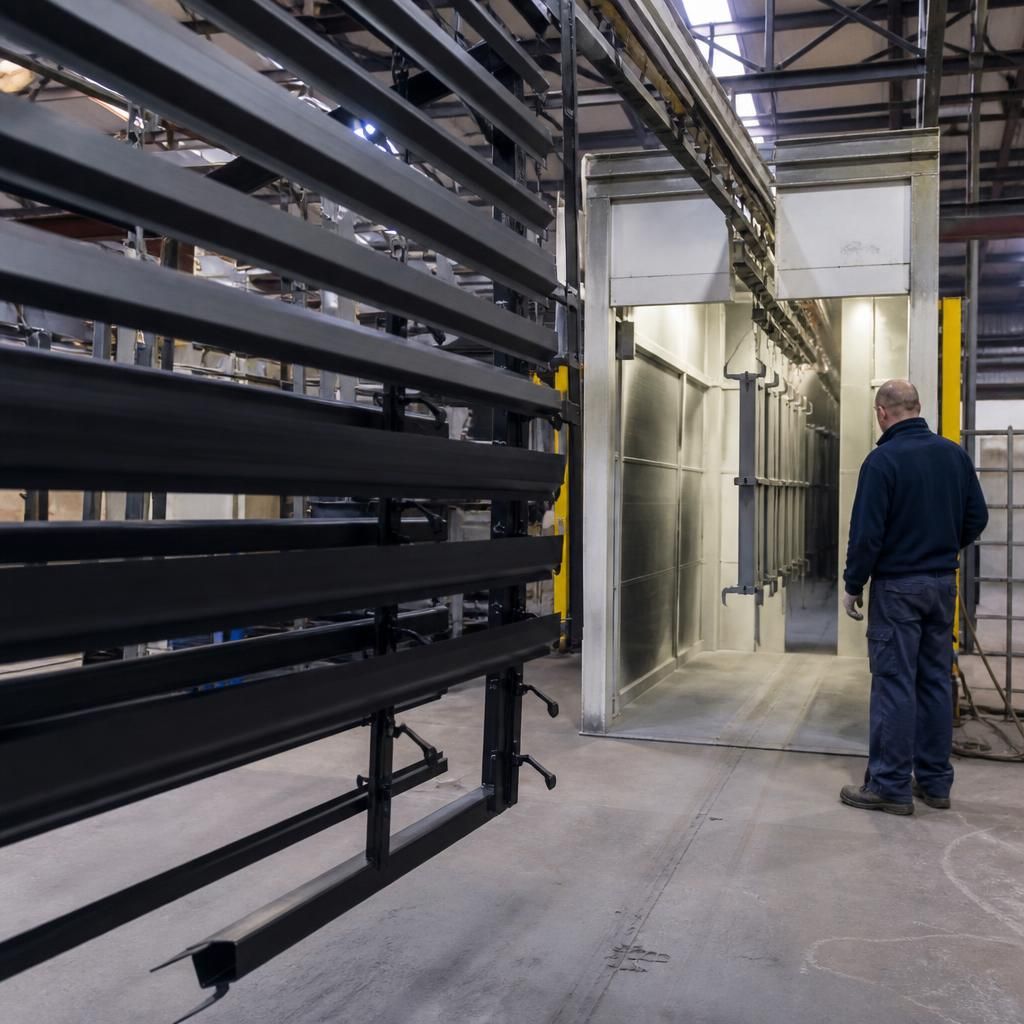
Component size and geometry: Large-scale work often includes long sections, fabricated frames, panels, brackets and parts with recesses or difficult-to-reach areas. The coating type must be compatible with the component’s geometry and with the method used to charge and deposit the powder. Sharp edges, deep corners, internal faces and overlapping sections can affect coverage and film build. A technically suitable powder may therefore need a particular application approach to achieve a uniform result across the whole component.
Substrate and pre-treatment: The metal being coated is an important part of the specification. Steel, galvanised steel, aluminium and other substrates can require different cleaning, pre-treatment and curing considerations. A coating designed for one substrate is not automatically suitable for another. Surface preparation removes contamination and supports adhesion, while the pre-treatment system helps address corrosion risk. For large batches, the preparation process must also be repeatable so that coating performance does not vary between loads.
Curing and production control: Powder selection must include the manufacturer’s recommended cure schedule, including the required metal temperature and dwell time. Oven settings that are suitable for one component thickness may not be suitable for a heavier fabrication or a densely loaded batch. Under-curing can reduce the coating’s final properties, while excessive heat can affect colour, gloss or the substrate. A practical specification therefore considers the complete production cycle rather than selecting a powder solely from a colour chart.
Finish and appearance: Industrial powders are available in different gloss levels, textures and colours. Smooth finishes can make contamination easier to identify and clean, while textured finishes may help disguise minor surface variation or provide a different visual and tactile effect. Gloss, texture and colour can also influence how consistent a large batch appears, particularly when components are processed in separate loads. The approved finish should be defined clearly before production begins.
- Identify whether the parts are used indoors, outdoors or across both environments.
- Assess exposure to moisture, chemicals, sunlight, abrasion, impact and temperature variation.
- Confirm the substrate and any existing surface treatment or galvanising.
- Check that the powder’s cure requirements suit the component thickness and available oven process.
- Specify the required colour, gloss, texture, film build and visual tolerance.
- Consider how edges, recesses, joints, threaded areas and masking points will be treated.
- Confirm that the coating can be applied consistently across the full batch and component range.
For a large industrial project, the best coating is therefore the one that matches the part’s service conditions and can be applied repeatably at the required scale. A coating specification should be agreed from the component drawings, substrate, operating environment and finish requirements, with specialist advice used where the parts face unusual wear, chemical exposure or protective demands.
The most suitable powder coating for a large-scale industrial application is determined by its tested performance classification, not simply by whether it is described as polyester, epoxy or nylon. Powders within the same family can have different levels of resistance to ultraviolet exposure, chemicals, abrasion and corrosion, so the technical data should be checked against the component’s intended duty.
For repeat production, the chosen specification should also identify the approved colour, gloss, texture and film thickness, together with the required cure conditions. A representative sample or first-off component can then be assessed before the full batch is processed, helping confirm that the selected coating provides the required finish and practical coverage across the component design.