

How does the choice of powder coating material impact the durability and performance of large-scale industrial projects?
The choice of powder coating material directly affects a project’s resistance to corrosion, chemicals, weathering, abrasion and impact. Selecting a formulation suited to the metal substrate, operating environment and required finish helps large-scale components retain their protective performance and appearance throughout service.
The powder coating material determines the cured film’s structure, hardness, flexibility, chemical resistance and temperature tolerance. For a large-scale industrial project, the correct choice therefore depends on the component’s substrate, service conditions, geometry, handling requirements and specified finish—not simply on the colour or appearance required.
Most industrial powder coatings are thermosetting materials. During curing, the resin and cross-linking agent react to form a permanent film. Different resin systems produce different performance characteristics:
- Epoxy coatings generally provide strong adhesion and resistance to many chemicals, making them suitable for components used indoors or where protection of the substrate is the main priority. Their limitations must be considered where the coating will receive prolonged exposure to ultraviolet light.
- Polyester coatings are commonly selected for external applications because they offer a useful balance of finish retention, flexibility and general protection. The particular grade should be matched to the expected environment rather than treated as suitable for every outdoor application.
- Epoxy-polyester hybrid coatings combine characteristics of both resin types and may be appropriate for interior components where a balance between finish, adhesion and resistance is required.
- Polyurethane coatings can be specified where a smooth decorative finish and good resistance to handling or industrial contaminants are important.
- Nylon and other thermoplastic coatings can provide a thicker, more resilient layer for parts that need additional protection from friction, impact, moisture or repeated contact. They may require different preparation, application and processing arrangements from conventional thermosetting powders.
Film thickness is another important material-related decision. A thin coating can be appropriate where dimensional tolerances are tight, while a thicker system may be needed for edges, high-contact areas or components exposed to more demanding service conditions. Excessive thickness is not automatically beneficial: it can affect fit, obscure detail, increase the risk of surface defects and alter the appearance of the finished part. The specified thickness should therefore reflect the component’s function and the powder manufacturer’s technical requirements.
Flexibility also affects long-term performance. Rigid films may offer useful hardness but can be less tolerant of forming, vibration or movement in the component. A more flexible formulation may be preferable for parts that are handled frequently or subject to thermal expansion. The balance between hardness and flexibility is particularly relevant to large assemblies, because damage can occur during lifting, transport, installation or subsequent fabrication even when the coating itself has been correctly cured.
The material must be compatible with the substrate and its preparation. Steel, galvanised steel, aluminium and previously coated components can each present different adhesion and outgassing considerations. For example, a substrate with residual oils, moisture, scale or contaminants can prevent the selected powder from forming a sound bond. Some galvanised or cast components may require a suitable pre-treatment approach and controlled heating to reduce the risk of pinholes, bubbles or other defects.
Curing behaviour has a direct effect on performance. The required cure is based on the metal’s actual temperature and the powder system’s technical data, not merely the oven air temperature or the time that a component spends inside the oven. Large or irregularly shaped parts may heat at different rates, so the process needs to account for the coldest areas of the load. Under-curing can leave the film with inadequate mechanical or chemical properties, while excessive heat can affect colour, gloss or the substrate.
Material selection should also take account of production scale. A powder that performs well on a small component may be less suitable for a large batch if its application window, curing profile or recoat behaviour makes consistent processing difficult. The specification should address:
- the base metal and any pre-treatment system;
- the required film thickness and acceptable tolerance;
- the operating temperature and exposure conditions;
- contact with oils, fuels, cleaning agents or process chemicals;
- handling, assembly and transport requirements;
- surface appearance, texture, colour and gloss;
- dimensional tolerances and areas that must remain uncoated; and
- inspection and testing requirements for the completed batch.
For large-scale work, consistency is as important as the nominal performance of the powder. The same material, preparation standard and curing parameters should be maintained across the batch wherever possible. Changes in substrate condition, powder storage, application settings or component loading can produce differences in film appearance and performance. Clear technical specifications and representative trial pieces can help identify compatibility or processing issues before full production begins.
The most suitable coating material is therefore the one whose resin chemistry and processing requirements match the component’s complete service profile. A coating specialist can review the substrate, intended use, dimensions and production requirements before recommending a formulation and confirming the preparation, application and curing conditions needed for the project.
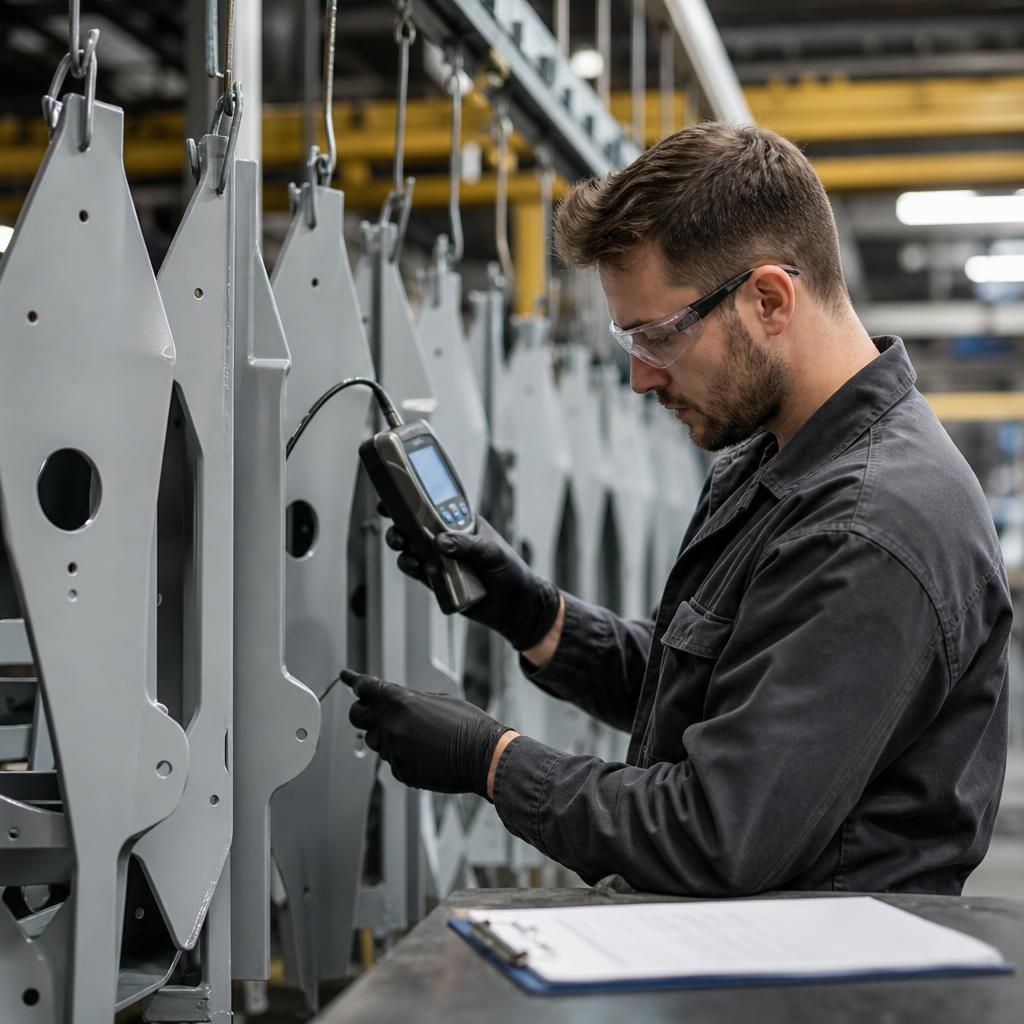
Powder coating material should be selected alongside a suitable performance verification plan, because a visually uniform finish does not necessarily confirm that it will withstand the project’s service conditions. Different resin systems and film constructions require different acceptance checks.
For large-scale production, inspection may include film-thickness measurement, adhesion assessment, cure verification and checks for surface defects. Where the components face specific risks, testing should reflect those risks—for example, resistance to cleaning chemicals, repeated handling, impact or corrosion exposure. The results can then be compared with agreed project requirements rather than judged solely by colour, gloss or general appearance.
This approach helps distinguish a coating that looks satisfactory immediately after curing from one that is technically suitable for its intended service. It also provides a consistent basis for reviewing batch variation when the same components are processed in substantial quantities.