

What safety and compliance standards should be considered when implementing a conveyor powder coating system in an industrial setting?
Implementing a conveyor powder coating system requires consideration of UK requirements covering machinery safety, combustible dust and explosion risks, workplace exposure, fire protection, electrical installations and operator training. The assessment should typically address PUWER, DSEAR, COSHH and relevant ATEX principles, supported by risk assessments, suitable guarding, effective extraction, earthing, housekeeping, inspection and documented maintenance procedures.
A compliant conveyor powder coating system must be designed, installed, commissioned and operated as a complete item of industrial machinery rather than as a collection of separate components. In practice, this means aligning the system with applicable UK machinery, workplace, fire, environmental and electrical requirements, then retaining evidence that the controls have been selected, validated and maintained for the actual production process.
Establish responsibility for the completed system. The equipment manufacturer, system integrator and operating business may each have different legal duties. If conveyors, booths, ovens, recovery equipment and control panels are integrated into one production line, the party placing the completed assembly into service may need to demonstrate conformity for the system as a whole. A change that materially affects the machinery’s safety can also create additional conformity obligations. Contracts should therefore define who is responsible for the technical file, instructions, declarations, final verification and handover documentation.
Apply the appropriate machinery standards. The legal route for supplying or commissioning the equipment should be confirmed for the location and date of installation, including whether UKCA or CE marking requirements apply. Relevant design standards may include:
- BS EN ISO 12100 for machinery risk reduction and the selection of protective measures;
- BS EN 60204-1 for the electrical equipment of machines;
- BS EN ISO 13849 or another suitable functional-safety standard for safety-related control systems; and
- the applicable standard for coating plants for liquid or powder organic coating materials, subject to confirmation by the designer or conformity specialist.
These standards should not be treated as a substitute for a project-specific assessment. Their relevance depends on the system layout, powder chemistry, conveyor arrangement, oven design, cleaning method and intended operating conditions.
Verify safety functions before production. Commissioning should include documented tests of emergency stops, access-door or panel interlocks, conveyor stopping arrangements, oven permissives, fault indications, restart prevention and any safety-related control circuits. A safety function should be checked under realistic fault conditions, not merely shown to operate during normal running. The final records should identify the test performed, the result, the person responsible and any corrective action.
Consider the wider workplace risks. Powder coating lines can introduce hazards that are not limited to the application booth. The assessment should cover loading and unloading, manual handling of frames and components, access to elevated parts of the line, movement of vehicles and pedestrians, heat from the curing process, noise, slips, sharp edges, cleaning tasks and foreseeable maintenance activities. Where access platforms, ladders or lifting equipment are used, their inspection, safe-use arrangements and load limits should be addressed separately. Layout drawings should show safe operator positions, escape routes and segregation from traffic.
Coordinate fire and building controls. The responsible person for the premises should consider the requirements of the Regulatory Reform (Fire Safety) Order 2005, where applicable, alongside the building’s fire strategy and the recommendations of the insurer. This can affect compartmentation, escape routes, alarm arrangements, storage of powder and packaging, access for emergency services and the separation of process equipment from combustible materials. Any detection, suppression or isolation arrangement should be compatible with the system controls and included in the commissioning and maintenance records rather than treated as a standalone building feature.
Manage powder and chemical information correctly. Every coating product should be supported by current supplier information, including the safety data sheet and classification under the applicable GB chemical regime. Product changes should trigger a review because additives, curing agents, cleaning materials and reclaimed powder may alter handling precautions, waste classification or process conditions. Operators need clear instructions for storage, decanting, spill response, waste containers and disposal. The business should also check whether its use of substances or release of process emissions requires notification, authorisation or an environmental permit from the relevant regulator.
Control waste and emissions. Powder overspray, contaminated filters, sweepings, rejected parts, packaging and cleaning residues should be identified and managed through a documented waste procedure. Waste must be stored so that it cannot create a fire, dust or contamination risk, and its classification should be confirmed rather than assumed. Depending on the scale and location of the operation, local environmental requirements may apply to particulate emissions, waste handling or other aspects of the installation. Keeping records of waste transfers and process changes helps demonstrate ongoing control.
Provide suitable operator information. Training should be specific to the installed line and should cover normal operation, abnormal conditions, isolation, safe cleaning, product changes, spill response, emergency arrangements and reporting of defects. Written instructions should be available at the relevant workstations and should reflect the final configuration, not an earlier design. Visitors, contractors and maintenance personnel need defined access rules and a clear handover process.
Maintain evidence after installation. A practical compliance file should normally contain the final layout and circuit drawings, equipment specifications, declarations and manuals, control-system validation records, commissioning results, inspection certificates, product safety information, training records, maintenance schedules and records of modifications. Periodic reviews should be triggered by changes to powder formulation, production rate, conveyor speed, booth or oven settings, recovery equipment, software or building layout. Keeping this information current is essential because compliance applies throughout the system’s working life, not only on the day it is installed.
Before procurement, the operating business should ask the designer or integrator for a compliance matrix showing each applicable requirement, the control provided and the evidence that will be delivered at handover. An independent competent review is particularly valuable where several suppliers contribute to one line, where the process involves combustible powder, or where the installation is being modified from an existing arrangement.
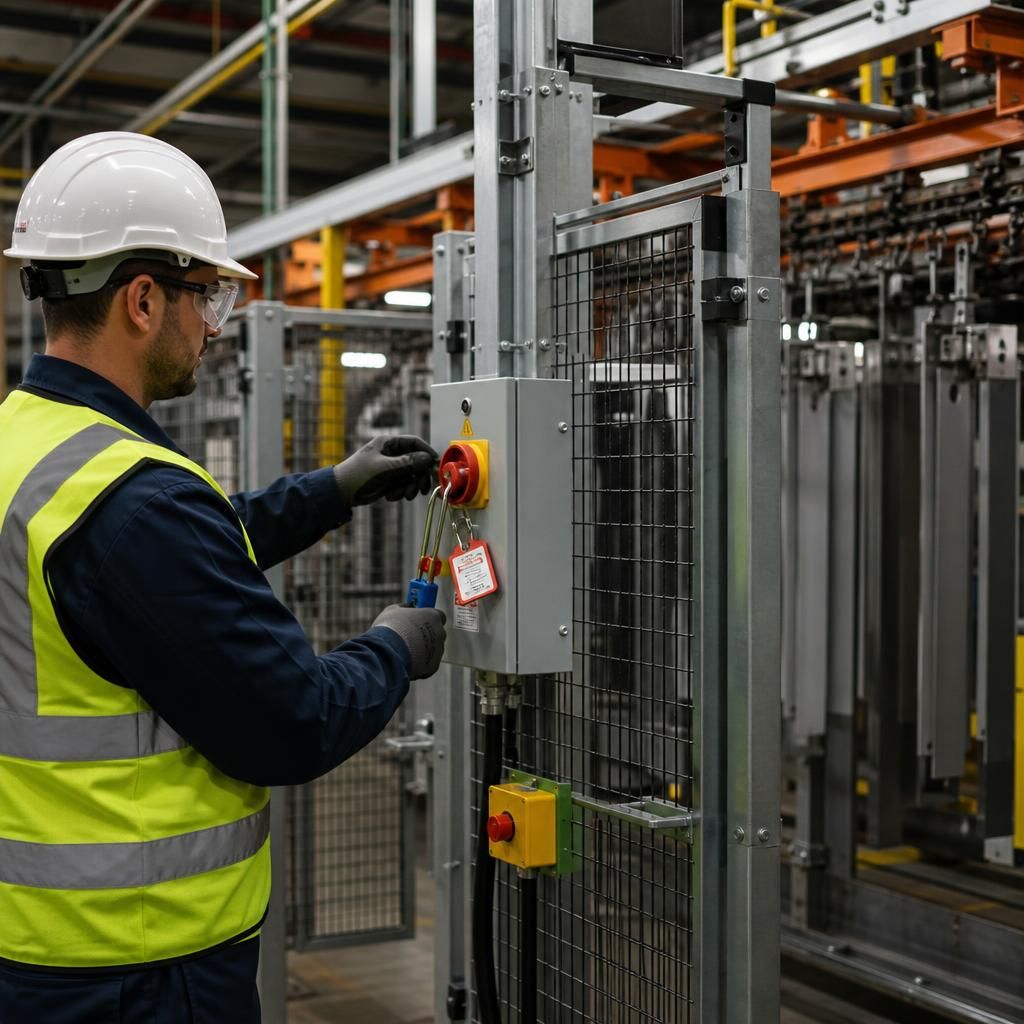
Safe isolation is a critical compliance control during cleaning, inspection and maintenance of a conveyor powder coating system. The procedure should identify every energy source, including electrical supplies, compressed air, heated ovens, moving conveyors and stored mechanical energy. Equipment should be shut down, isolated, locked off and proved dead before guards or access panels are removed.
Isolation arrangements should be supported by clearly labelled disconnectors, accessible emergency controls and written instructions suited to the installed line. Maintenance personnel should verify that the conveyor cannot restart automatically and that hot surfaces, suspended loads and residual pressure have been made safe. A controlled permit-to-work process may be appropriate where several people or contractors are involved.
After the work, guards and interlocks should be restored before operation resumes. The responsible person should confirm that tools and temporary barriers have been removed, test the relevant safety functions and record any defects or alterations. This approach helps ensure that maintenance activity does not introduce a new risk into an otherwise compliant coating process.