

How can I determine the right size and configuration of a conveyor powder coating system for my specific production needs?
Determine the right conveyor powder coating system by matching its configuration to the parts being coated, required throughput, coating material, curing process and available floor space. Assess part dimensions and weight, hanging orientation, conveyor speed, batch volume and future capacity needs before specifying the line layout, booth, oven and handling equipment.
The correct size and configuration of a conveyor powder coating system are determined by the relationship between the workpiece envelope, production demand, coating specification and process sequence. Begin with measured production data rather than selecting equipment from a nominal line size, then use that data to define the conveyor, loading arrangement, spray booth, curing oven, recovery equipment and control system as one integrated process.
1. Establish a representative production profile
List the parts that will run through the system and group them by coating requirements and physical characteristics. For each part or product family, record:
- Overall length, width, height and any parts that project beyond the main body;
- Weight and the likely centre of gravity when suspended;
- Available hanging points and the orientation needed for effective coverage;
- Surface condition, substrate and pre-treatment requirements;
- Powder type, colour changes and any special finish requirements;
- Whether the item requires one-sided access, full surrounding coverage or masking;
- Production quantity and the expected mix of part sizes.
Use the largest and most demanding parts to establish the physical envelope, but also check smaller components. A line designed only around the maximum item may handle large work effectively while becoming inefficient for small parts, frequent colour changes or mixed batches.
2. Translate demand into a line capacity
Production demand should be expressed in terms of parts or coated surface area that the system must process within the planned production cycle. Include loading, unloading, inspection, rework and changeover requirements when assessing usable capacity. The theoretical capacity of a conveyor is not the same as its practical output if operators cannot load parts consistently or if the oven and booth become bottlenecks.
Assess the normal product mix as well as peak demand. If the line will process parts of substantially different sizes, calculate the loading pattern for each product family. This helps identify whether the system needs adjustable hanging positions, alternative hooks, carrier fixtures or a separate route for unusually large components.
3. Select the conveyor and suspension arrangement
The conveyor must support the combined load of the workpieces, hooks, jigs and carriers without excessive deflection or unstable movement. Its design should also accommodate the required track route, inclines, drops, inspection points and operator access. A stable, repeatable presentation of each part is essential because inconsistent movement changes the distance between the powder gun and the surface.
Suspension design is often as important as the conveyor itself. Hooks and fixtures should keep parts secure, expose the required surfaces and allow electrical contact where electrostatic application depends on grounding. They should also minimise areas that shield the coating or collect powder. For products with multiple orientations, interchangeable fixtures may provide more useful flexibility than simply increasing line size.
Check the permitted spacing between carriers against the part profile. Closely spaced items may interfere with spray access, while excessive spacing uses conveyor capacity without improving the finish. The correct arrangement is the one that maintains reliable coverage and curing while making efficient use of each conveyor position.
4. Size the spray booth and application equipment
The booth must contain the largest coated envelope with sufficient clearance for the suspended part, its movement and the application equipment. Consider access for manual touch-up, gun adjustment, cleaning and inspection, not just the external dimensions of the enclosure.
Specify the number and position of powder guns according to the surfaces that must be coated. Complex fabrications may require different gun angles, reciprocators or manual access to reach recesses and internal faces. The configuration should distinguish between surfaces that can be coated automatically and areas that need operator intervention. Powder recovery and filtration must also be matched to the powder volume and the frequency of colour or product changes, since recovery arrangements affect cleaning and changeover procedures.
5. Confirm the curing requirement
Oven selection depends on the coating manufacturer’s specified metal temperature and dwell requirement, together with the thermal mass and geometry of the parts. The oven must provide a consistent thermal profile around the actual workpiece, not merely reach the required air temperature. Dense fabrications, hollow sections and different metal thicknesses can heat at different rates.
Map the temperature profile for representative products during commissioning and after significant changes to the line. This can reveal cold spots, excessive heat exposure or insufficient dwell that may not be apparent from the oven display. The oven length, conveyor path and air circulation arrangement should therefore be selected from validated curing requirements rather than from conveyor capacity alone.
6. Check pre-treatment, drainage and process order
Where cleaning, rinsing, drying or chemical pre-treatment is required, the stages must be arranged around the part’s geometry and the coating specification. Parts need suitable drainage and ventilation positions so that liquids do not remain trapped in folds, tubes or enclosed sections. The transfer between pre-treatment, drying, coating and curing should protect the prepared surface from contamination.
Include space for inspection and process control between stages. A fault detected before curing is generally easier to correct than one found after a complete cycle, so the layout should allow operators to identify contamination, poor grounding, missed areas or incorrect hanging before the finish is fixed.
7. Allow for cleaning, changeovers and maintenance
Configuration decisions should account for how the system will be cleaned and maintained. Provide safe access to filters, guns, booth surfaces, conveyor components, oven inspection points and recovery equipment. If the business handles multiple powders, assess whether a quick-change arrangement is justified by the required product mix, or whether a dedicated application route would provide better control.
Minimise concealed ledges and difficult-to-reach areas where powder can accumulate. Include suitable isolation points, inspection access and lifting provisions for components that need removal. These details do not increase coating capacity directly, but they influence how consistently the line can be operated and how easily faults can be diagnosed.
8. Review controls, monitoring and integration
The control system should make the key process variables visible and repeatable. Relevant functions may include conveyor movement, gun operation, oven temperature, powder feed, extraction, alarm handling and recipe management. Interlocks should prevent unsafe or unsuitable operation, such as application equipment running without the required extraction or the conveyor stopping in a position that could expose parts to excessive heat.
Consider how production information will be recorded and how operators will identify the correct settings for each product family. Clear recipes and traceable process checks are particularly useful where several finishes share the same line but require different application or curing conditions.
9. Test the proposed configuration before final specification
Use representative parts, hooks and powder during the design review wherever possible. A physical trial or detailed layout study should confirm access, grounding, spray coverage, operator movement, oven loading and maintenance clearance. Include awkward parts and likely future products rather than testing only the easiest item.
Ask the system designer to document the assumptions behind the proposal: product envelope, loading pattern, conveyor load, application method, curing profile, extraction requirements and planned expansion points. This makes it easier to identify which changes would require a major redesign and which can be accommodated through new fixtures, gun settings or recipes.
For a Midlands manufacturer or fabricator assessing an industrial powder coating line, this structured information can also support a more useful discussion with a specialist coating provider. A supplier reviewing actual component drawings, production data and finish requirements can help distinguish between equipment that is genuinely needed and capacity that would remain unused.
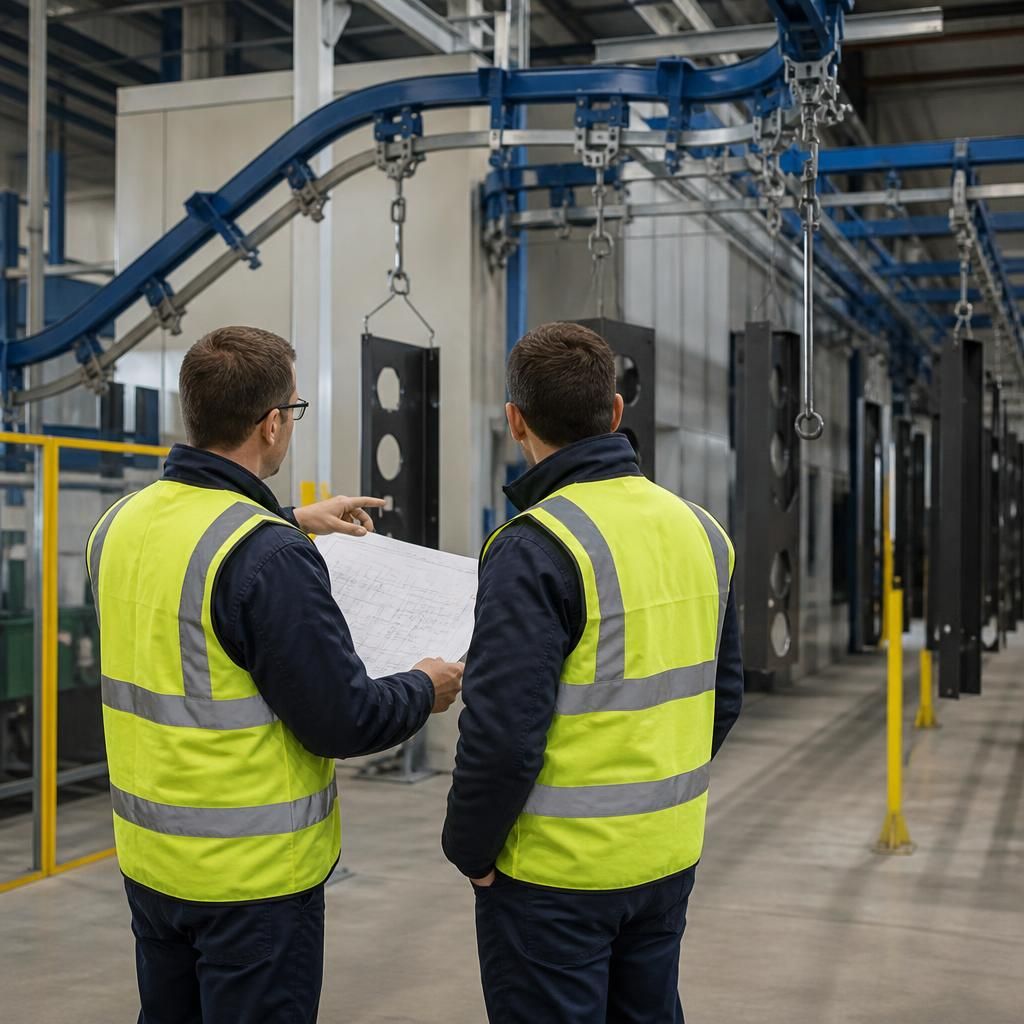
A conveyor powder coating system must be sized against the available building services and installation constraints as well as the parts it will process. A line that fits the product envelope may still be unsuitable if the site cannot support its power, extraction, heating, compressed-air or ventilation requirements.
- Building layout: Check ceiling height, floor loading, access routes for delivery and installation, operator walkways, emergency access and space around serviceable equipment.
- Utilities: Confirm the available electrical supply, heating provision, compressed air quality and pressure, extraction capacity and any ventilation requirements before equipment is specified.
- Process connections: Establish where pre-treatment drainage, wastewater handling, powder recovery and exhaust discharge will be accommodated. Their position can affect the order and overall length of the line.
- Future access: Leave practical clearance for removing filters, burners, fans, guns, conveyor components and oven panels. Equipment that cannot be reached safely can turn routine servicing into a major interruption.
A site survey should record these constraints alongside the production data. This allows the proposed conveyor route, booth, oven and ancillary equipment to be checked as a complete installation rather than treated as separate items.
Discuss your conveyor powder coating system requirements
Discuss your conveyor powder coating system requirements with a specialist using representative component drawings, production data and finish specifications. This will help assess the proposed configuration and identify practical options for your operation.