

What are the long-term maintenance requirements for clear and black powder coated finishes on industrial metal components?
Long-term maintenance for clear and black powder coated industrial metal components involves regular inspection, gentle cleaning and prompt attention to chips, scratches, corrosion or coating breakdown. Use a soft cloth or brush with mild detergent and water, avoid abrasive tools and aggressive chemicals, and arrange professional assessment where damage exposes the underlying metal or requires recoating.
Long-term care for clear and black powder coated industrial components is mainly a matter of controlling exposure, preventing mechanical damage and checking that the coating system remains suitable for its working environment. The required regime depends on whether the component is indoors or outdoors, the level of ultraviolet exposure, contact with moisture or chemicals, and the amount of handling, impact or abrasion it receives.
Set the maintenance regime according to the operating environment
A component installed in a clean, dry interior location will generally face different risks from one used externally, near roads, in a manufacturing plant or in a setting exposed to moisture and airborne contaminants. Coastal or high-salt environments, industrial pollutants, wash-down areas and locations where condensation forms can place greater demands on the coating. Maintenance planning should therefore consider:
- Whether water, condensation or cleaning fluids can collect on horizontal surfaces, joints or enclosed sections.
- Exposure to sunlight and ultraviolet radiation, particularly on externally installed components.
- Contact with oils, fuels, solvents, acids, alkalis or process chemicals.
- Repeated impact, rubbing, vibration or contact with abrasive materials.
- Whether the component is handled, stacked, bolted, moved or removed during servicing.
Manage moisture and contamination at the installation
Good installation and housekeeping reduce the load placed on the coating. Components should not be arranged in a way that creates persistent water traps, concealed damp interfaces or contact between wet, contaminated surfaces. Drainage points should remain clear, and damaged seals, gaskets or protective caps should be dealt with as part of the wider equipment maintenance plan. Where coated parts are mounted against other metals, the fixing arrangement should also be reviewed so that moisture and dissimilar-metal contact do not create a local corrosion problem beneath or around the finish.
Allow for the different behaviour of clear and black finishes
A clear powder coat preserves more of the appearance of the underlying metal, so staining, surface marks, changes in the substrate and local defects may remain more visible. It is especially important that the metal is correctly prepared before application and that contamination is not allowed to become embedded in the finish.
Black coatings can make dust, pale deposits, handling marks and surface scuffs more noticeable, while prolonged ultraviolet exposure can affect colour and gloss depending on the powder formulation and exposure conditions. A black finish should therefore be assessed against the performance requirements of the specific application rather than selected on colour alone. For either finish, the coating specification, intended exposure category and any restrictions supplied with the coating should be retained with the component’s maintenance records.
Protect the finish during handling and associated work
Many long-term coating problems begin after installation rather than during the original application. Avoid dragging components across benches, floors or transport surfaces. Use clean separators when stacking finished parts, and prevent metal swarf, grit and sharp edges from rubbing against the coating. During drilling, welding, grinding or modification of adjacent items, shield the coated surface from sparks, heat and debris. Temporary protection should be removed carefully so that trapped moisture or adhesive residue does not remain against the finish.
Fasteners, brackets and contact points deserve particular attention. Over-tightening can damage the coating locally, while movement caused by vibration can produce wear around holes and interfaces. Where a component is regularly removed, the maintenance procedure should identify those areas as higher-risk points and use suitable tools and handling methods.
Use a defined condition assessment process
Long-term maintenance records should distinguish between cosmetic change and loss of protective function. Note the location, size and type of any defect, together with the likely cause, such as impact, abrasion, chemical exposure, trapped moisture or movement at a fixing point. Comparing the same areas over time helps determine whether a mark is stable or developing into coating failure.
- Surface appearance: record changes in colour, gloss, staining, chalking, blistering or lifting.
- Coating integrity: look for cracking, flaking, exposed substrate and defects around edges, holes and joints.
- Underlying metal: establish whether corrosion is superficial, localised or extending beneath the coating.
- Operating cause: identify impact, chemical contact, heat, moisture or movement so that the cause is corrected rather than only treating the visible mark.
Plan repairs according to the extent of failure
A small, isolated defect may be suitable for a controlled local repair if the surrounding coating is sound and the repair material is compatible with the original system. Larger areas of breakdown, widespread corrosion, loss of adhesion or repeated damage may require removal of the existing coating, preparation of the metal and full re-coating. The repair decision should take account of the component’s function, geometry, exposure and the required appearance; a local repair can restore protection without producing an identical visual blend, particularly on clear or high-gloss finishes.
Before recoating, the source of the problem should be addressed. This may involve improving drainage, changing a contact arrangement, protecting an abrasion point, controlling chemical exposure or revising the handling method. Applying a new layer without correcting the underlying cause can lead to recurring failure.
Keep the coating specification with the asset records
Record the finish colour and appearance, the substrate, the intended environment, any pre-treatment or primer used, and the powder coating requirements provided for the job. This information helps a maintenance team select compatible repair materials and gives a coater the details needed to assess whether a component can be repaired, stripped and recoated, or should be replaced. For batch-produced parts, consistent records also help identify whether a problem is isolated to one component or associated with storage, installation or operating conditions.
In practical terms, the most effective long-term approach is preventative: control moisture and contaminants, reduce avoidable abrasion, protect coated parts during handling, monitor vulnerable interfaces and match any repair to the original coating system. Clear and black finishes can both remain serviceable for industrial use when the maintenance plan reflects their exposure and the component is not treated as protected from every form of mechanical or chemical attack.
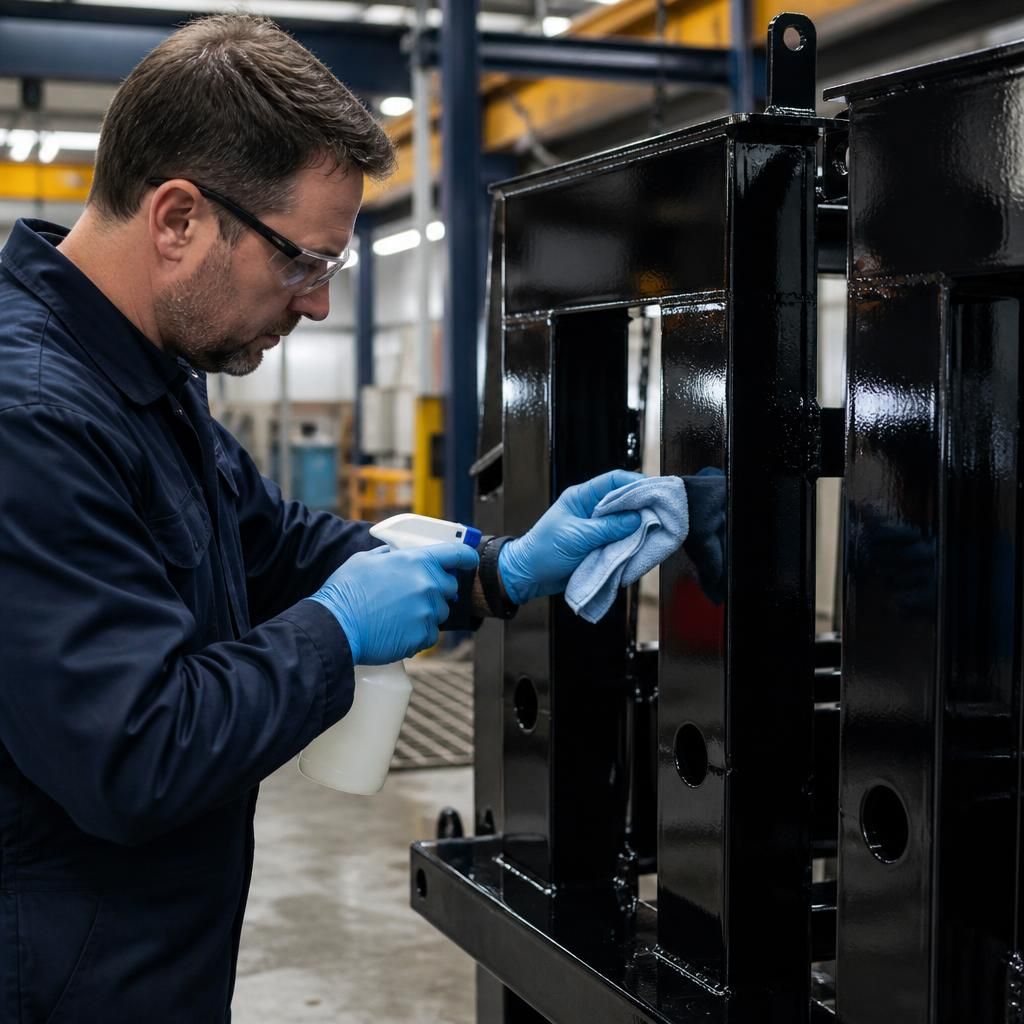
A long-term maintenance plan should include a documented cleaning specification, particularly where industrial components are exposed to process residues or routine wash-down. The key issue is not simply removing dirt, but confirming that the cleaning chemical, concentration, temperature and contact time are compatible with the clear or black powder coated finish.
Before introducing a new detergent, degreaser or disinfectant, test it on a small, inconspicuous area or an equivalent coated sample. Check the surface after cleaning and drying for changes in gloss, colour, whitening, tackiness, staining or loss of adhesion. Keep a record of approved cleaning products, dilution instructions and any restrictions so that maintenance staff do not substitute stronger chemicals without assessment.
- Remove process residues before they dry or accumulate.
- Prevent concentrated cleaner from remaining in joints, recesses or around fixings.
- Rinse away chemical residue rather than allowing it to form a surface film.
- Review the cleaning specification if the process, chemical products or operating environment changes.
This approach is particularly useful where appearance is part of the component requirement: changes in gloss may be more apparent on black finishes, while residue or staining can remain prominent on clear finishes because the underlying metal is visible.
Discuss Long-Term Care for Your Powder Coated Components
Discuss your component’s operating environment, finish requirements and anticipated maintenance regime with a powder-coating specialist before specifying the coating system. This helps establish whether a clear or black finish is appropriate and what information should be retained for future repairs or recoating.