

How does the polyester black coating enhance the corrosion resistance of stainless steel?
Polyester black coating enhances the corrosion resistance of stainless steel by forming a continuous barrier that limits contact with moisture, salts and other contaminants. It adds an additional layer of protection while providing a durable black finish for components used in demanding industrial environments.
Polyester black coating enhances stainless steel’s corrosion resistance by protecting its passive surface from conditions that can initiate localised attack, particularly moisture, chlorides and industrial contaminants. Stainless steel is naturally corrosion resistant because it forms a thin chromium-rich oxide layer, but that protection can be compromised by surface contamination, abrasion, crevices or aggressive environments. A correctly applied polyester coating provides an additional protective system rather than relying on the stainless steel surface alone.
The main improvement comes from reducing the number of direct pathways to the metal. A continuous, well-cured coating separates the stainless steel from water and dissolved salts, helping to limit:
- Pitting corrosion: chloride deposits can attack small areas of exposed or weakened metal; an intact coating reduces contact with those deposits.
- Crevice-related corrosion: moisture retained around joints, folds and fittings can create concentrated conditions. Coating coverage helps protect accessible surfaces, although the component design still needs to minimise moisture traps.
- Contamination-related corrosion: iron particles, workshop residues and process chemicals can interfere with stainless steel’s passive layer. Thorough preparation and coating can prevent these contaminants from remaining at the surface.
- Atmospheric corrosion: the coating reduces the effect of repeated exposure to humidity, condensation and airborne pollutants.
Adhesion is central to this performance. Stainless steel is relatively smooth and chemically stable, so powder cannot simply be applied over an inadequately prepared surface and expected to remain protective. Degreasing removes oils and handling residues, while an appropriate mechanical or chemical pre-treatment helps create a clean, receptive surface. Depending on the component and intended environment, controlled abrasion or another suitable preparation method may be used to improve the bond between the substrate and the polyester film.
Good edge and recess coverage also affect corrosion resistance. Thin areas, sharp corners and poorly coated internal sections can become weak points where moisture reaches the substrate. Coating specifications should therefore take account of the component’s geometry, including apertures, returns, welds and fixing areas. Weld discolouration, heat-affected areas and residues from fabrication require particular attention because they may have different surface characteristics from the surrounding stainless steel.
The polyester powder must then be cured according to its technical requirements. Correct curing allows the resin to form a coherent film with the intended hardness, adhesion and chemical resistance. Insufficient curing can leave the coating more vulnerable to scratching, solvents and moisture ingress, while excessive heat or unsuitable process control can affect the finish and substrate. For this reason, coating performance depends on the complete process—preparation, application, film formation and curing—not on the powder type alone.
Polyester coating also provides a degree of resistance to handling and service wear. A durable black finish can help protect the stainless steel from minor abrasion and routine contact, but it is not impervious to impact or cutting. If the film is breached, corrosion resistance at that point depends on the environment, the size of the damage and whether moisture or salts remain trapped against the exposed metal. Damaged areas should be assessed and repaired using a compatible method rather than left untreated.
The coating should be selected in relation to the service environment. Indoor components in a dry setting place different demands on the finish from parts exposed to road salt, coastal air, chemical vapours, wash-down procedures or outdoor weathering. Polyester systems can provide effective protection for many industrial applications, but the coating specification, preparation method and component design must be appropriate for the expected exposure. Stainless steel grade, weld quality, drainage and contact with dissimilar metals remain relevant even when a black coating is applied.
In practical terms, polyester black coating improves the corrosion resistance of stainless steel through a combination of:
- clean, suitably prepared substrate surfaces;
- strong adhesion between the powder film and stainless steel;
- consistent coverage across faces, edges and fabrication details;
- adequate curing to develop the coating’s protective properties;
- resistance to the moisture and contaminants expected in service; and
- inspection and maintenance that identify damage before corrosion becomes established.
It should therefore be viewed as an additional engineered barrier, not as a substitute for corrosion-resistant stainless steel, sound fabrication or suitable design. When these factors are considered together, the polyester layer helps preserve the metal beneath it while delivering the required black appearance for industrial components.
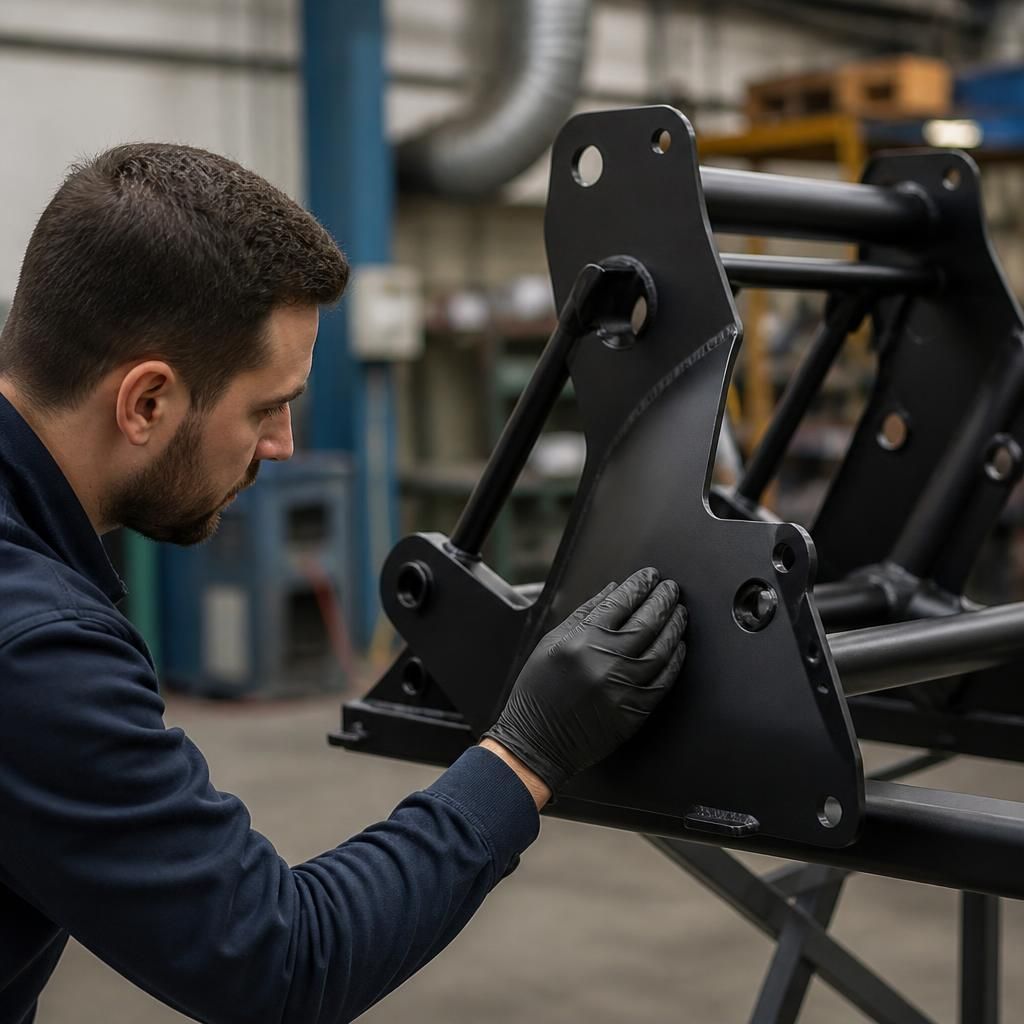
The black colour of a polyester coating does not chemically increase stainless steel’s resistance to corrosion; its practical contribution is that it provides a consistent, easily inspected surface. Scratches, chips, blistering, pinholes and areas of coating wear can be more readily identified against a uniform black finish before they develop into pathways for moisture and contaminants.
This supports condition-based maintenance of coated components. Inspection should focus on edges, fixing points, contact areas and locations exposed to impact or repeated handling. Any breach should be cleaned, assessed and repaired with a compatible system, particularly where the component encounters chlorides, wash-down water or industrial residues. In this way, the visible finish helps maintenance teams identify local defects early and preserve the corrosion protection provided by the polyester film.